QUESTION IMAGE
Question
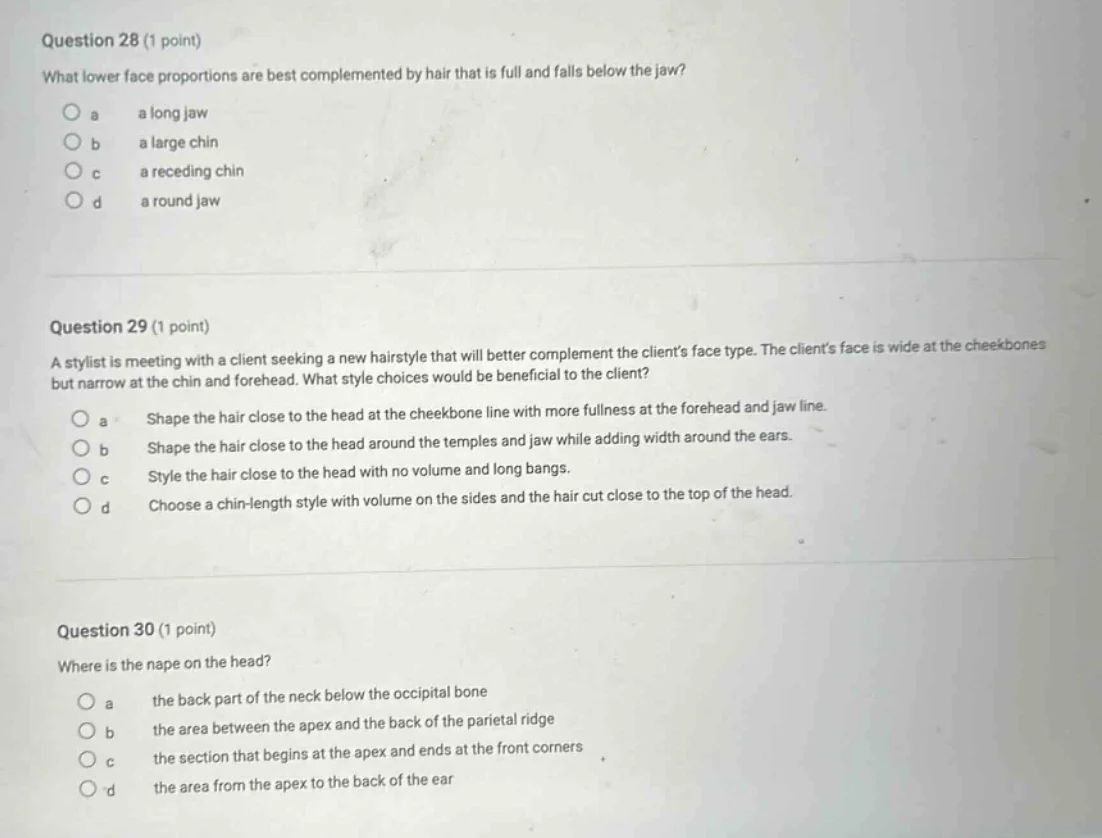
question 28 (1 point)
what lower face proportions are best complemented by hair that is full and falls below the jaw?
○ a a long jaw
○ b a large chin
○ c a receding chin
○ d a round jaw
question 29 (1 point)
a stylist is meeting with a client seeking a new hairstyle that will better complement the client’s face type. the client’s face is wide at the cheekbones but narrow at the chin and forehead. what style choices would be beneficial to the client?
○ a shape the hair close to the head at the cheekbone line with more fullness at the forehead and jaw line.
○ b shape the hair close to the head around the temples and jaw while adding width around the ears.
○ c style the hair close to the head with no volume and long bangs.
○ d choose a chin - length style with volume on the sides and the hair cut close to the top of the head.
question 30 (1 point)
where is the nape on the head?
○ a the back part of the neck below the occipital bone
○ b the area between the apex and the back of the parietal ridge
○ c the section that begins at the apex and ends at the front corners
○ d the area from the apex to the back of the ear
Question 28
To determine the lower face proportion complemented by full hair below the jaw, we analyze each option:
- Option a (long jaw): Full hair below the jaw may not complement a long jaw as it could elongate the face further.
- Option b (large chin): Full hair below the jaw might draw more attention to a large chin, not complementing it.
- Option c (receding chin): Full, jaw - length or longer hair can add volume and balance a receding chin by creating the illusion of a more balanced lower face.
- Option d (round jaw): Full hair below the jaw could make a round jaw look wider or more rounded.
So, a receding chin is best complemented by full hair falling below the jaw.
The client has a face wide at the cheekbones and narrow at the chin and forehead. We need a hairstyle that balances these proportions:
- Option a: Shaping hair close at the cheekbones (where the face is wide) and adding fullness at the narrow forehead and jaw line helps balance the face's width and narrowness.
- Option b: Adding width around the ears when the face is already wide at the cheekbones would make the face look wider at the sides, not balancing.
- Option c: Styling with no volume and long bangs would not add the needed balance to the narrow forehead and chin.
- Option d: A chin - length style with volume on the sides and hair close at the top may not address the narrow forehead and could emphasize the wide cheekbones.
So, option a is the beneficial style choice.
We recall the anatomical definition of the nape:
- Option a: The nape is defined as the back part of the neck below the occipital bone.
- Option b: The area between the apex and the back of the parietal ridge is not the nape.
- Option c: The section from the apex to the front corners is not the nape.
- Option d: The area from the apex to the back of the ear is not the nape.
So, the nape is the back part of the neck below the occipital bone.

Snap & solve any problem in the app
Get step-by-step solutions on Sovi AI
Photo-based solutions with guided steps
Explore more problems and detailed explanations
c. a receding chin