Sovi.AI - AI Math Tutor

Scan to solve math questions

QUESTION IMAGE

question 5 of 26 the model shows an error that can occur during dna rep…

Question

question 5 of 26

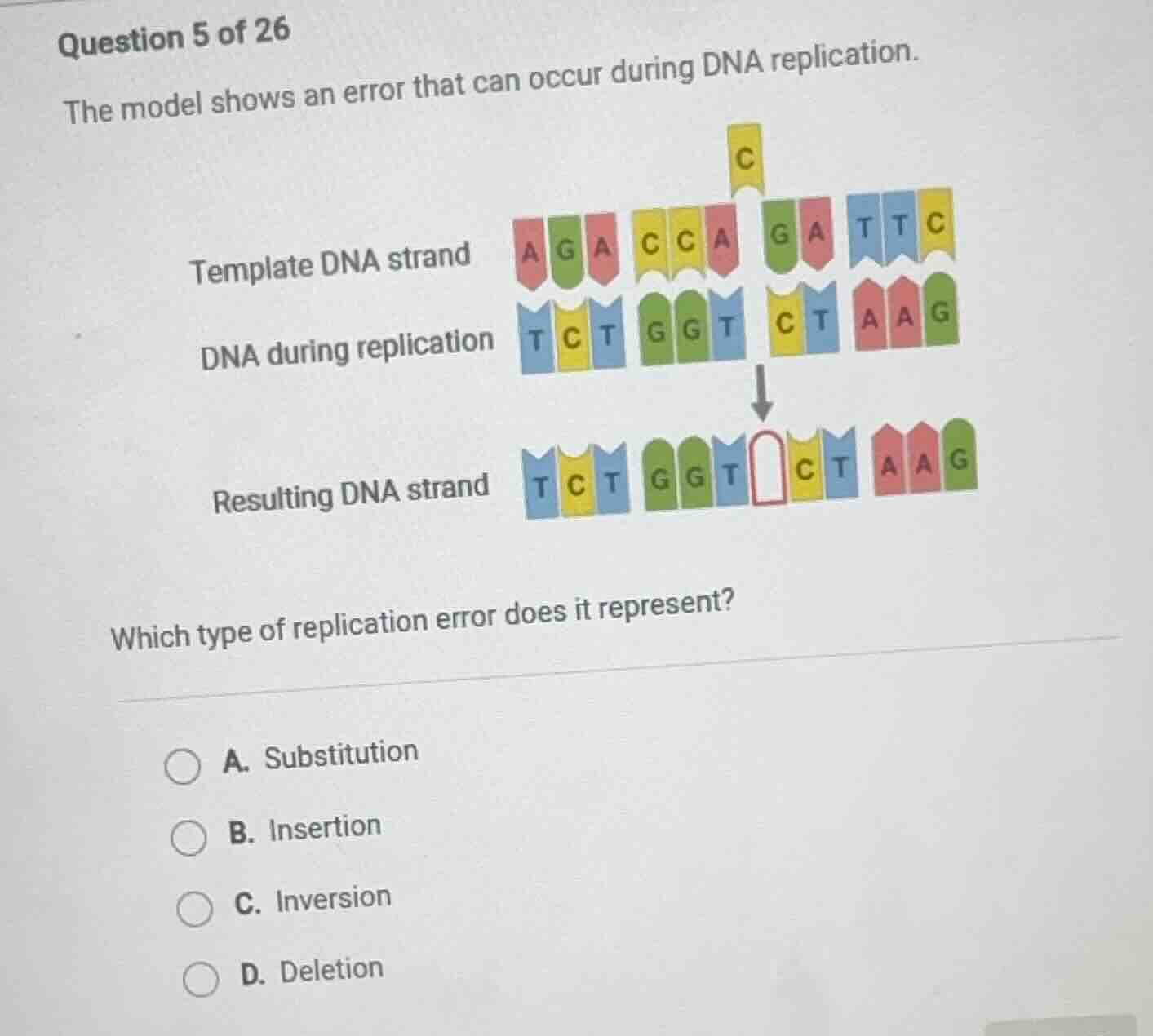
the model shows an error that can occur during dna replication.

which type of replication error does it represent?

a. substitution
b. insertion
c. inversion
d. deletion

Explanation:

Response

<pre_analysis>
{
"quality": "clear",
"question_count": 1,
"skills_matched": [
"direct_cot",
"multiple_choice_formatter",
"explain_then_answer",
"tutor"
],
"needs_drawing": false,
"concepts_used": [
"DNA Structure"
],
"new_concepts": [
"DNA Replication Errors",
"Gene Mutations"
],
"current_concepts": [
"DNA Structure",
"DNA Replication Errors",
"Gene Mutations"
]
}
</pre_analysis>

<reasoning>

Analyze the template strand

The template DNA strand has the sequence:
A - G - A - C - C - A - [C] - G - A - T - T - C
Notice the extra cytosine nucleotide labeled C in the yellow tab above the main sequence.

Observe replication process

During replication, the complementary nucleotides are paired:

  • A pairs with T
  • G pairs with C

The extra cytosine C is being added into the newly synthesized strand.

Identify the resulting strand

The resulting DNA strand contains an extra nucleotide:
T - C - T - G - G - T - [A newly inserted nucleotide] - C - T - A - A - G
This represents an addition of a base pair.

Define the mutation type

An addition of one or more nucleotides is an insertion.
Using our understanding of DNA Structure, adding a base is an insertion.
</reasoning>

<answer>
<mcq-option>A. Substitution</mcq-option>
<mcq-correct>B. Insertion</mcq-correct>
<mcq-option>C. Inversion</mcq-option>
<mcq-option>D. Deletion</mcq-option>
</answer>

<post_analysis>
{
"subject": "Natural Science",
"question_type": "Multiple Choice",
"knowledge_point": [
"Natural Science",
"Biology",
"DNA Replication Errors"
]
}
</post_analysis>

Answer:

<pre_analysis>
{
"quality": "clear",
"question_count": 1,
"skills_matched": [
"direct_cot",
"multiple_choice_formatter",
"explain_then_answer",
"tutor"
],
"needs_drawing": false,
"concepts_used": [
"DNA Structure"
],
"new_concepts": [
"DNA Replication Errors",
"Gene Mutations"
],
"current_concepts": [
"DNA Structure",
"DNA Replication Errors",
"Gene Mutations"
]
}
</pre_analysis>

<reasoning>

Analyze the template strand

The template DNA strand has the sequence:
A - G - A - C - C - A - [C] - G - A - T - T - C
Notice the extra cytosine nucleotide labeled C in the yellow tab above the main sequence.

Observe replication process

During replication, the complementary nucleotides are paired:

  • A pairs with T
  • G pairs with C

The extra cytosine C is being added into the newly synthesized strand.

Identify the resulting strand

The resulting DNA strand contains an extra nucleotide:
T - C - T - G - G - T - [A newly inserted nucleotide] - C - T - A - A - G
This represents an addition of a base pair.

Define the mutation type

An addition of one or more nucleotides is an insertion.
Using our understanding of DNA Structure, adding a base is an insertion.
</reasoning>

<answer>
<mcq-option>A. Substitution</mcq-option>
<mcq-correct>B. Insertion</mcq-correct>
<mcq-option>C. Inversion</mcq-option>
<mcq-option>D. Deletion</mcq-option>
</answer>

<post_analysis>
{
"subject": "Natural Science",
"question_type": "Multiple Choice",
"knowledge_point": [
"Natural Science",
"Biology",
"DNA Replication Errors"
]
}
</post_analysis>