QUESTION IMAGE
Question
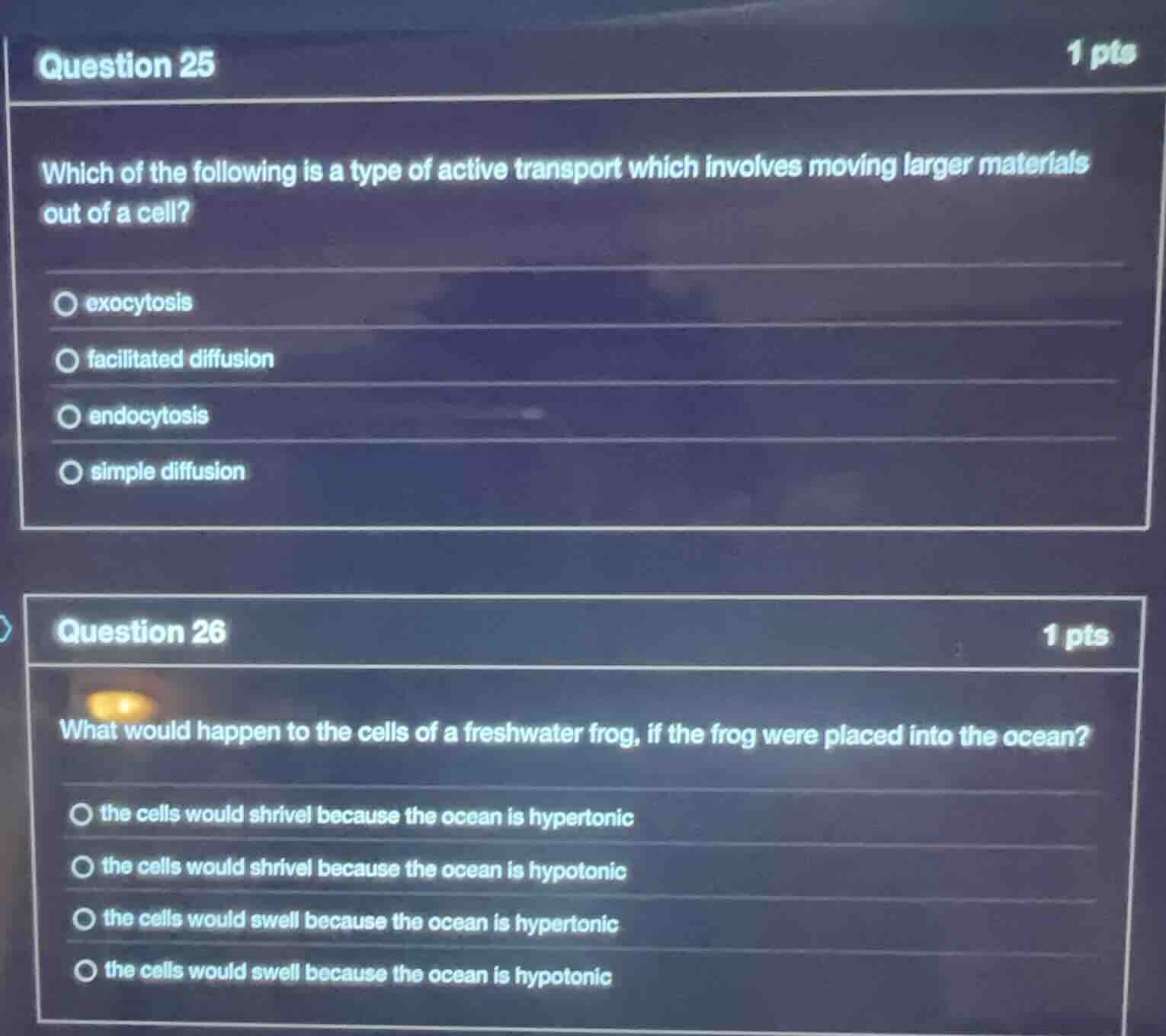
question 25
which of the following is a type of active transport which involves moving larger materials out of a cell?
exocytosis
facilitated diffusion
endocytosis
simple diffusion
question 26
what would happen to the cells of a freshwater frog, if the frog were placed into the ocean?
the cells would shrivel because the ocean is hypertonic
the cells would shrivel because the ocean is hypotonic
the cells would swell because the ocean is hypertonic
the cells would swell because the ocean is hypotonic
Analyze Question 25
Using the Active Transport and Exocytosis knowledge points
- The question asks for a type of active transport that moves larger materials out of a cell.
- "Exo-" means outward or external, and "cytosis" refers to a cellular transport process.
- Therefore, exocytosis is the process of exporting bulky materials from the cell using vesicles.
Analyze Question 26
- This question asks about the effect of placing a freshwater frog's cells into the ocean (saltwater).
- The ocean has a much higher solute concentration than the cytoplasm of freshwater cells, making the ocean environment hypertonic.
- Water moves out of the cells by osmosis from an area of lower solute concentration (inside the cells) to higher solute concentration (the ocean).
- As water leaves the cells, they will shrivel.

Snap & solve any problem in the app
Get step-by-step solutions on Sovi AI
Photo-based solutions with guided steps
Explore more problems and detailed explanations
Question 25
- exocytosis (Correct answer)
- facilitated diffusion
- endocytosis
- simple diffusion
Question 26
- the cells would shrivel because the ocean is hypertonic (Correct answer)
- the cells would shrivel because the ocean is hypotonic
- the cells would swell because the ocean is hypertonic
- the cells would swell because the ocean is hypotonic