QUESTION IMAGE
Question
question 1 of 20
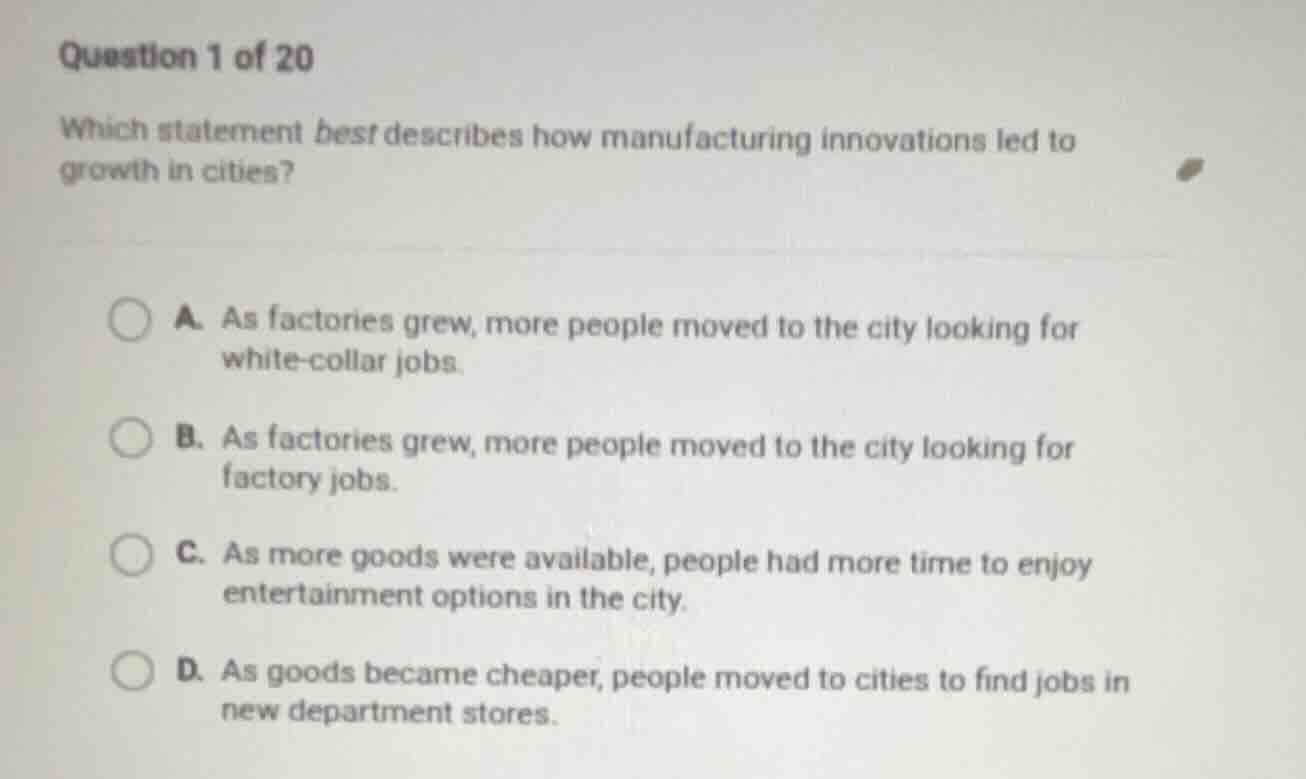
which statement best describes how manufacturing innovations led to growth in cities?
a. as factories grew, more people moved to the city looking for white-collar jobs.
b. as factories grew, more people moved to the city looking for factory jobs.
c. as more goods were available, people had more time to enjoy entertainment options in the city.
d. as goods became cheaper, people moved to cities to find jobs in new department stores.
Analyze the question and options
The question asks how manufacturing innovations led to growth in cities (urbanization).
- Option A suggests people moved for "white-collar" jobs. While some managerial roles grew, the vast majority of urban growth was driven by industrial labor.
- Option B states that as factories grew, more people moved to the city looking for factory jobs. This directly links manufacturing growth (industrialization) to urban population growth (urbanization).
- Option C focuses on leisure and entertainment, which is a secondary effect rather than the primary driver of massive urban migration.
- Option D focuses on department store jobs, which were a smaller sector compared to the massive industrial factory workforce.
Evaluate the correct option
Manufacturing innovations (such as steam power, the assembly line, and electric machinery) allowed factories to expand rapidly in urban centers. This expansion created a massive demand for labor, drawing millions of rural Americans and immigrants to cities in search of factory jobs. Therefore, Option B is the most accurate description.

Snap & solve any problem in the app
Get step-by-step solutions on Sovi AI
Photo-based solutions with guided steps
Explore more problems and detailed explanations
- (A) As factories grew, more people moved to the city looking for white-collar jobs.
- (B) As factories grew, more people moved to the city looking for factory jobs. (Correct answer)
- (C) As more goods were available, people had more time to enjoy entertainment options in the city.
- (D) As goods became cheaper, people moved to cities to find jobs in new department stores.