QUESTION IMAGE
Question
question 20
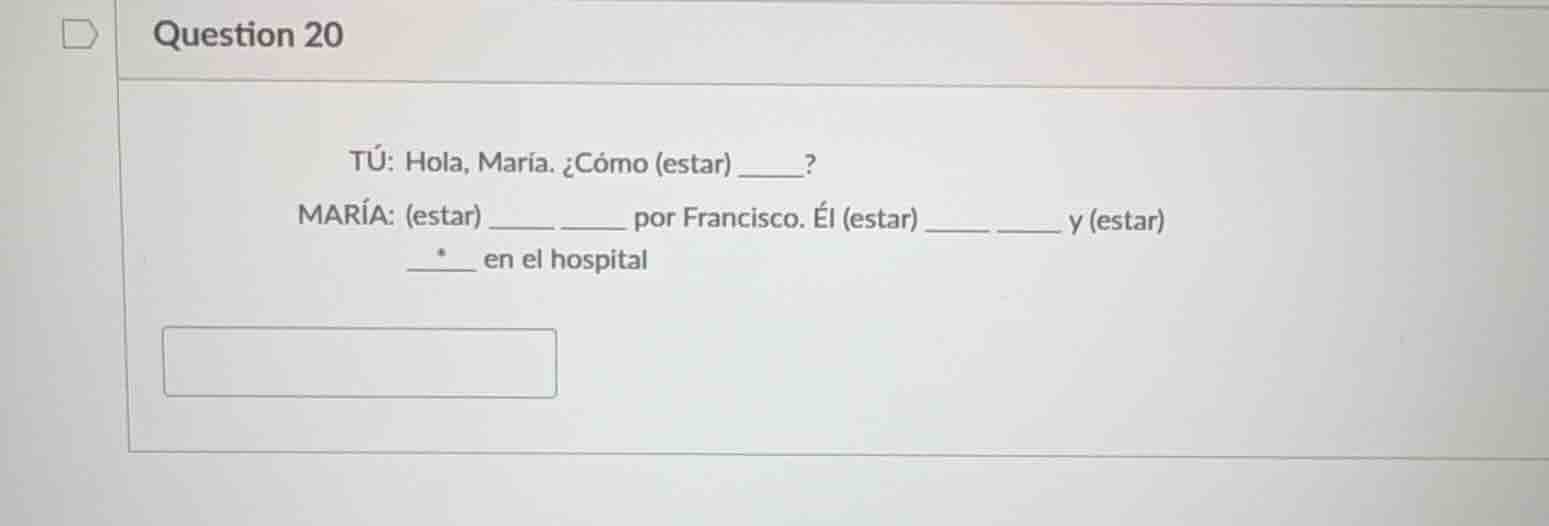
tú: hola, maría. ¿cómo (estar) ______?
maría: (estar) ____ por francisco. él (estar) __ y (estar) ____ en el hospital
Identify the subject and context
The conversation is between "TÚ" and "MARÍA". We need to conjugate the verb estar correctly based on the subject pronouns and context.
Conjugate the first blank
The first sentence is: "TÚ: Hola, María. ¿Cómo (estar) \_\_\_\_\_?"
The subject is "tú" (informal "you").
Using Estar Conjugation, the correct form for "tú" is estás.
Conjugate the second blank
The second sentence starts with: "MARÍA: (estar) \_\_\_\_\_ \_\_\_\_\_ por Francisco."
María is speaking about herself ("yo") and expressing concern/worry about Francisco.
The verb estar conjugates to estoy for "yo".
To express "worried", we use the adjective preocupada (matching María, feminine singular) using Estar with Emotions.
Thus, the blanks are estoy preocupada.
Conjugate the third and fourth blanks
The next part is: "Él (estar) \_\_\_\_\_ \_\_\_\_\_ y (estar) \_\_\_\_\_ en el hospital."
The subject is "Él" (Francisco, masculine singular).
For "Él (estar) \_\_\_\_\_ \_\_\_\_\_", we need está followed by an adjective like enfermo (sick) or mal (bad/ill). Given the context of being in the hospital, está enfermo (he is sick) or está mal (he is unwell) fits perfectly. Let's use está enfermo.
For "y (estar) \_\_\_\_\_ en el hospital", the subject is still "él", so the verb is está.
Thus, the remaining blanks are está enfermo and está.

Snap & solve any problem in the app
Get step-by-step solutions on Sovi AI
Photo-based solutions with guided steps
Explore more problems and detailed explanations
TÚ: Hola, María. ¿Cómo (estar) <blank>estás</blank>?
MARÍA: (estar) <blank>Estoy preocupada</blank> por Francisco. Él (estar) <blank>está enfermo</blank> y (estar) <blank>está</blank> en el hospital.