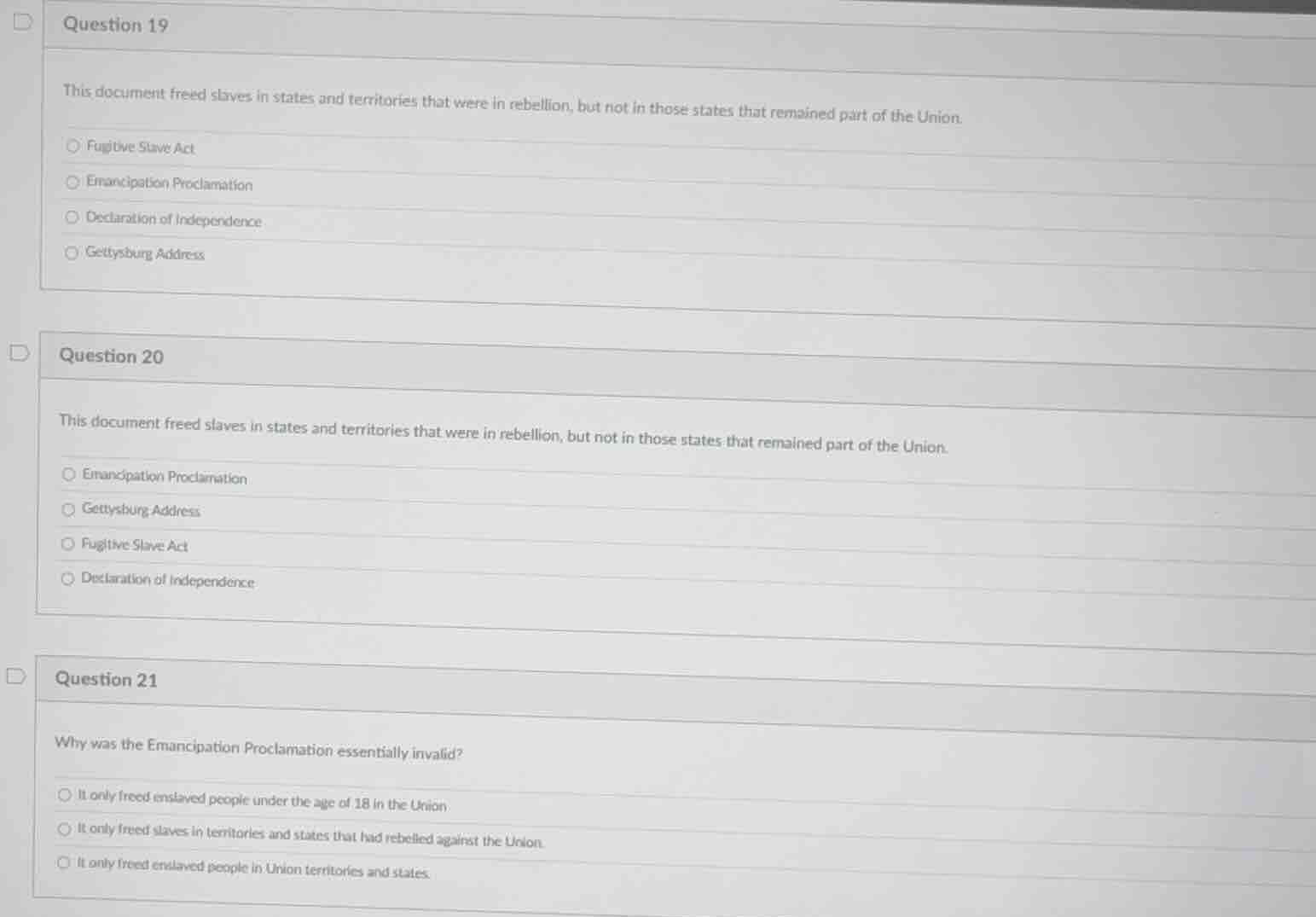
QUESTION IMAGE
Question
question 19
this document freed slaves in states and territories that were in rebellion, but not in those states that remained part of the union.
- fugitive slave act
- emancipation proclamation
- declaration of independence
- gettysburg address
question 20
this document freed slaves in states and territories that were in rebellion, but not in those states that remained part of the union.
- emancipation proclamation
- gettysburg address
- fugitive slave act
- declaration of independence
question 21
why was the emancipation proclamation essentially invalid?
- it only freed enslaved people under the age of 18 in the union
- it only freed slaves in territories and states that had rebelled against the union
- it only freed enslaved people in union territories and states
Analyze Question 19
The prompt describes a document that "freed slaves in states and territories that were in rebellion, but not in those states that remained part of the Union." This is the defining feature of Abraham Lincoln's Emancipation Proclamation, issued on January 1, 1863. It specifically targeted areas in active rebellion against the United States, leaving slavery intact in the loyal border states.
Analyze Question 20
This question contains the exact same prompt as Question 19: "This document freed slaves in states and territories that were in rebellion, but not in those states that remained part of the Union." Therefore, the correct answer is once again the Emancipation Proclamation.
Analyze Question 21
The prompt asks: "Why was the Emancipation Proclamation essentially invalid?"
The Emancipation Proclamation declared enslaved people free only in areas controlled by the Confederacy (states in rebellion). Because the Union government did not have actual administrative control or physical authority over the Confederate states at the time the proclamation was issued, it could not immediately enforce this freedom. Thus, it was practically invalid in those areas until Union armies advanced and liberated them. The second option, "It only freed slaves in territories and states that had rebelled against the Union," directly highlights this limitation.

Snap & solve any problem in the app
Get step-by-step solutions on Sovi AI
Photo-based solutions with guided steps
Explore more problems and detailed explanations
Question 19
- (A) Fugitive Slave Act
- (B) Emancipation Proclamation (Correct answer)
- (C) Declaration of Independence
- (D) Gettysburg Address
Question 20
- (A) Emancipation Proclamation (Correct answer)
- (B) Gettysburg Address
- (C) Fugitive Slave Act
- (D) Declaration of Independence
Question 21
- (A) It only freed enslaved people under the age of 18 in the Union
- (B) It only freed slaves in territories and states that had rebelled against the Union (Correct answer)
- (C) It only freed enslaved people in Union territories and states