QUESTION IMAGE
Question
question 18 (multiple choice worth 3 points)
(02.08 mc)
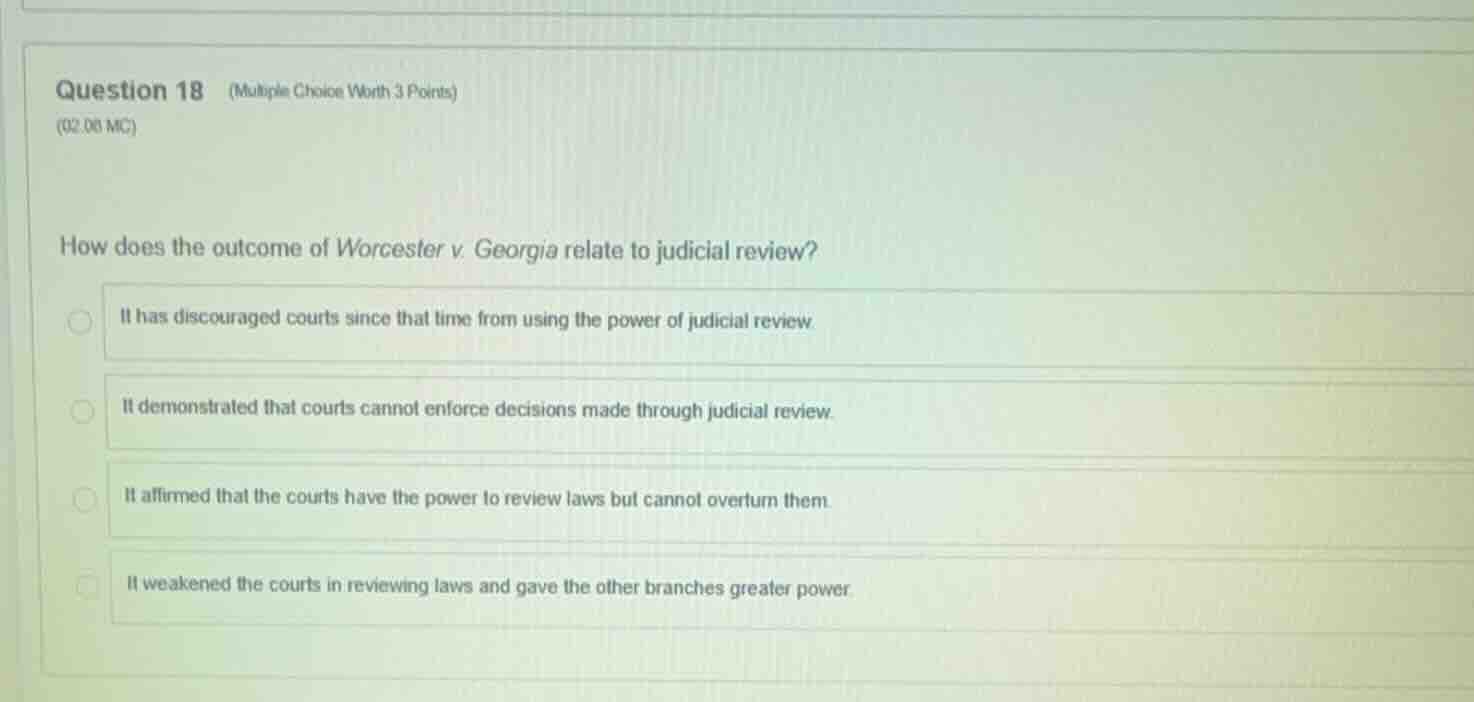
how does the outcome of worcester v. georgia relate to judicial review?
it has discouraged courts since that time from using the power of judicial review.
it demonstrated that courts cannot enforce decisions made through judicial review.
it affirmed that the courts have the power to review laws but cannot overturn them.
it weakened the courts in reviewing laws and gave the other branches greater power.
Analyze Worcester v. Georgia
Using the Judicial Review knowledge point
In Worcester v. Georgia (1832), the Supreme Court ruled that Georgia's license laws governing non-Native Americans on Cherokee land were unconstitutional because the federal government, not the states, had sole authority over Native American nations.
Examine the enforcement issue
President Andrew Jackson famously refused to enforce the Court's ruling, highlighting a fundamental structural limitation of the federal judiciary: the courts possess the power of judgment but lack the power of implementation or enforcement, relying instead on the executive branch to carry out their decisions.
Evaluate the options
- Option 1 is incorrect because courts were not discouraged from using judicial review.
- Option 2 is correct because the aftermath of the case demonstrated that the judiciary cannot enforce its own rulings.
- Option 3 is incorrect because courts can and do overturn unconstitutional laws.
- Option 4 is incorrect because the ruling itself did not weaken the legal power of judicial review, but rather exposed the practical limits of judicial enforcement.

Snap & solve any problem in the app
Get step-by-step solutions on Sovi AI
Photo-based solutions with guided steps
Explore more problems and detailed explanations
- It has discouraged courts since that time from using the power of judicial review.
- It demonstrated that courts cannot enforce decisions made through judicial review. (Correct answer)
- It affirmed that the courts have the power to review laws but cannot overturn them.
- It weakened the courts in reviewing laws and gave the other branches greater power.