QUESTION IMAGE
Question
question 14 of 20
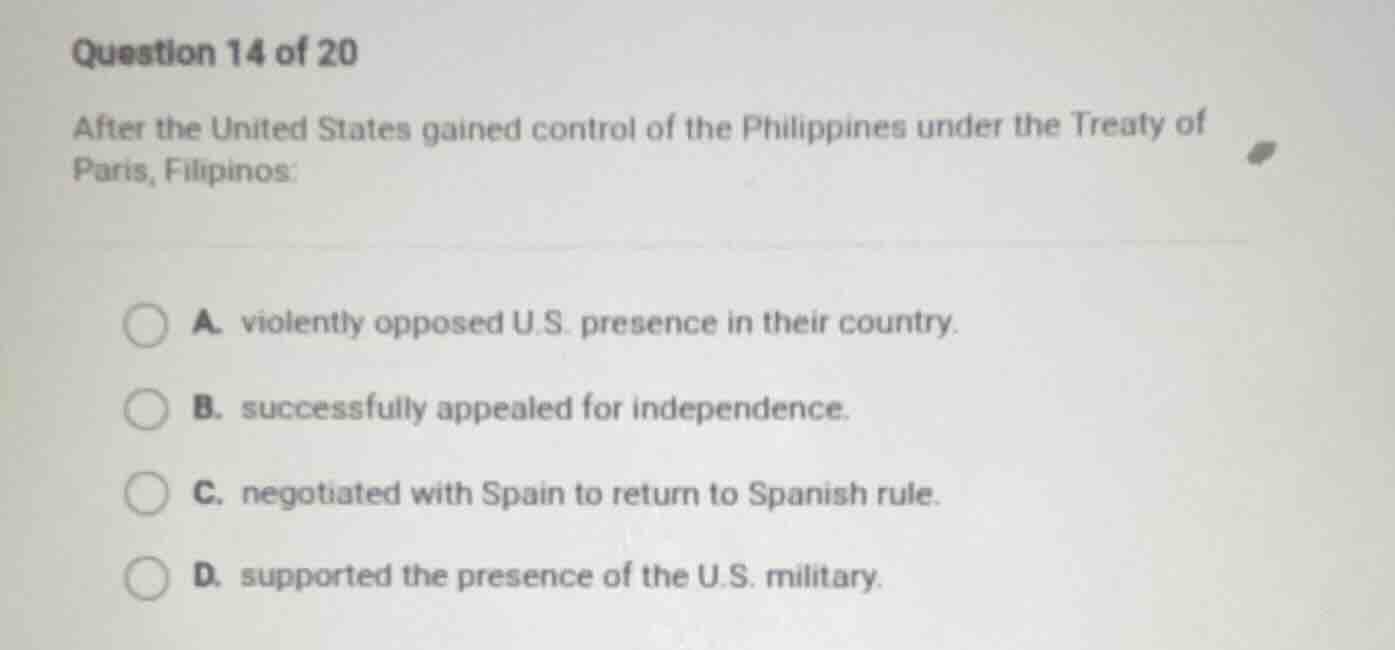
after the united states gained control of the philippines under the treaty of paris, filipinos:
a. violently opposed u.s. presence in their country.
b. successfully appealed for independence.
c. negotiated with spain to return to spanish rule.
d. supported the presence of the u.s. military.
Analyze the historical context of the Treaty of Paris
Following the Spanish-American War, the 1898 Treaty of Paris transferred control of the Philippines from Spain to the United States. Filipinos, led by Emilio Aguinaldo, had already declared independence and expected the U.S. to recognize their sovereignty.
Evaluate the Filipino response to U.S. annexation
When the United States decided to annex the archipelago rather than grant immediate independence, Filipino nationalists resisted. This tension quickly escalated into the Philippine-American War (1899–1902), a brutal conflict characterized by armed resistance against U.S. forces.
Assess the given options
- Option A is correct because Filipinos launched an armed insurrection to oppose U.S. colonial rule.
- Option B is incorrect because they did not successfully appeal for independence at that time (independence was not achieved until 1946).
- Option C is incorrect because they fought against Spanish rule and did not want to return to it.
- Option D is incorrect because the nationalist movement strongly opposed the U.S. military presence.

Snap & solve any problem in the app
Get step-by-step solutions on Sovi AI
Photo-based solutions with guided steps
Explore more problems and detailed explanations
- (A) violently opposed U.S. presence in their country. (Correct answer)
- (B) successfully appealed for independence.
- (C) negotiated with Spain to return to Spanish rule.
- (D) supported the presence of the U.S. military.