QUESTION IMAGE
Question
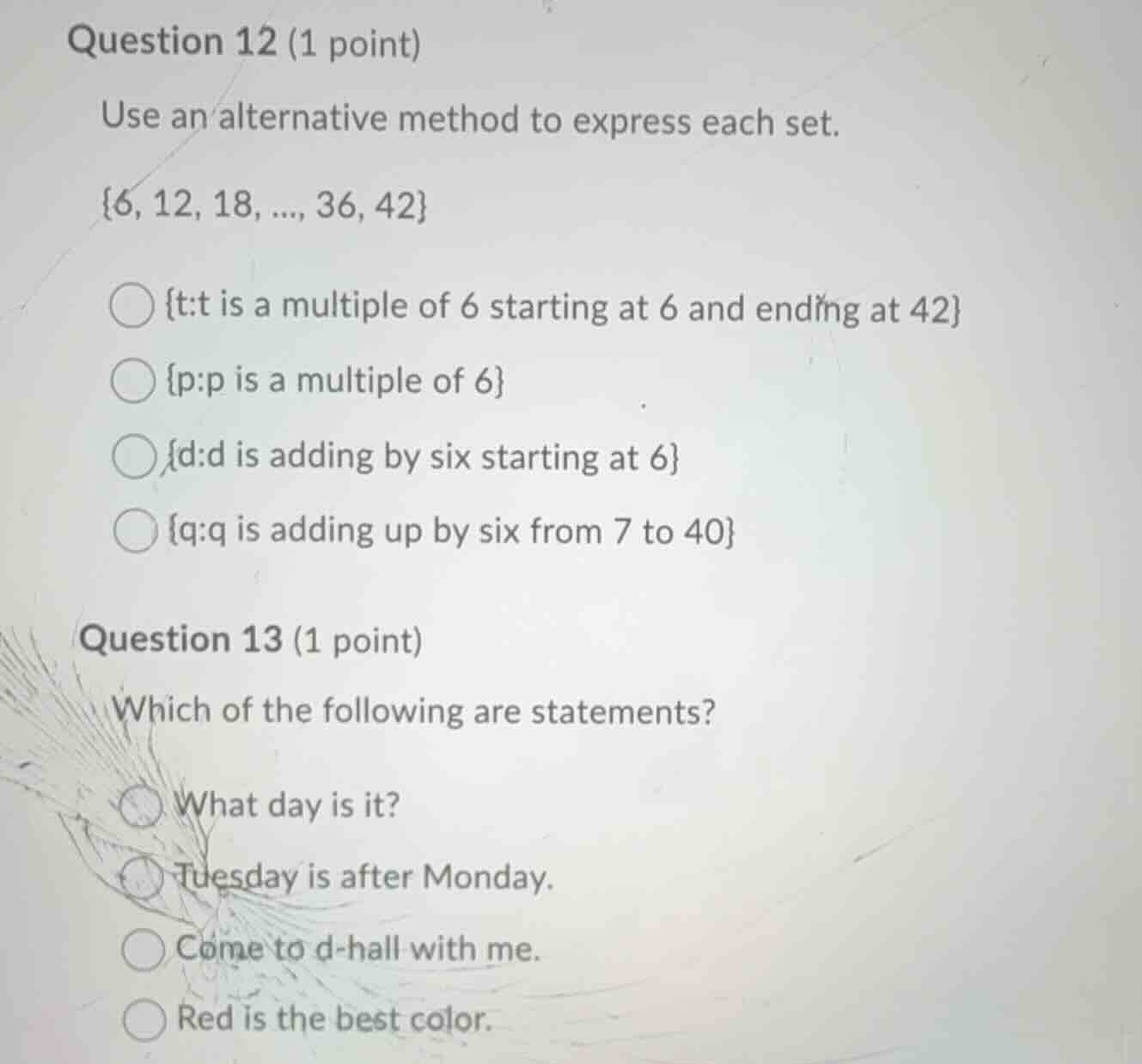
question 12 (1 point)
use an alternative method to express each set.
\\(\\{6, 12, 18, \dots, 36, 42\\}\\)
\\(\bigcirc\\) \\(\\{t : t \text{ is a multiple of } 6 \text{ starting at } 6 \text{ and ending at } 42\\}\\)
\\(\bigcirc\\) \\(\\{p : p \text{ is a multiple of } 6\\}\\)
\\(\bigcirc\\) \\(\\{d : d \text{ is adding by six starting at } 6\\}\\)
\\(\bigcirc\\) \\(\\{q : q \text{ is adding up by six from } 7 \text{ to } 40\\}\\)
question 13 (1 point)
which of the following are statements?
\\(\bigcirc\\) what day is it?
\\(\bigcirc\\) tuesday is after monday.
\\(\bigcirc\\) come to d-hall with me.
\\(\bigcirc\\) red is the best color.
🆕 New Concept Discovered: Set-Builder Notation & Logical Statements
Describing sets with rules and identifying declarative propositions.
---
Question 12
Step 1: Analyze the Given Set
The given set is:
This is a finite set of numbers. Let's look at the pattern:
- The elements are \(6 \times 1 = 6\), \(6 \times 2 = 12\), \(6 \times 3 = 18\), up to \(6 \times 7 = 42\).
- These numbers are positive multiples of \(6\).
- The set starts at \(6\) and ends at \(42\).
Step 2: Evaluate the Options
- Option 1: \(\{t : t \text{ is a multiple of } 6 \text{ starting at } 6 \text{ and ending at } 42\}\)
- This correctly defines the elements as multiples of \(6\) within the boundaries of \(6\) and \(42\).
- Option 2: \(\{p : p \text{ is a multiple of } 6\}\)
- This describes an infinite set: \(\{6, 12, 18, 24, \dots\}\), which does not stop at \(42\).
- Option 3: \(\{d : d \text{ is adding by six starting at } 6\}\)
- This describes an operation/process rather than a mathematically precise set of elements, and it lacks an upper bound.
- Option 4: \(\{q : q \text{ is adding up by six from } 7 \text{ to } 40\}\)
- The numbers in our set do not start at \(7\) or end at \(40\).
The correct option is the first one.
---
Question 13
Step 1: Define a Logical Statement
In mathematical logic, a statement (or proposition) is a declarative sentence that is either strictly true or strictly false, but not both.
- Questions, commands, opinions, and exclamations are not logical statements because they cannot be assigned a definitive truth value (true or false).
Step 2: Evaluate the Options
- "What day is it?"
- This is a question. It cannot be declared true or false. (Not a statement)
- "Tuesday is after Monday."
- This is a declarative sentence that is objectively true. (This is a statement)
- "Come to d-hall with me."
- This is an imperative sentence (a command or request). It cannot be true or false. (Not a statement)
- "Red is the best color."
- This is a subjective opinion/preference. It does not have an objective truth value. (Not a statement in classical logic)
The correct option is the second one.
---

Snap & solve any problem in the app
Get step-by-step solutions on Sovi AI
Photo-based solutions with guided steps
Explore more problems and detailed explanations
- Question 12: \(\{t : t \text{ is a multiple of } 6 \text{ starting at } 6 \text{ and ending at } 42\}\)
- Question 13: Tuesday is after Monday.