QUESTION IMAGE
Question
question 3 of 10
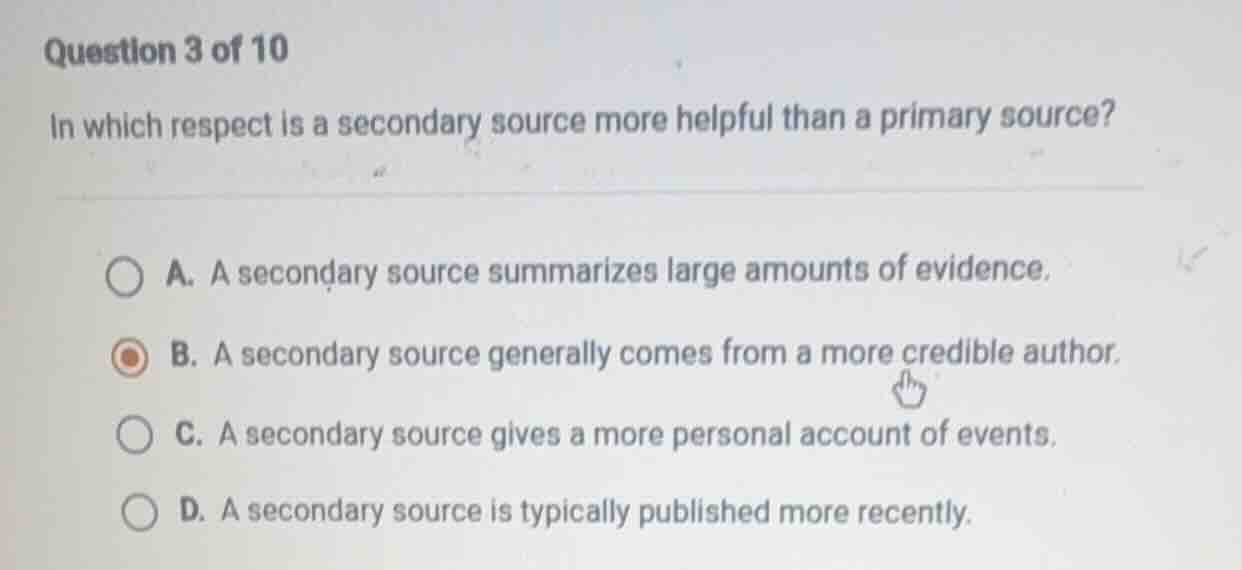
in which respect is a secondary source more helpful than a primary source?
a. a secondary source summarizes large amounts of evidence.
b. a secondary source generally comes from a more credible author.
c. a secondary source gives a more personal account of events.
d. a secondary source is typically published more recently.
🆕 New Concept Discovered: Primary vs. Secondary Sources
Distinguishing firsthand evidence from secondhand analysis.
Step 1: Understand the difference between sources
A primary source is an immediate, firsthand account of a topic, event, or time period from people who had a direct connection with it (e.g., diaries, letters, photographs, raw data, or speeches).
A secondary source is one step removed from the event. It is written by someone who did not experience the event firsthand. Instead, the author analyzes, interprets, synthesizes, and summarizes multiple primary and secondary sources (e.g., textbooks, biographies, and review articles).
Step 2: Evaluate the given options
- A. A secondary source summarizes large amounts of evidence.
This is a key advantage of secondary sources. Because they are written after the fact, authors of secondary sources can look at many different primary sources, find patterns, and condense a vast amount of information into a single, easy-to-read summary.
- B. A secondary source generally comes from a more credible author.
This is incorrect. Primary sources (like eyewitness accounts or official documents) are highly credible for understanding what happened at the moment. Credibility depends on the specific author and context, not whether the source is primary or secondary.
- C. A secondary source gives a more personal account of events.
This is incorrect. Primary sources (like diaries or personal letters) provide personal, firsthand accounts. Secondary sources aim to be more objective and analytical.
- D. A secondary source is typically published more recently.
While often true, being published more recently does not automatically make a source "more helpful" for historical or academic research. The main helpful feature of a secondary source is its ability to synthesize and analyze information.

Snap & solve any problem in the app
Get step-by-step solutions on Sovi AI
Photo-based solutions with guided steps
Explore more problems and detailed explanations
A. A secondary source summarizes large amounts of evidence.