QUESTION IMAGE
Question
question 9 of 10
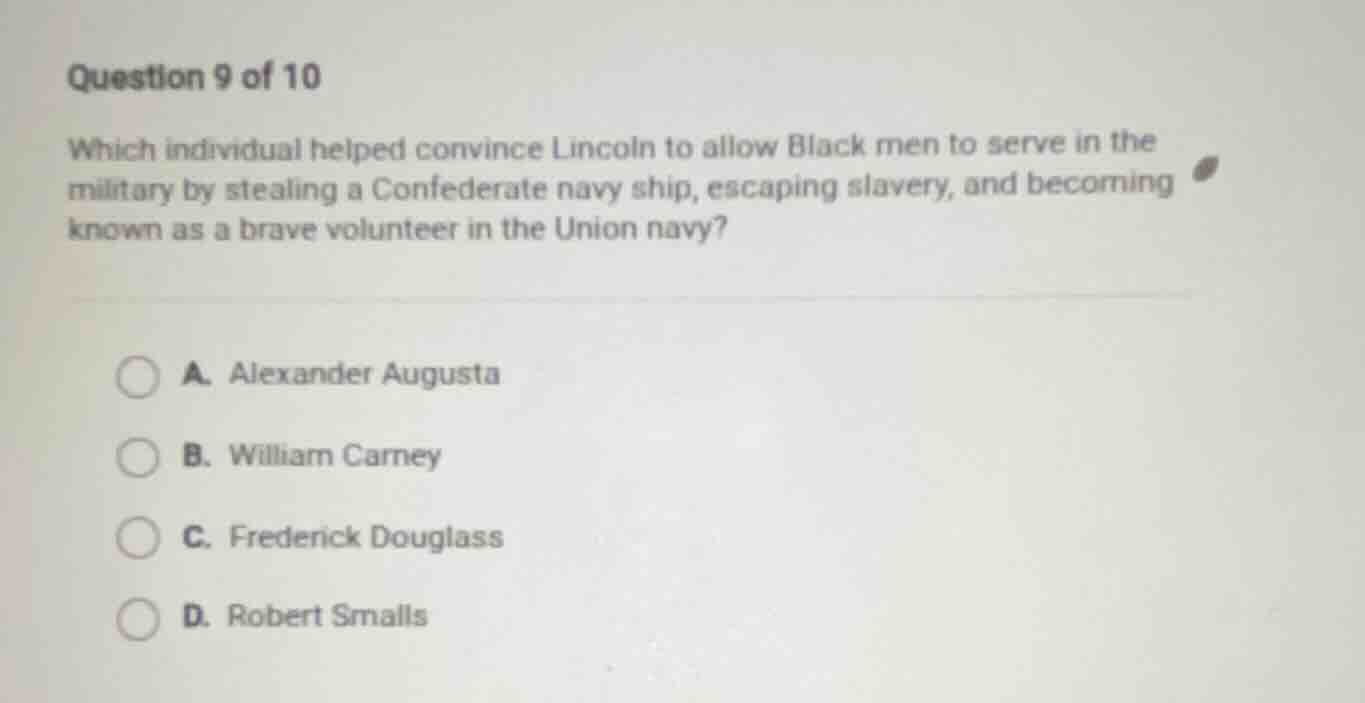
which individual helped convince lincoln to allow black men to serve in the military by stealing a confederate navy ship, escaping slavery, and becoming known as a brave volunteer in the union navy?
a. alexander augusta
b. william carney
c. frederick douglass
d. robert smalls
Identify the key historical details in the prompt
The question asks for a specific individual who:
- Escaped slavery.
- Commandeered (stole) a Confederate navy ship.
- Convinced President Lincoln to allow Black men to serve in the Union military.
- Became a brave volunteer in the Union navy.
Evaluate the historical figures in the options
- Alexander Augusta: A prominent Black physician who became the first commissioned Black medical officer in the Union Army. He did not escape by stealing a Confederate ship.
- William Carney: A soldier in the 54th Massachusetts Infantry Regiment who was awarded the Medal of Honor for his bravery at Fort Wagner. He did not escape by stealing a ship.
- Frederick Douglass: A famous abolitionist, orator, and writer who escaped slavery earlier in life and advocated heavily for the enlistment of African American Soldiers, but he did not commandeer a Confederate vessel.
- Robert Smalls: An enslaved harbor pilot in Charleston, South Carolina, who commandeered the Confederate military transport ship CSS Planter on May 13, 1862. He successfully sailed it past Confederate forts to the Union blockading fleet, freeing himself, his family, and his crew. This daring feat of bravery made him a national hero, and his subsequent meetings with Union officials helped persuade President Lincoln to permit Black men to enlist in the Union armed forces.
Match the details to the correct option
The actions described perfectly match the historical achievements of Robert Smalls, which corresponds to option D.

Snap & solve any problem in the app
Get step-by-step solutions on Sovi AI
Photo-based solutions with guided steps
Explore more problems and detailed explanations
- (A) Alexander Augusta
- (B) William Carney
- (C) Frederick Douglass
- (D) Robert Smalls (Correct answer)