QUESTION IMAGE
Question
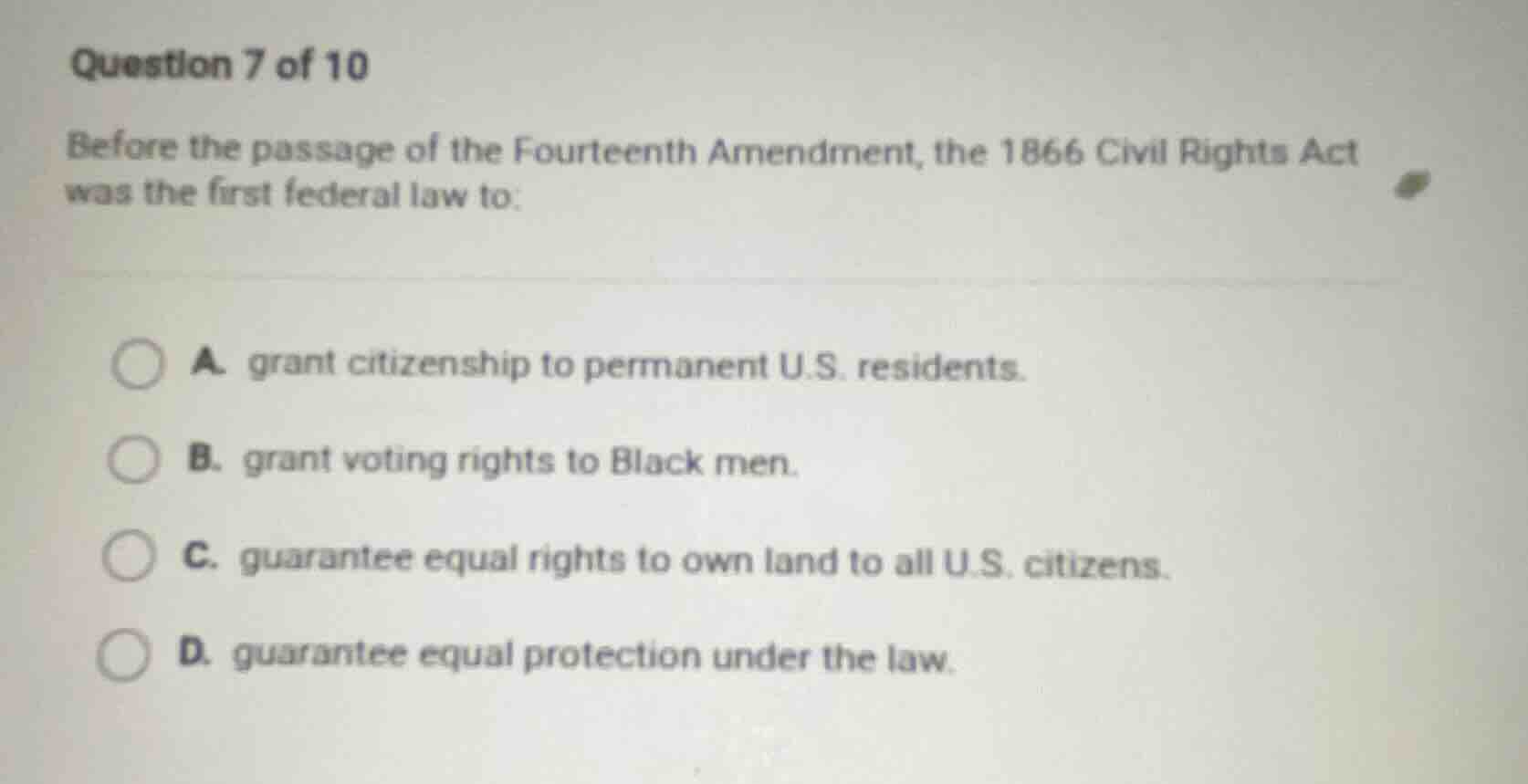
question 7 of 10
before the passage of the fourteenth amendment, the 1866 civil rights act was the first federal law to:
a. grant citizenship to permanent u.s. residents.
b. grant voting rights to black men.
c. guarantee equal rights to own land to all u.s. citizens.
d. guarantee equal protection under the law.
Contextualize the Civil Rights Act of 1866
Using the Reconstruction Era knowledge point, this act was passed by Congress over President Andrew Johnson's veto to protect the civil rights of newly freed African Americans.
Analyze the provisions of the Act
The Civil Rights Act of 1866 declared that all persons born in the United States were citizens, without regard to race, color, or previous condition of slavery. It specifically guaranteed citizens of every race the same right to make and enforce contracts, sue, inherit, purchase, lease, sell, hold, and convey real and personal property.
Evaluate the given options
Using the Reconstruction Amendments knowledge point:
- A is incorrect because it refers broadly to permanent residents rather than defining birthright citizenship.
- B is incorrect because voting rights were not granted federally until the Fifteenth Amendment (1870).
- D is incorrect because "equal protection under the law" was formally established by the Fourteenth Amendment (1868).
- C is correct because the 1866 Act specifically guaranteed all citizens, regardless of race, the equal right to own, inherit, and lease land and property.

Snap & solve any problem in the app
Get step-by-step solutions on Sovi AI
Photo-based solutions with guided steps
Explore more problems and detailed explanations
- (A) grant citizenship to permanent U.S. residents.
- (B) grant voting rights to Black men.
- (C) guarantee equal rights to own land to all U.S. citizens. (Correct answer)
- (D) guarantee equal protection under the law.