QUESTION IMAGE
Question
question 10 of 10
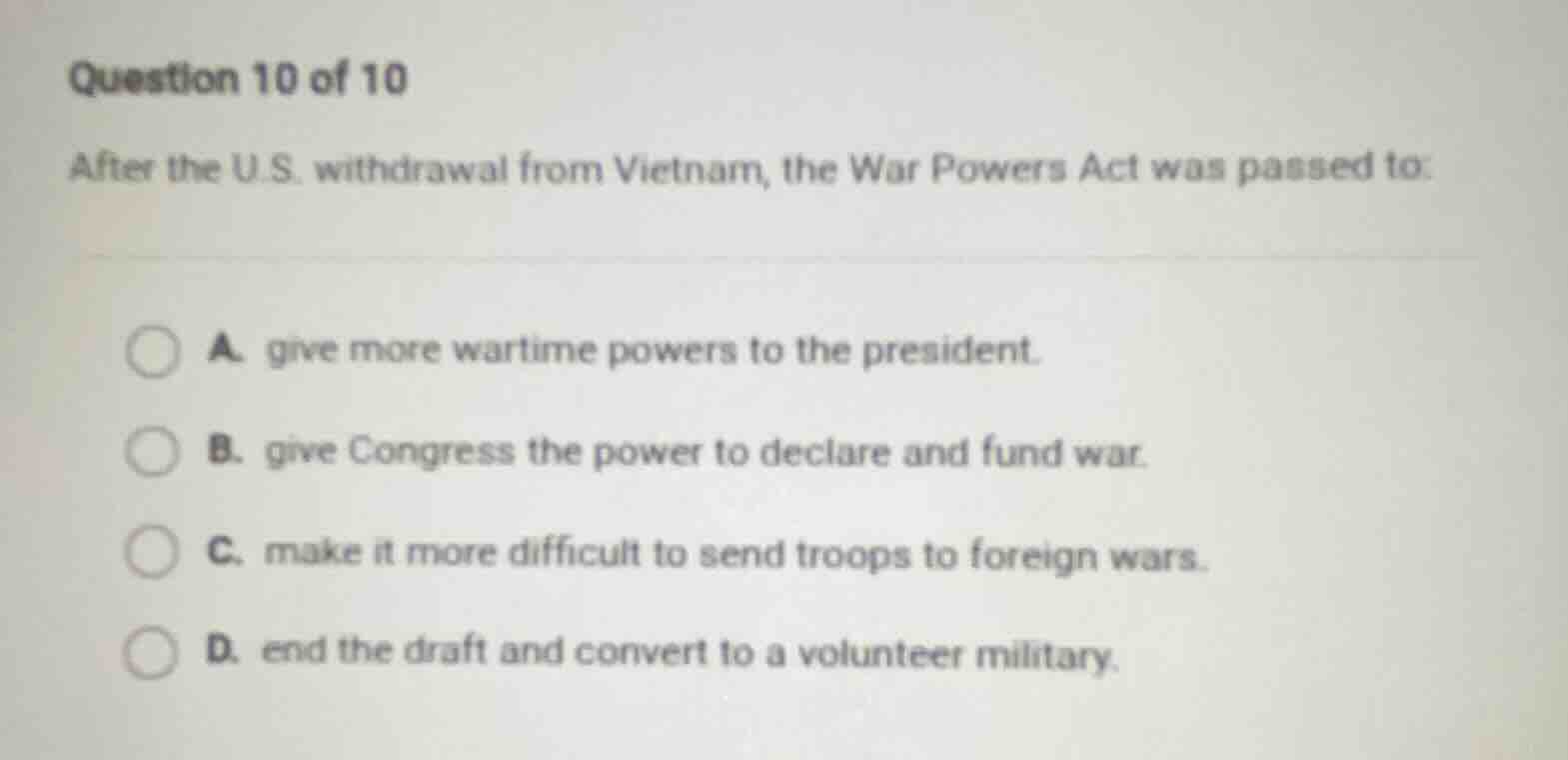
after the u.s. withdrawal from vietnam, the war powers act was passed to:
a. give more wartime powers to the president.
b. give congress the power to declare and fund war.
c. make it more difficult to send troops to foreign wars.
d. end the draft and convert to a volunteer military.
Analyze the historical context
The Vietnam War led to significant public and congressional concern over the expansion of executive power. Presidents had committed U.S. forces to combat without formal declarations of war from Congress.
Identify the legislative response
In 1973, Congress passed the War Powers Resolution (or War Powers Act) over President Richard Nixon's veto. This law aimed to reassert congressional authority over foreign military engagements.
Evaluate the options
- Option A is incorrect because the act sought to limit, not expand, presidential wartime powers.
- Option B is incorrect because Congress already possessed the constitutional power to declare and fund war.
- Option C is correct because the act requires the president to notify Congress within 48 hours of committing armed forces and limits their stay to 60 days without authorization, making unilateral deployment more difficult.
- Option D is incorrect because the draft ended separately through administrative and legislative actions, not the War Powers Act.

Snap & solve any problem in the app
Get step-by-step solutions on Sovi AI
Photo-based solutions with guided steps
Explore more problems and detailed explanations
- (A) give more wartime powers to the president.
- (B) give Congress the power to declare and fund war.
- (C) make it more difficult to send troops to foreign wars. (Correct answer)
- (D) end the draft and convert to a volunteer military.