QUESTION IMAGE
Question
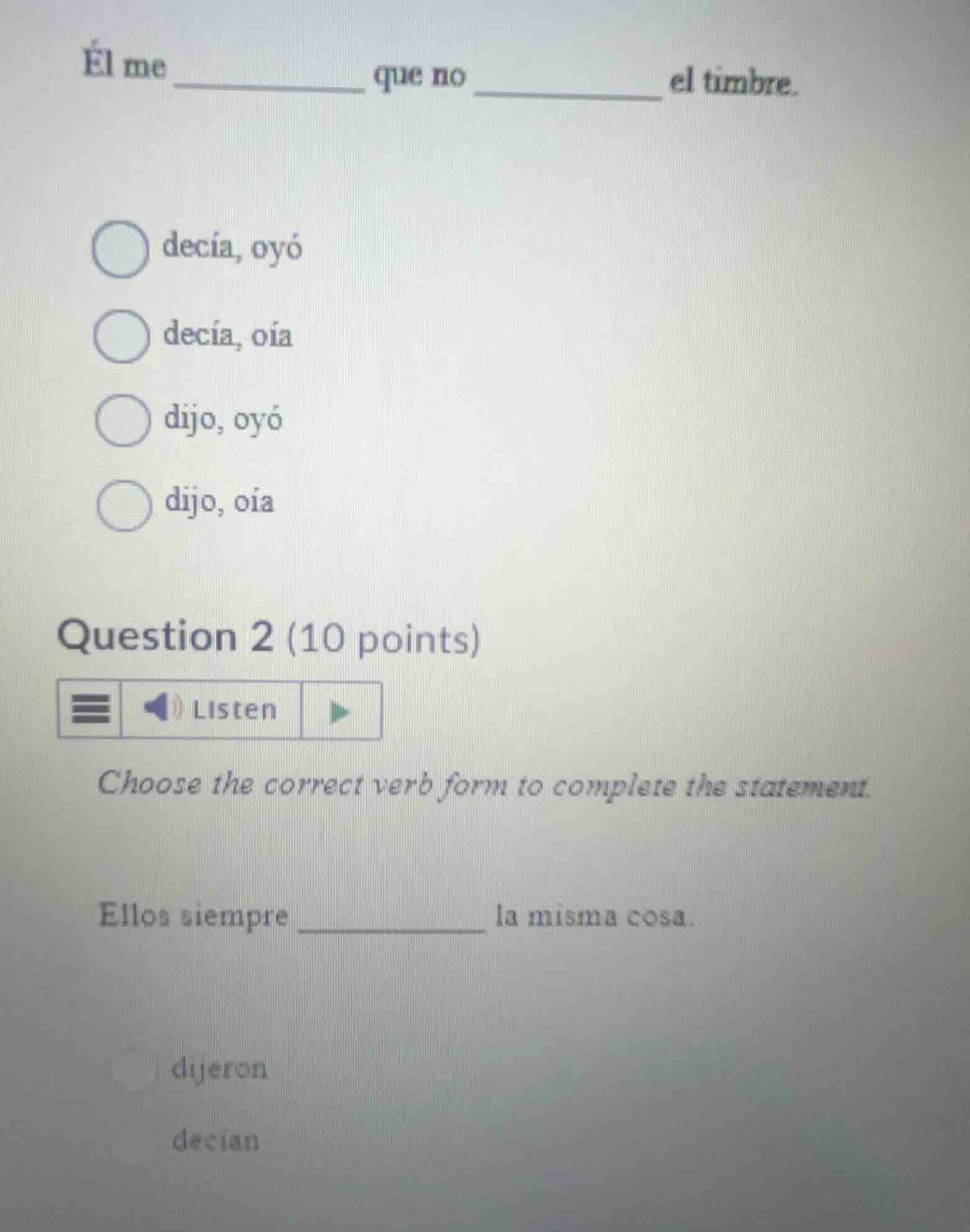
él me ____ que no ____ el timbre.
decía, oyó
decía, oía
dijo, oyó
dijo, oía
question 2 (10 points)
choose the correct verb form to complete the statement.
ellos siempre ______ la misma cosa.
dijeron
decían
<pre_analysis>
{
"quality": "clear",
"question_count": 2,
"skills_matched": [
"direct_cot",
"multiple_choice_formatter",
"explain_then_answer",
"quick"
],
"needs_drawing": false,
"concepts_used": [],
"new_concepts": [
"Spanish Preterite vs Imperfect"
],
"current_concepts": [
"Spanish Preterite Tense",
"Spanish Imperfect Tense",
"Spanish Preterite vs Imperfect"
]
}
</pre_analysis>
<reasoning>
Analyze the first question
The sentence is: "Él me ______ que no ______ el timbre."
- The first blank describes a completed action in the past (He told me): preterite of decir for él is dijo.
- The second blank describes an ongoing state or background action in the past (he didn't hear / wasn't hearing the doorbell): imperfect of oír for él is oía.
- Therefore, the correct combination is "dijo, oía".
Analyze the second question
The sentence is: "Ellos siempre ________ la misma cosa."
- The keyword "siempre" (always) indicates a habitual or repeated action in the past, which requires the imperfect tense.
- The imperfect form of decir for ellos is decían.
</reasoning>
<answer>
Question 1
<mcq-option>(A) decía, oyó</mcq-option>
<mcq-option>(B) decía, oía</mcq-option>
<mcq-option>(C) dijo, oyó</mcq-correct>
<mcq-correct>(D) dijo, oía</mcq-correct>
Question 2
<mcq-option>(A) dijeron</mcq-option>
<mcq-correct>(B) decían</mcq-correct>
</answer>
<post_analysis>
{
"subject": "Others",
"question_type": "Multiple Choice",
"knowledge_point": [
"Others",
"Spanish",
"Spanish Preterite vs Imperfect"
]
}
</post_analysis>
Snap & solve any problem in the app
Get step-by-step solutions on Sovi AI
Photo-based solutions with guided steps
Explore more problems and detailed explanations
<pre_analysis>
{
"quality": "clear",
"question_count": 2,
"skills_matched": [
"direct_cot",
"multiple_choice_formatter",
"explain_then_answer",
"quick"
],
"needs_drawing": false,
"concepts_used": [],
"new_concepts": [
"Spanish Preterite vs Imperfect"
],
"current_concepts": [
"Spanish Preterite Tense",
"Spanish Imperfect Tense",
"Spanish Preterite vs Imperfect"
]
}
</pre_analysis>
<reasoning>
Analyze the first question
The sentence is: "Él me ______ que no ______ el timbre."
- The first blank describes a completed action in the past (He told me): preterite of decir for él is dijo.
- The second blank describes an ongoing state or background action in the past (he didn't hear / wasn't hearing the doorbell): imperfect of oír for él is oía.
- Therefore, the correct combination is "dijo, oía".
Analyze the second question
The sentence is: "Ellos siempre ________ la misma cosa."
- The keyword "siempre" (always) indicates a habitual or repeated action in the past, which requires the imperfect tense.
- The imperfect form of decir for ellos is decían.
</reasoning>
<answer>
Question 1
<mcq-option>(A) decía, oyó</mcq-option>
<mcq-option>(B) decía, oía</mcq-option>
<mcq-option>(C) dijo, oyó</mcq-correct>
<mcq-correct>(D) dijo, oía</mcq-correct>
Question 2
<mcq-option>(A) dijeron</mcq-option>
<mcq-correct>(B) decían</mcq-correct>
</answer>
<post_analysis>
{
"subject": "Others",
"question_type": "Multiple Choice",
"knowledge_point": [
"Others",
"Spanish",
"Spanish Preterite vs Imperfect"
]
}
</post_analysis>