QUESTION IMAGE
Question
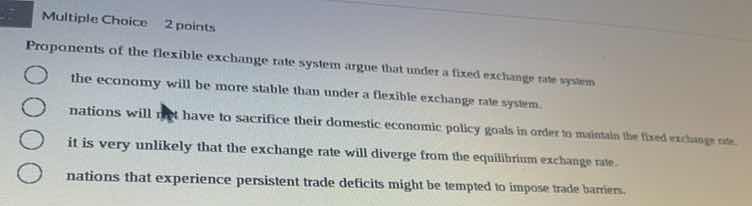
proponents of the flexible exchange rate system argue that under a fixed exchange rate system
the economy will be more stable than under a flexible exchange rate system.
nations will not have to sacrifice their domestic economic policy goals in order to maintain the fixed exchange rate.
it is very unlikely that the exchange rate will diverge from the equilibrium exchange rate.
nations that experience persistent trade deficits might be tempted to impose trade barriers.
Analyze the core argument for flexible exchange rates
Proponents of flexible exchange rates argue that a fixed exchange rate system forces countries to use monetary and fiscal policies to maintain the pegged rate, often sacrificing domestic goals like full employment or price stability. Under a fixed system, persistent trade deficits require intervention (such as raising interest rates or restricting trade) to defend the currency peg. Therefore, nations with persistent trade deficits under a fixed system might be tempted to impose trade barriers to correct the balance of payments without altering the exchange rate.
Evaluate the given options
- Option 1: Proponents of flexible rates argue that flexible systems, not fixed systems, provide better automatic stabilization.
- Option 2: Under a fixed system, nations must sacrifice domestic goals to maintain the peg, which is the opposite of this statement.
- Option 3: Under a fixed system, the official rate frequently diverges from the market equilibrium rate, requiring constant intervention.
- Option 4: Because exchange rates cannot adjust automatically under a fixed system, nations experiencing persistent trade deficits are indeed tempted to use protectionist trade barriers to reduce imports and defend the peg.

Snap & solve any problem in the app
Get step-by-step solutions on Sovi AI
Photo-based solutions with guided steps
Explore more problems and detailed explanations
- (A) the economy will be more stable than under a flexible exchange rate system.
- (B) nations will not have to sacrifice their domestic economic policy goals in order to maintain the fixed exchange rate.
- (C) it is very unlikely that the exchange rate will diverge from the equilibrium exchange rate.
- (D) nations that experience persistent trade deficits might be tempted to impose trade barriers. (Correct answer)