QUESTION IMAGE
Question
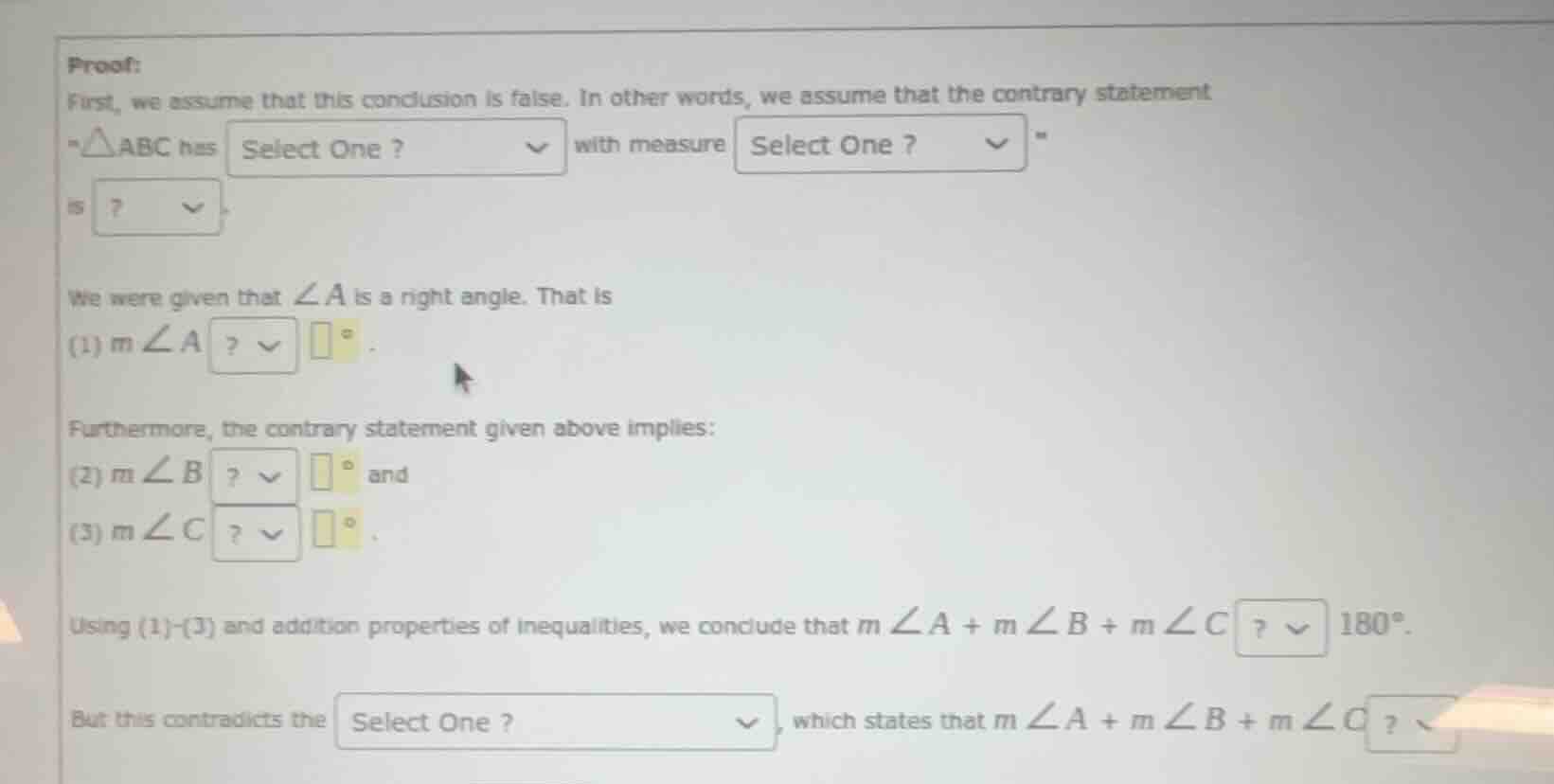
proof:
first, we assume that this conclusion is false. in other words, we assume that the contrary statement
\\\(\triangle abc\\) has select one? with measure select one? is ? \.
we were given that \\(\angle a\\) is a right angle. that is
(1) \\(m\angle a\\ ?\\ ?^\circ\\).
furthermore, the contrary statement given above implies:
(2) \\(m\angle b\\ ?\\ ?^\circ\\) and
(3) \\(m\angle c\\ ?\\ ?^\circ\\).
using (1)-(3) and addition properties of inequalities, we conclude that \\(m\angle a + m\angle b + m\angle c\\ ?\\ 180^\circ\\).
but this contradicts the select one? which states that \\(m\angle a + m\angle b + m\angle c\\ ?\\ ?\\).
Identify the theorem being proved and the contrary statement
The proof is an indirect proof (proof by contradiction) of the theorem: "A triangle can have at most one right angle."
To prove this indirectly, we assume the contrary of the conclusion.
The conclusion is "$\triangle ABC$ has at most one right angle."
The contrary statement is "$\triangle ABC$ has at least two angles with measure equal to $90^\circ$."
Thus, the first sentence is:
"First, we assume that this conclusion is false. In other words, we assume that the contrary statement '$\triangle ABC$ has at least two angles with measure equal to $90^\circ$' is true."
Express the given conditions and contrary assumptions mathematically
We are given that $\angle A$ is a right angle. That is:
(1) $m\angle A = 90^\circ$.
The contrary statement (at least two angles are right angles, meaning $\angle A$ and at least one other angle, say both $\angle B$ and $\angle C$, are right angles) implies:
(2) $m\angle B \ge 90^\circ$ (or $= 90^\circ$ depending on standard dropdown options, typically $\ge$ or $=$ in inequality proofs)
(3) $m\angle C \ge 90^\circ$ (or $> 0^\circ$ if only two are right angles, but standard indirect proof for "at most one right angle" assumes two angles are right angles, so $m\angle B = 90^\circ$ and $m\angle C > 0^\circ$).
Let's analyze standard geometry curriculum proofs for "A triangle can have at most one right angle":
Assume $\triangle ABC$ has two right angles, say $\angle A$ and $\angle B$.
Then:
(1) $m\angle A = 90^\circ$
(2) $m\angle B = 90^\circ$
(3) $m\angle C > 0^\circ$ (since the measure of any angle of a triangle must be greater than $0^\circ$).
Adding these inequalities:
$m\angle A + m\angle B + m\angle C > 90^\circ + 90^\circ + 0^\circ = 180^\circ$.
Thus, $m\angle A + m\angle B + m\angle C > 180^\circ$.
Identify the contradiction
This contradicts the Triangle Angle Sum Theorem, which states that $m\angle A + m\angle B + m\angle C = 180^\circ$.

Snap & solve any problem in the app
Get step-by-step solutions on Sovi AI
Photo-based solutions with guided steps
Explore more problems and detailed explanations
Proof:
First, we assume that this conclusion is false. In other words, we assume that the contrary statement "$\triangle ABC$ has <blank>at least two angles</blank> with measure <blank>equal to</blank> is <blank>\(90^\circ\)</blank>" is true.
We were given that \(\angle A\) is a right angle. That is
(1) \(m\angle A\) <blank>\(=\)</blank> <blank>\(90\)</blank>\(^\circ\).
Furthermore, the contrary statement given above implies:
(2) \(m\angle B\) <blank>\(=\)</blank> <blank>\(90\)</blank>\(^\circ\) and
(3) \(m\angle C\) <blank>\(>\)</blank> <blank>\(0\)</blank>\(^\circ\).
Using (1)-(3) and addition properties of inequalities, we conclude that \(m\angle A + m\angle B + m\angle C\) <blank>\(>\)</blank> \(180^\circ\).
But this contradicts the <blank>Triangle Angle Sum Theorem</blank> which states that \(m\angle A + m\angle B + m\angle C\) <blank>\(=\)</blank> <blank>\(180\)</blank>\(^\circ\).