QUESTION IMAGE
Question
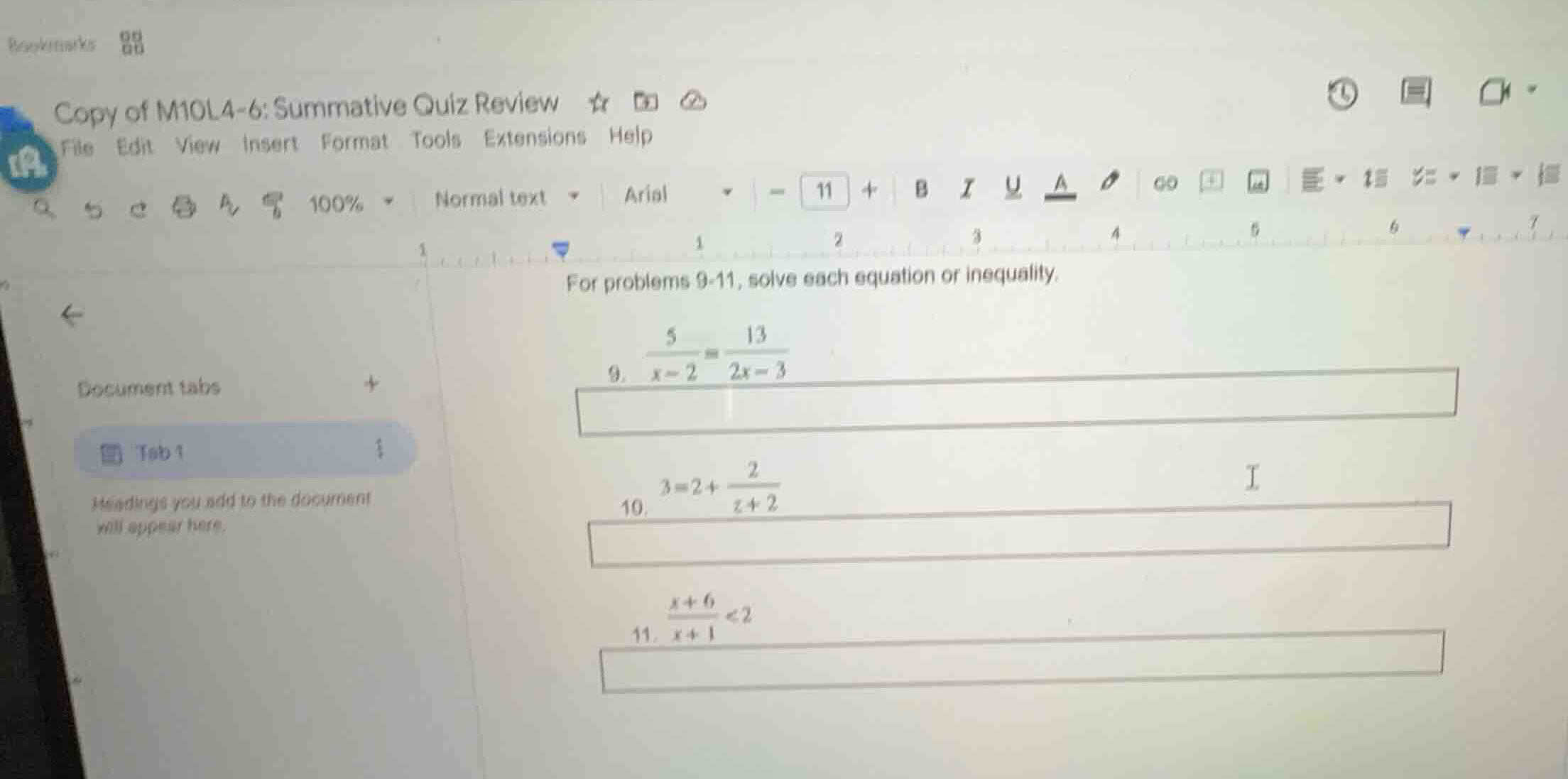
for problems 9-11, solve each equation or inequality.
- \\(\frac{5}{x-2} =
\frac{13}{2x-3}\\)
- \\(3 = 2 + \frac{2}{x+2}\\)
- \\(\frac{x+6}{x+1} < 2\\)
Solve Question 9
We solve the rational equation:
First, identify the domain restrictions:
Cross-multiply to eliminate the denominators:
Distribute both sides:
Subtract \(10x\) from both sides:
Add \(26\) to both sides:
Since \(\frac{11}{3}\) does not violate the restrictions, it is the solution.
Solve Question 10
We solve the rational equation:
First, identify the domain restriction:
Subtract \(2\) from both sides:
Multiply both sides by \(z+2\):
Subtract \(2\) from both sides:
Since \(0
eq -2\), the solution is valid.
Solve Question 11
We solve the rational inequality:
First, identify the domain restriction:
Subtract \(2\) from both sides to set the inequality to \(0\):
Find a common denominator:
Simplify the numerator:
Find the critical points where the numerator or denominator is zero:
Test the intervals created by these critical points: \((-\infty, -1)\), \((-1, 4)\), and \((4, \infty)\).
- For \(x \in (-\infty, -1)\), let \(x = -2\):
- For \(x \in (-1, 4)\), let \(x = 0\):
- For \(x \in (4, \infty)\), let \(x = 5\):
Thus, the solution set is:
In interval notation:

Snap & solve any problem in the app
Get step-by-step solutions on Sovi AI
Photo-based solutions with guided steps
Explore more problems and detailed explanations
Question 9
\(x = \frac{11}{3}\)
Question 10
\(z = 0\)
Question 11
\(x < -1\) or \(x > 4\) (or in interval notation: \((-\infty, -1) \cup (4, \infty)\))