QUESTION IMAGE
Question
i predict that the pressure in the container will increase if the temperature increases. as the gas gets hotter, the particles move faster and hit the walls of the container more often and with more force, causing the pressure to increase.
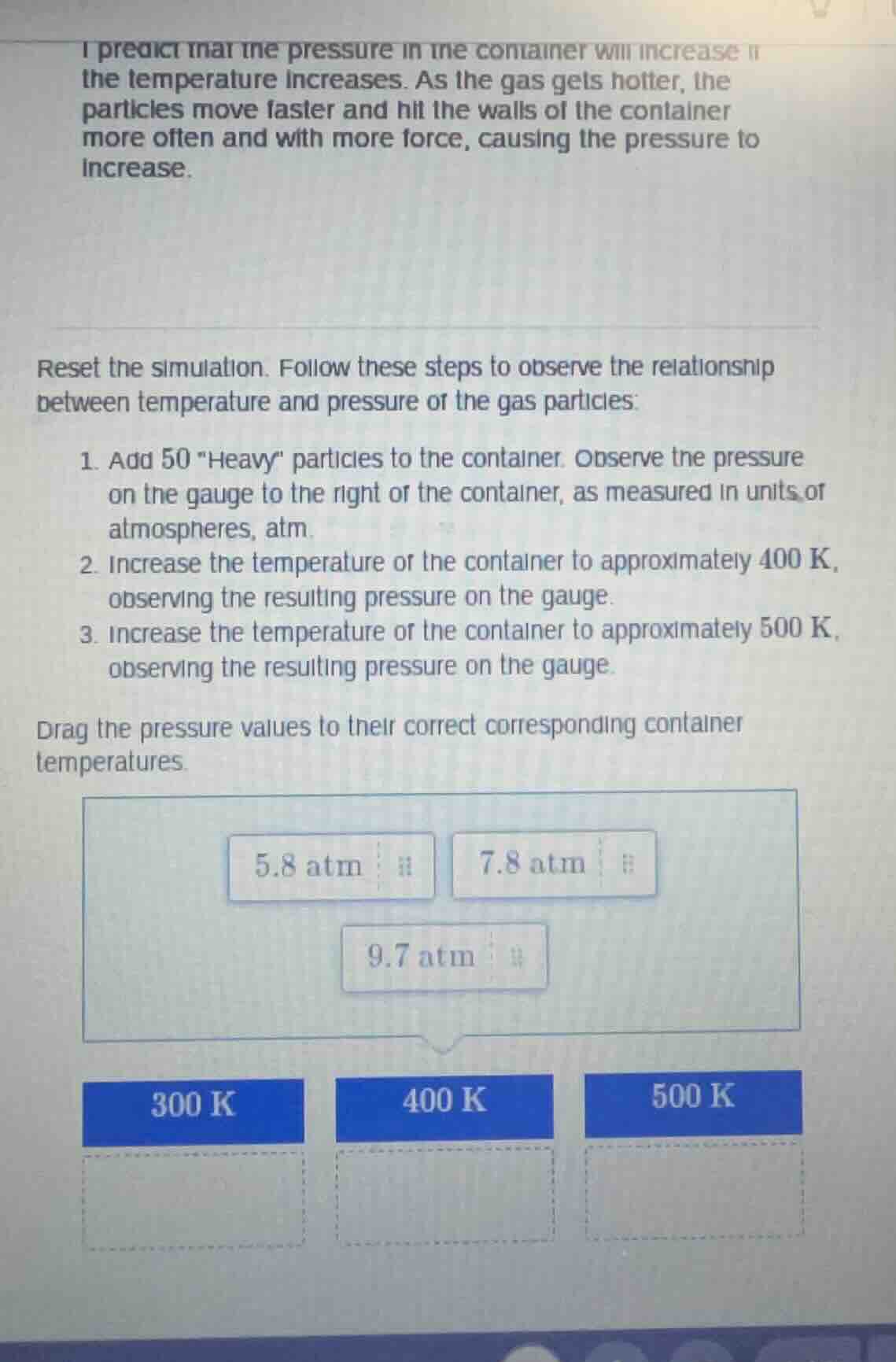
reset the simulation. follow these steps to observe the relationship between temperature and pressure of the gas particles:
- add 50 \heavy\ particles to the container. observe the pressure on the gauge to the right of the container, as measured in units of atmospheres, atm.
- increase the temperature of the container to approximately 400 k, observing the resulting pressure on the gauge.
- increase the temperature of the container to approximately 500 k, observing the resulting pressure on the gauge.
drag the pressure values to their correct corresponding container temperatures.
5.8 atm
7.8 atm
9.7 atm
300 k
400 k
500 k
Identify the relationship between temperature and pressure
Using the Pressure-Volume-Temperature Relationships and Gas Laws knowledge points:
At constant volume and amount of gas, pressure is directly proportional to absolute temperature (Gay-Lussac's Law):
Match the given values
Since pressure increases as temperature increases:
- Lowest temperature (\(300\text{ K}\)) corresponds to the lowest pressure (\(5.8\text{ atm}\)).
- Intermediate temperature (\(400\text{ K}\)) corresponds to the intermediate pressure (\(7.8\text{ atm}\)).
- Highest temperature (\(500\text{ K}\)) corresponds to the highest pressure (\(9.7\text{ atm}\)).
Verify proportionality
The ratios are approximately constant, confirming the direct linear relationship.

Snap & solve any problem in the app
Get step-by-step solutions on Sovi AI
Photo-based solutions with guided steps
Explore more problems and detailed explanations
- 300 K: 5.8 atm
- 400 K: 7.8 atm
- 500 K: 9.7 atm