QUESTION IMAGE
Question
practice: complex inheritance patterns
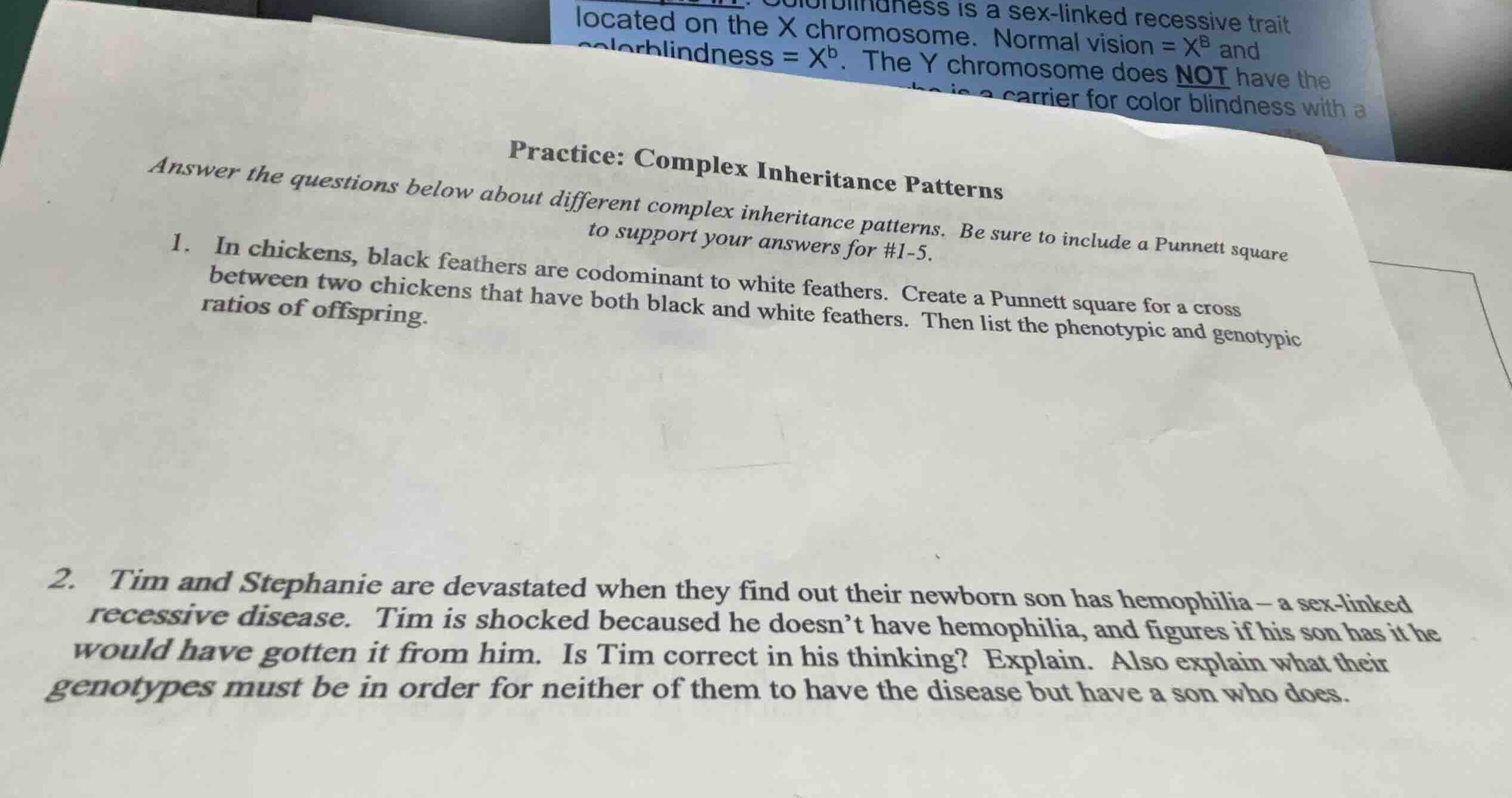
answer the questions below about different complex inheritance patterns. be sure to include a punnett square to support your answers for #1-5.
- in chickens, black feathers are codominant to white feathers. create a punnett square for a cross between two chickens that have both black and white feathers. then list the phenotypic and genotypic ratios of offspring.
- tim and stephanie are devastated when they find out their newborn son has hemophilia - a sex-linked recessive disease. tim is shocked because he doesnt have hemophilia, and figures if his son has it he would have gotten it from him. is tim correct in his thinking? explain. also explain what their genotypes must be in order for neither of them to have the disease but have a son who does.
Identify genotypes for codominant cross
Using the Phenotypic Expression knowledge point, we define alleles for feather color in chickens. Since black and white feathers are codominant, we use \(B\) for black feathers and \(W\) for white feathers.
- Black feather genotype: \(BB\)
- White feather genotype: \(WW\)
- Black and white feathered (erminitte) genotype: \(BW\)
The problem asks for a cross between two chickens that have both black and white feathers:
- Parent 1: \(BW\)
- Parent 2: \(BW\)
Construct Punnett square and ratios
Using the Phenotypic Expression knowledge point, we cross the two heterozygous \(BW\) parents:
| B | W | |
|---|---|---|
| W | \(BW\) | \(WW\) |
- Genotypic ratio: \(1\ BB : 2\ BW : 1\ WW\) (or \(1:2:1\))
- Phenotypic ratio: \(1\) Black : \(2\) Black and White : \(1\) White (or \(1:2:1\))
Analyze sex-linked inheritance for hemophilia
Using the Sex Linkage and Sex-Linked Disorders knowledge points, we analyze the inheritance of hemophilia, an X-linked recessive disorder. Let \(X^H\) be the normal allele and \(X^h\) be the hemophilia allele.
- Males have one X chromosome and one Y chromosome (\(XY\)).
- A son inherits his Y chromosome from his father (Tim) and his X chromosome from his mother (Stephanie).
- Since the son has hemophilia, his genotype is \(X^hY\). He must have inherited the \(X^h\) allele from Stephanie.
- Therefore, Tim is incorrect; a son cannot inherit an X-linked trait from his father.
Determine parental genotypes
Using the Sex Linkage and Sex-Linked Disorders knowledge points, we determine the genotypes of Tim and Stephanie:
- Tim does not have hemophilia, so his genotype must be \(X^HY\).
- Stephanie does not have hemophilia but must carry the recessive allele to pass it to her son. Her genotype is \(X^HX^h\) (a carrier).
- This combination allows them to be unaffected while having an affected son (\(X^hY\)).

Snap & solve any problem in the app
Get step-by-step solutions on Sovi AI
Photo-based solutions with guided steps
Explore more problems and detailed explanations
Question 1
- Punnett Square:
| B | W | |
|---|---|---|
| W | \(BW\) | \(WW\) |
- Genotypic Ratio: \(1\ BB : 2\ BW : 1\ WW\) (or \(25\%\) \(BB\), \(50\%\) \(BW\), \(25\%\) \(WW\))
- Phenotypic Ratio: \(1\) Black : \(2\) Black and White : \(1\) White (or \(25\%\) Black, \(50\%\) Black and White, \(25\%\) White)
Question 2
- Is Tim correct? No, Tim is incorrect.
- Explanation: Hemophilia is a sex-linked recessive trait located on the X chromosome. A son (\(XY\)) inherits his Y chromosome from his father and his X chromosome from his mother. Therefore, the son inherited the hemophilia allele (\(X^h\)) from Stephanie, not Tim.
- Parental Genotypes:
- Tim: \(X^HY\) (unaffected male)
- Stephanie: \(X^HX^h\) (unaffected carrier female)