QUESTION IMAGE
Question
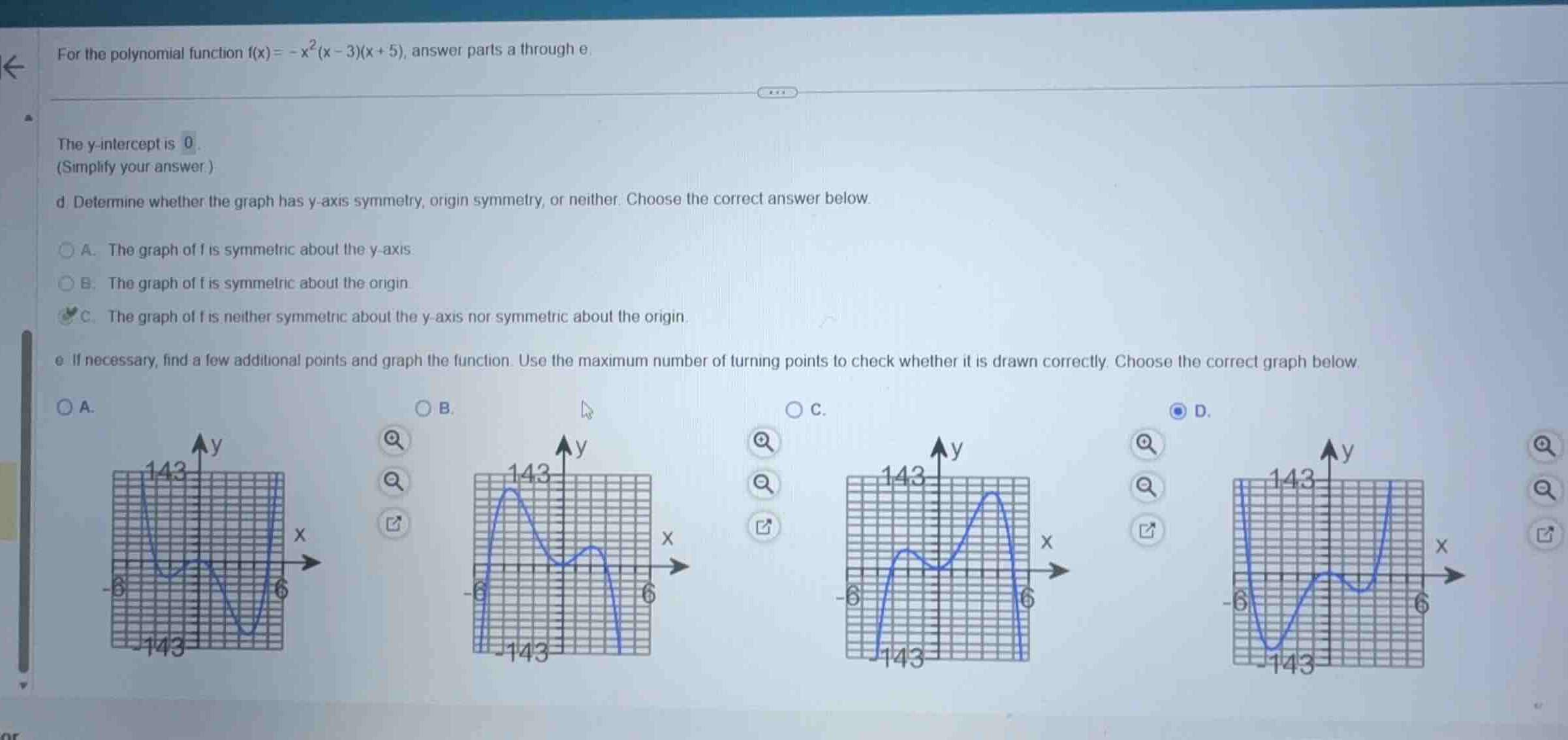
for the polynomial function \\(f(x) = -x^2(x - 3)(x + 5)\\), answer parts a through e.
the y-intercept is 0.
(simplify your answer.)
d. determine whether the graph has y-axis symmetry, origin symmetry, or neither. choose the correct answer below.
a. the graph of f is symmetric about the y-axis.
b. the graph of f is symmetric about the origin.
c. the graph of f is neither symmetric about the y-axis nor symmetric about the origin.
e. if necessary, find a few additional points and graph the function. use the maximum number of turning points to check whether it is drawn correctly. choose the correct graph below.
Determine the symmetry of the function
Using the Symmetry of Functions and Even and Odd Functions knowledge points
Analyze the end behavior of the polynomial
Using the End Behavior of Polynomials knowledge point
The leading term is \(-x^4\). Since the degree is even (\(4\)) and the leading coefficient is negative (\(-1\)), the graph falls to both the left and the right:
Analyze the behavior at the zeros
Using the Multiplicity of Zeros knowledge point
The zeros of \(f(x) = -x^2(x-3)(x+5)\) are:
- \(x = 0\) with multiplicity \(2\) (the graph is tangent to the \(x\)-axis, touching and turning around at \(x = 0\)).
- \(x = 3\) with multiplicity \(1\) (the graph crosses the \(x\)-axis).
- \(x = -5\) with multiplicity \(1\) (the graph crosses the \(x\)-axis).
Match the correct graph
Using the End Behavior of Polynomials and Multiplicity of Zeros knowledge points
- The graph must cross the \(x\)-axis at \(x = -5\) and \(x = 3\).
- The graph must touch and turn around at the origin \((0,0)\).
- Both ends of the graph must point downwards.
- Evaluating a test point: for \(x = -2\), \(f(-2) = -(-2)^2(-2-3)(-2+5) = -4(-5)(3) = 60 > 0\).
- Evaluating another test point: for \(x = 2\), \(f(2) = -(2)^2(2-3)(2+5) = -4(-1)(7) = 28 > 0\).
- This matches the graph in Option B, which has local maxima on both sides of the origin and touches the origin from above.

Snap & solve any problem in the app
Get step-by-step solutions on Sovi AI
Photo-based solutions with guided steps
Explore more problems and detailed explanations
Question d
- A. The graph of f is symmetric about the y-axis.
- B. The graph of f is symmetric about the origin.
- C. The graph of f is neither symmetric about the y-axis nor symmetric about the origin. (Correct answer)
Question e
- A. Graph with a local minimum at the origin and falling ends.
- B. Graph with a local minimum touching the origin from above, crossing at -5 and 3, and falling ends. (Correct answer)
- C. Graph with rising ends.
- D. Graph with a local maximum at the origin and falling ends.