QUESTION IMAGE
Question
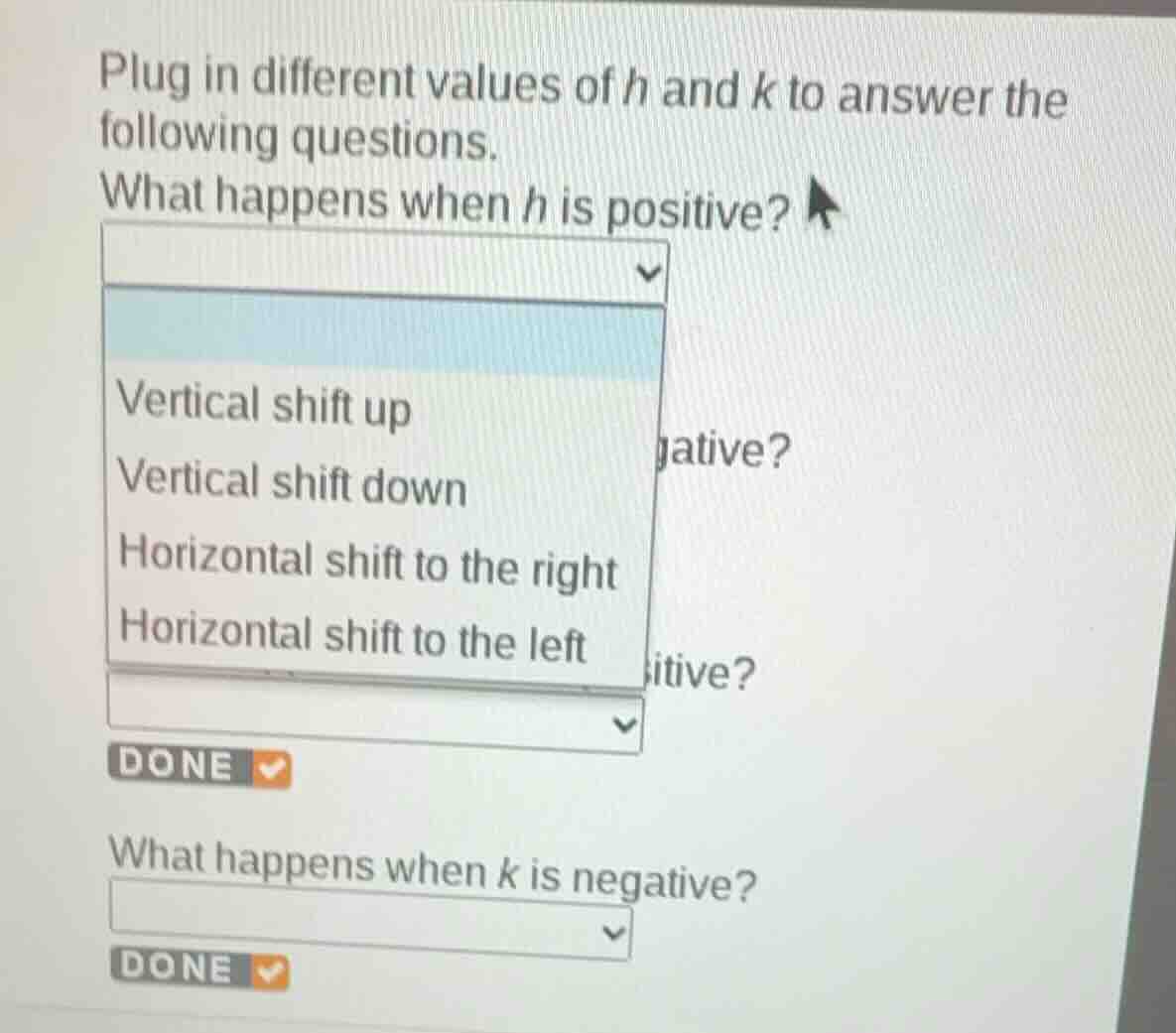
plug in different values of \\(h\\) and \\(k\\) to answer the following questions.
what happens when \\(h\\) is positive?
vertical shift up
vertical shift down
horizontal shift to the right
horizontal shift to the left
what happens when \\(h\\) is negative?
what happens when \\(k\\) is positive?
what happens when \\(k\\) is negative?
Identify the standard transformation form
The problem asks about the effects of parameters \(h\) and \(k\) on a function's graph. This refers to the standard vertex form of a function, typically written as:
Analyze the horizontal shift parameter h
Using the Horizontal Translation knowledge point
- When \(h > 0\) (positive), the function becomes \(f(x - h)\), which shifts the graph to the right.
- When \(h < 0\) (negative), the function becomes \(f(x + |h|)\), which shifts the graph to the left.
Analyze the vertical shift parameter k
Using the Vertical Translation knowledge point
- When \(k > 0\) (positive), the term \(+ k\) shifts the graph up.
- When \(k < 0\) (negative), the term \(- |k|\) shifts the graph down.
Match the questions to their corresponding effects
Based on the standard rules of translations:
- "What happens when \(h\) is positive?" \(
ightarrow\) Horizontal shift to the right
- "What happens when \(h\) is negative?" \(
ightarrow\) Horizontal shift to the left
- "What happens when \(k\) is positive?" \(
ightarrow\) Vertical shift up
- "What happens when \(k\) is negative?" \(
ightarrow\) Vertical shift down

Snap & solve any problem in the app
Get step-by-step solutions on Sovi AI
Photo-based solutions with guided steps
Explore more problems and detailed explanations
Question 1
What happens when \(h\) is positive?
<blank>Horizontal shift to the right</blank>
Question 2
What happens when \(h\) is negative?
<blank>Horizontal shift to the left</blank>
Question 3
What happens when \(k\) is positive?
<blank>Vertical shift up</blank>
Question 4
What happens when \(k\) is negative?
<blank>Vertical shift down</blank>