QUESTION IMAGE
Question
- (partially visible) a function? lesson 6-1 8.f.1.1
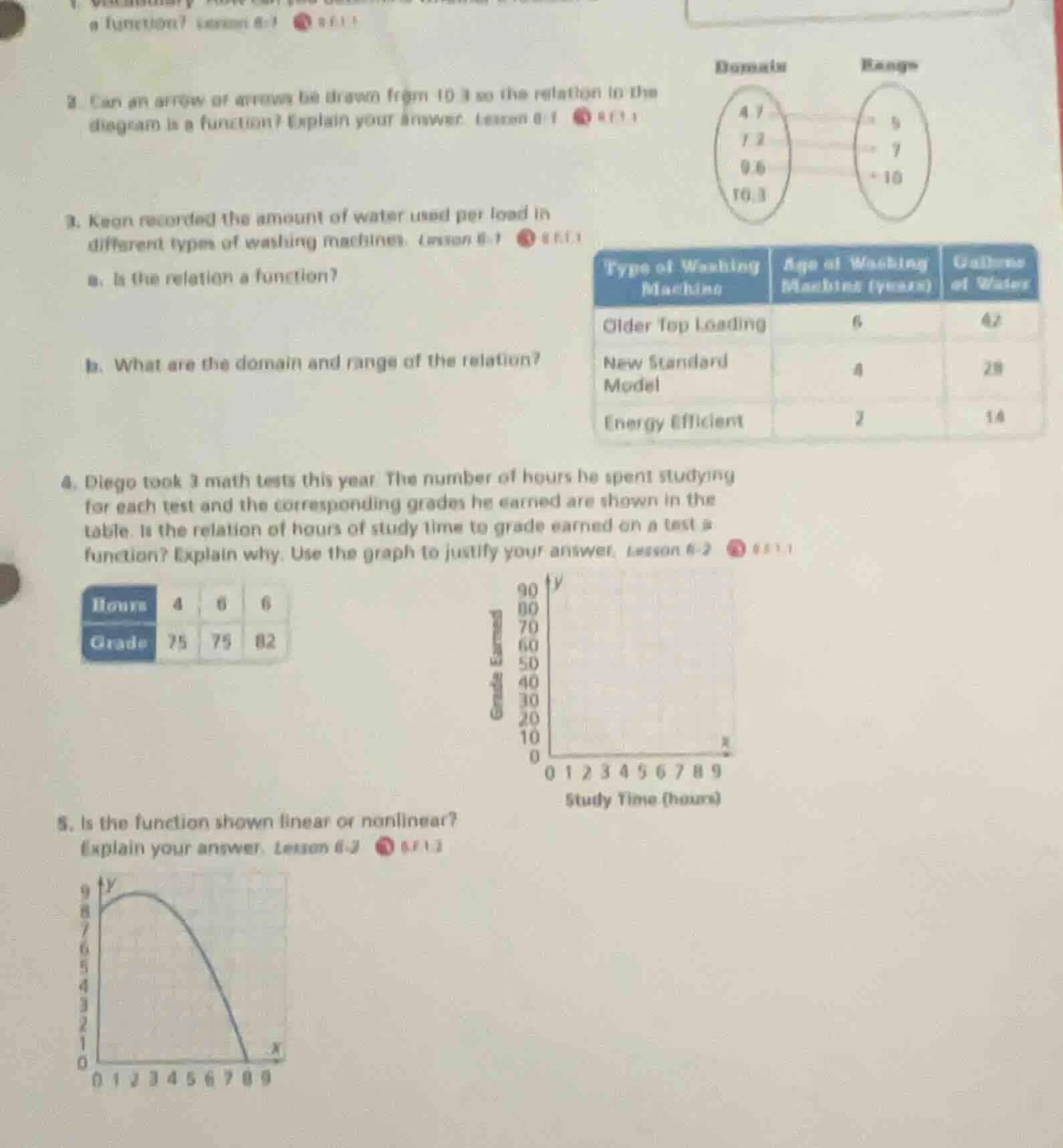
- can an arrow or arrows be drawn from 10.3 so the relation in the diagram is a function? explain your answer. lesson 6-1 8.f.1.1
diagram: domain (4.7, 7.2, 9.6, 10.3) to range (5, 7, 10) with existing arrows
- keon recorded the amount of water used per load in different types of washing machines. lesson 6-1 8.f.1.1
a. is the relation a function?
b. what are the domain and range of the relation?
chart: type of washing machine (older top loading, new standard model, energy efficient); age of washing machine (years) (6, 4, 2); gallons of water (42, 28, 14)
- diego took 3 math tests this year. the number of hours he spent studying for each test and the corresponding grades he earned are shown in the table. is the relation of hours of study time to grade earned on a test a function? explain why. use the graph to justify your answer. lesson 6-2 8.f.1.1
table: hours (4, 6, 6); grade (75, 75, 82)
graph: x-axis study time (hours) 0-9, y-axis grade earned 0-90, with axes labeled
- is the function shown linear or nonlinear? explain your answer. lesson 6-3 8.f.1.2
graph: x-axis 0-9, y-axis 0-9, curve starting at (0,8), peaking, then falling to (8,0)
Question 2
To determine if a relation is a function, each element in the domain must map to exactly one element in the range. In the given diagram, the domain element \( 10.3 \) currently has no arrow. If we draw an arrow from \( 10.3 \) to any element in the range (5, 7, or 10), we need to check if it violates the function definition. Since adding an arrow from \( 10.3 \) to one element in the range will mean each domain element (4.7, 7.2, 9.6, 10.3) maps to one range element (assuming we pick one for 10.3), it can be a function. The key is that each domain element has at most one range element. So, yes, an arrow can be drawn (e.g., to 5, 7, or 10) and the relation will still be a function because each domain element will have a unique mapping (or we assign one mapping to 10.3).
A relation is a function if each input (in the domain) has exactly one output (in the range). Here, the "Age of Washing Machine (years)" column has values 6, 4, 2 (each unique), and each age maps to one "Gallons of Water" value (42, 28, 14 respectively). So each input (age) has one output (gallons), so it's a function.
The domain is the set of all input values (age of washing machine), which are 6, 4, 2. The range is the set of all output values (gallons of water), which are 42, 28, 14. We list them in set notation, ensuring uniqueness (though they are already unique here).

Snap & solve any problem in the app
Get step-by-step solutions on Sovi AI
Photo-based solutions with guided steps
Explore more problems and detailed explanations
Yes, an arrow can be drawn from \( 10.3 \) to make the relation a function. This is because a function requires each element in the domain to map to exactly one element in the range. By drawing an arrow from \( 10.3 \) to one of the range elements (5, 7, or 10), each domain element (4.7, 7.2, 9.6, 10.3) will map to exactly one range element, satisfying the function definition.