QUESTION IMAGE
Question
part d - unwinding the dna
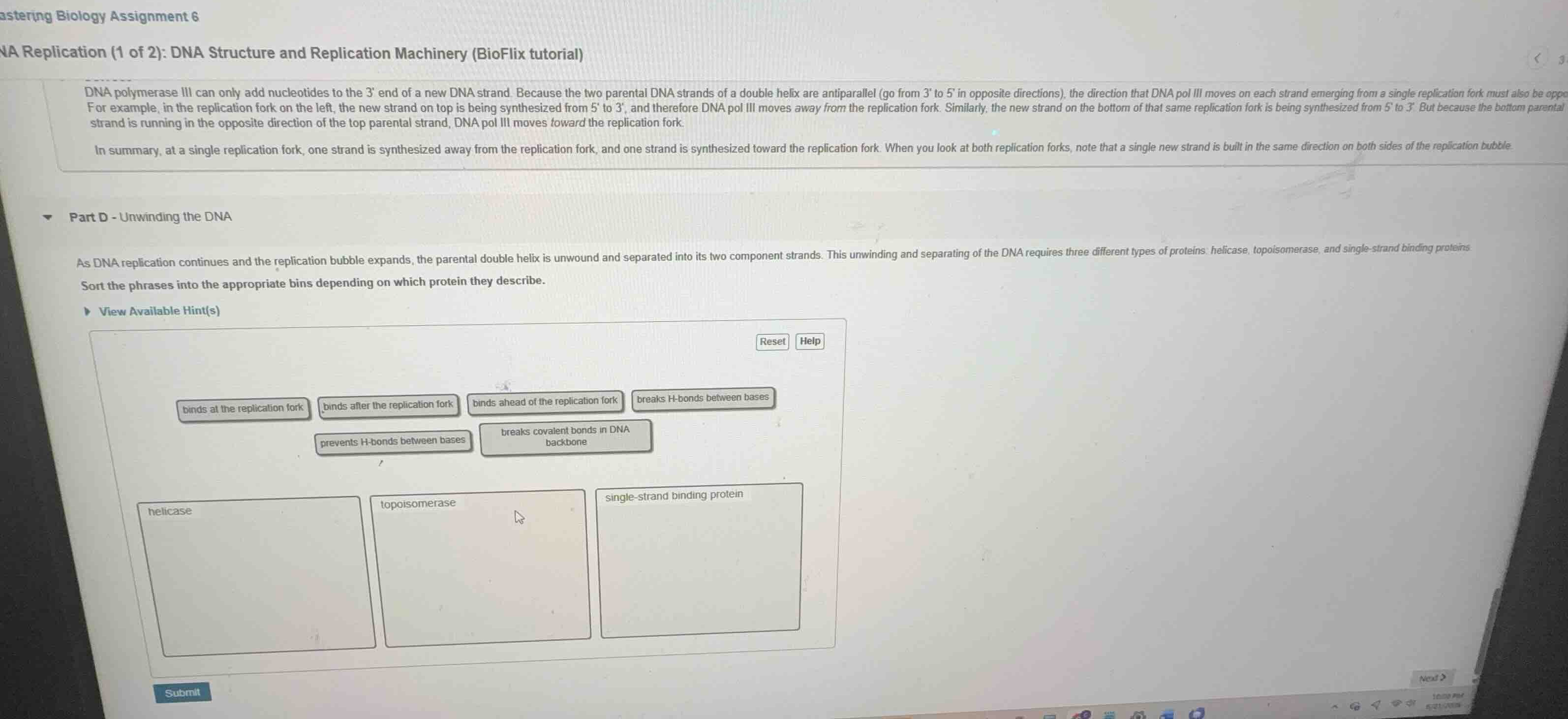
as dna replication continues and the replication bubble expands, the parental double helix is unwound and separated into its two component strands. this unwinding and separating of the dna requires three different types of proteins: helicase, topoisomerase, and single-strand binding proteins.
sort the phrases into the appropriate bins depending on which protein they describe.
phrases:
- binds at the replication fork
- binds after the replication fork
- binds ahead of the replication fork
- breaks h-bonds between bases
- prevents h-bonds between bases
- breaks covalent bonds in dna backbone
bins:
- helicase
- topoisomerase
- single-strand binding protein
Identify protein roles
We analyze the functions of helicase, topoisomerase, and single-strand binding protein (SSBP) during DNA replication.
Analyze helicase
Helicase unwinds the double helix at the replication fork.
- It binds at the replication fork.
- It breaks hydrogen bonds between bases to separate the strands.
Analyze topoisomerase
Topoisomerase relieves overwinding strain ahead of replication forks.
- It binds ahead of the replication fork.
- It breaks covalent bonds in the DNA backbone to relieve torsional strain, then rejoins them.
Analyze single-strand binding protein
SSBPs stabilize single-stranded DNA templates.
- They bind after the replication fork (on the newly separated single strands).
- They prevent hydrogen bonds from re-forming between bases, keeping the strands separated.

Snap & solve any problem in the app
Get step-by-step solutions on Sovi AI
Photo-based solutions with guided steps
Explore more problems and detailed explanations
| helicase | topoisomerase | single-strand binding protein |
|---|