QUESTION IMAGE
Question
part a: multiple choice - knowledge and understanding (20 marks)
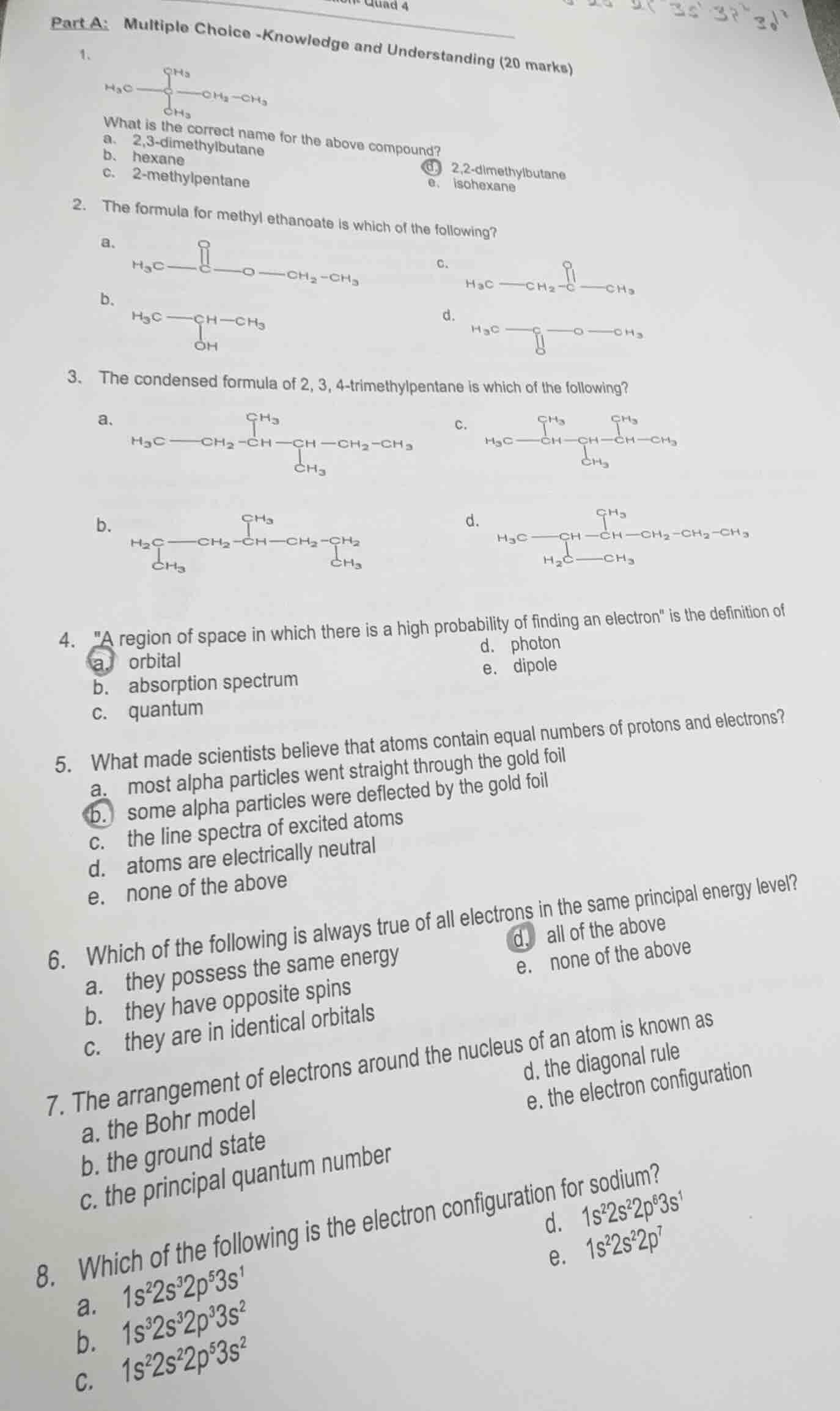
- what is the correct name for the above compound?
a. 2,3-dimethylbutane
b. hexane
c. 2-methylpentane
d. 2,2-dimethylbutane
e. isohexane
- the formula for methyl ethanoate is which of the following?
- the condensed formula of 2, 3, 4-trimethylpentane is which of the following?
- \a region of space in which there is a high probability of finding an electron\ is the definition of
a. orbital
b. absorption spectrum
c. quantum
d. photon
e. dipole
- what made scientists believe that atoms contain equal numbers of protons and electrons?
a. most alpha particles went straight through the gold foil
b. some alpha particles were deflected by the gold foil
c. the line spectra of excited atoms
d. atoms are electrically neutral
e. none of the above
- which of the following is always true of all electrons in the same principal energy level?
a. they possess the same energy
b. they have opposite spins
c. they are in identical orbitals
d. all of the above
e. none of the above
- the arrangement of electrons around the nucleus of an atom is known as
a. the bohr model
b. the ground state
c. the principal quantum number
d. the diagonal rule
e. the electron configuration
- which of the following is the electron configuration for sodium?
a. \\(1s^2 2s^3 2p^5 3s^1\\)
b. \\(1s^3 2s^2 2p^3 3s^2\\)
c. \\(1s^2 2s^2 2p^5 3s^2\\)
d. \\(1s^2 2s^2 2p^6 3s^1\\)
e. \\(1s^2 2s^2 2p^7\\)
Identify the first alkane structure
Using the IUPAC Nomenclature knowledge point
The longest carbon chain has 4 carbons (butane). Two methyl groups are on carbon-2.
Identify the ester formula
Using the Organic Chemistry Families and Functional Groups knowledge points
Methyl ethanoate contains an ethanoate group (\(\text{CH}_3\text{COO}-\)) and a methyl group (\(-\text{CH}_3\)).
Identify the trimethylpentane structure
Using the IUPAC Nomenclature knowledge point
The parent chain is pentane (5 carbons). Methyl groups are at positions 2, 3, and 4.
Define the electron region
An orbital is defined as a region of space with a high probability of finding an electron.
Determine atomic neutrality evidence
Atoms are electrically neutral, meaning the positive charge of protons must equal the negative charge of electrons.
Analyze electrons in the same energy level
Electrons in the same principal energy level (\(n\)) do not all have the same energy (due to subshells \(s, p, d, f\)), nor do they all have opposite spins or identical orbitals. Thus, none of the statements are always true.
Define electron arrangement
The arrangement of electrons around the nucleus of an atom is known as the electron configuration.
Determine sodium's electron configuration
Sodium (\(\text{Na}\), \(Z=11\)) has 11 electrons.

Snap & solve any problem in the app
Get step-by-step solutions on Sovi AI
Photo-based solutions with guided steps
Explore more problems and detailed explanations
Question 1
- a. 2,3-dimethylbutane
- b. hexane
- c. 2-methylpentane
- d. 2,2-dimethylbutane (Correct answer)
- e. isohexane
Question 2
- a. \(\text{H}_3\text{C}-\text{C}(=\text{O})-\text{O}-\text{CH}_2-\text{CH}_3\)
- b. \(\text{H}_3\text{C}-\text{CH}(\text{OH})-\text{CH}_3\)
- c. \(\text{H}_3\text{C}-\text{CH}_2-\text{C}(=\text{O})-\text{CH}_3\)
- d. \(\text{H}_3\text{C}-\text{C}(=\text{O})-\text{O}-\text{CH}_3\) (Correct answer)
Question 3
- a. \(\text{H}_3\text{C}-\text{CH}_2-\text{CH}(\text{CH}_3)-\text{CH}(\text{CH}_3)-\text{CH}_2-\text{CH}_3\)
- b. \(\text{H}_3\text{C}(\text{CH}_3)-\text{CH}_2-\text{CH}(\text{CH}_3)-\text{CH}_2-\text{CH}_2(\text{CH}_3)\)
- c. \(\text{H}_3\text{C}-\text{CH}(\text{CH}_3)-\text{CH}(\text{CH}_3)-\text{CH}(\text{CH}_3)-\text{CH}_3\) (Correct answer)
- d. \(\text{H}_3\text{C}-\text{CH}(\text{CH}_2\text{CH}_3)-\text{CH}(\text{CH}_3)-\text{CH}_2-\text{CH}_2-\text{CH}_3\)
Question 4
- a. orbital (Correct answer)
- b. absorption spectrum
- c. quantum
- d. photon
- e. dipole
Question 5
- a. most alpha particles went straight through the gold foil
- b. some alpha particles were deflected by the gold foil
- c. the line spectra of excited atoms
- d. atoms are electrically neutral (Correct answer)
- e. none of the above
Question 6
- a. they possess the same energy
- b. they have opposite spins
- c. they are in identical orbitals
- d. all of the above
- e. none of the above (Correct answer)
Question 7
- a. the Bohr model
- b. the ground state
- c. the principal quantum number
- d. the diagonal rule
- e. the electron configuration (Correct answer)
Question 8
- a. \(1s^2 2s^3 2p^5 3s^1\)
- b. \(1s^3 2s^2 2p^3 3s^2\)
- c. \(1s^2 2s^2 2p^5 3s^2\)
- d. \(1s^2 2s^2 2p^6 3s^1\) (Correct answer)
- e. \(1s^2 2s^2 2p^7\)