Sovi.AI - AI Math Tutor

Scan to solve math questions

QUESTION IMAGE

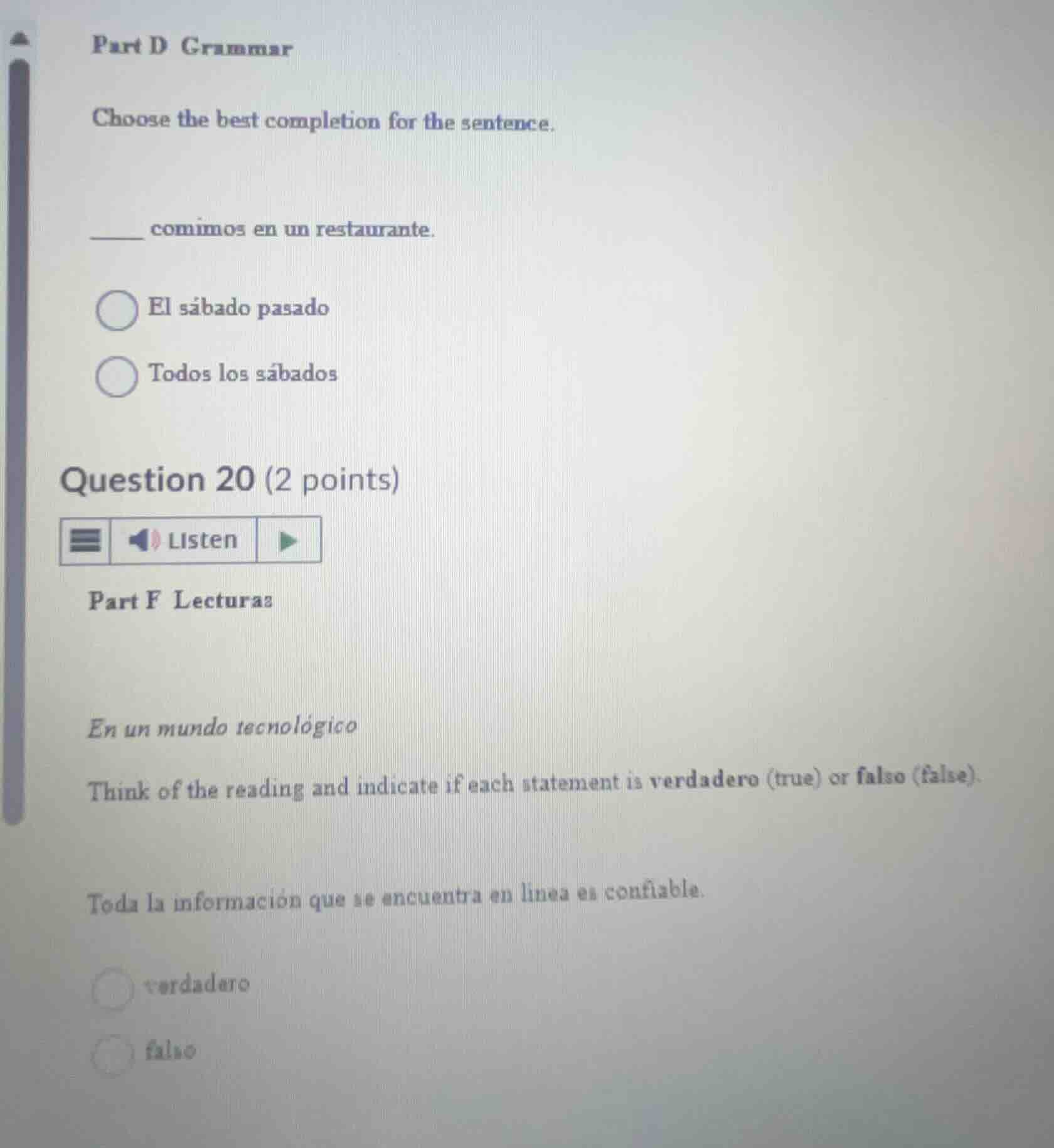
part d grammar choose the best completion for the sentence. ______ comi…

Question

part d grammar

choose the best completion for the sentence.

______ comimos en un restaurante.

el sábado pasado
todos los sábados

question 20 (2 points)

part f lecturas

en un mundo tecnológico

think of the reading and indicate if each statement is verdadero (true) or falso (false).

toda la información que se encuentra en línea es confiable.

verdadero
falso

Explanation:

Response

<pre_analysis>
{
"quality": "clear",
"question_count": 2,
"skills_matched": [
"direct_cot",
"multiple_choice_formatter",
"explain_then_answer",
"quick"
],
"needs_drawing": false,
"concepts_used": [
"Spanish Preterite Tense",
"Spanish Reading Analysis"
],
"new_concepts": [],
"current_concepts": [
"Spanish Preterite vs Imperfect",
"Spanish Reading Analysis"
]
}
</pre_analysis>

<reasoning>

Analyze the verb tense in the first sentence

The verb "comimos" (we ate) is conjugated in the preterite tense, which indicates a completed action at a specific point in the past. "El sábado pasado" (last Saturday) refers to a specific completed past time, whereas "Todos los sábados" (every Saturday) indicates habitual action in the past (which would require the imperfect tense "comíamos").

Analyze the statement in the reading section

The statement is "Toda la información que se encuentra en línea es confiable" (All information found online is reliable). In any general reading comprehension context, especially one titled "En un mundo tecnológico" (In a technological world), the claim that all online information is reliable is factually false.
</reasoning>

<answer>

Question 1

<mcq-correct>(A) El sábado pasado</mcq-correct>
<mcq-option>(B) Todos los sábados</mcq-option>

Question 2

<mcq-option>(A) verdadero</mcq-option>
<mcq-correct>(B) falso</mcq-correct>
</answer>

<post_analysis>
{
"subject": "Others",
"question_type": "Multiple Choice",
"knowledge_point": [
"Others",
"Spanish",
"Spanish Preterite vs Imperfect"
]
}
</post_analysis>

Answer:

<pre_analysis>
{
"quality": "clear",
"question_count": 2,
"skills_matched": [
"direct_cot",
"multiple_choice_formatter",
"explain_then_answer",
"quick"
],
"needs_drawing": false,
"concepts_used": [
"Spanish Preterite Tense",
"Spanish Reading Analysis"
],
"new_concepts": [],
"current_concepts": [
"Spanish Preterite vs Imperfect",
"Spanish Reading Analysis"
]
}
</pre_analysis>

<reasoning>

Analyze the verb tense in the first sentence

The verb "comimos" (we ate) is conjugated in the preterite tense, which indicates a completed action at a specific point in the past. "El sábado pasado" (last Saturday) refers to a specific completed past time, whereas "Todos los sábados" (every Saturday) indicates habitual action in the past (which would require the imperfect tense "comíamos").

Analyze the statement in the reading section

The statement is "Toda la información que se encuentra en línea es confiable" (All information found online is reliable). In any general reading comprehension context, especially one titled "En un mundo tecnológico" (In a technological world), the claim that all online information is reliable is factually false.
</reasoning>

<answer>

Question 1

<mcq-correct>(A) El sábado pasado</mcq-correct>
<mcq-option>(B) Todos los sábados</mcq-option>

Question 2

<mcq-option>(A) verdadero</mcq-option>
<mcq-correct>(B) falso</mcq-correct>
</answer>

<post_analysis>
{
"subject": "Others",
"question_type": "Multiple Choice",
"knowledge_point": [
"Others",
"Spanish",
"Spanish Preterite vs Imperfect"
]
}
</post_analysis>