QUESTION IMAGE
Question
oogenesis
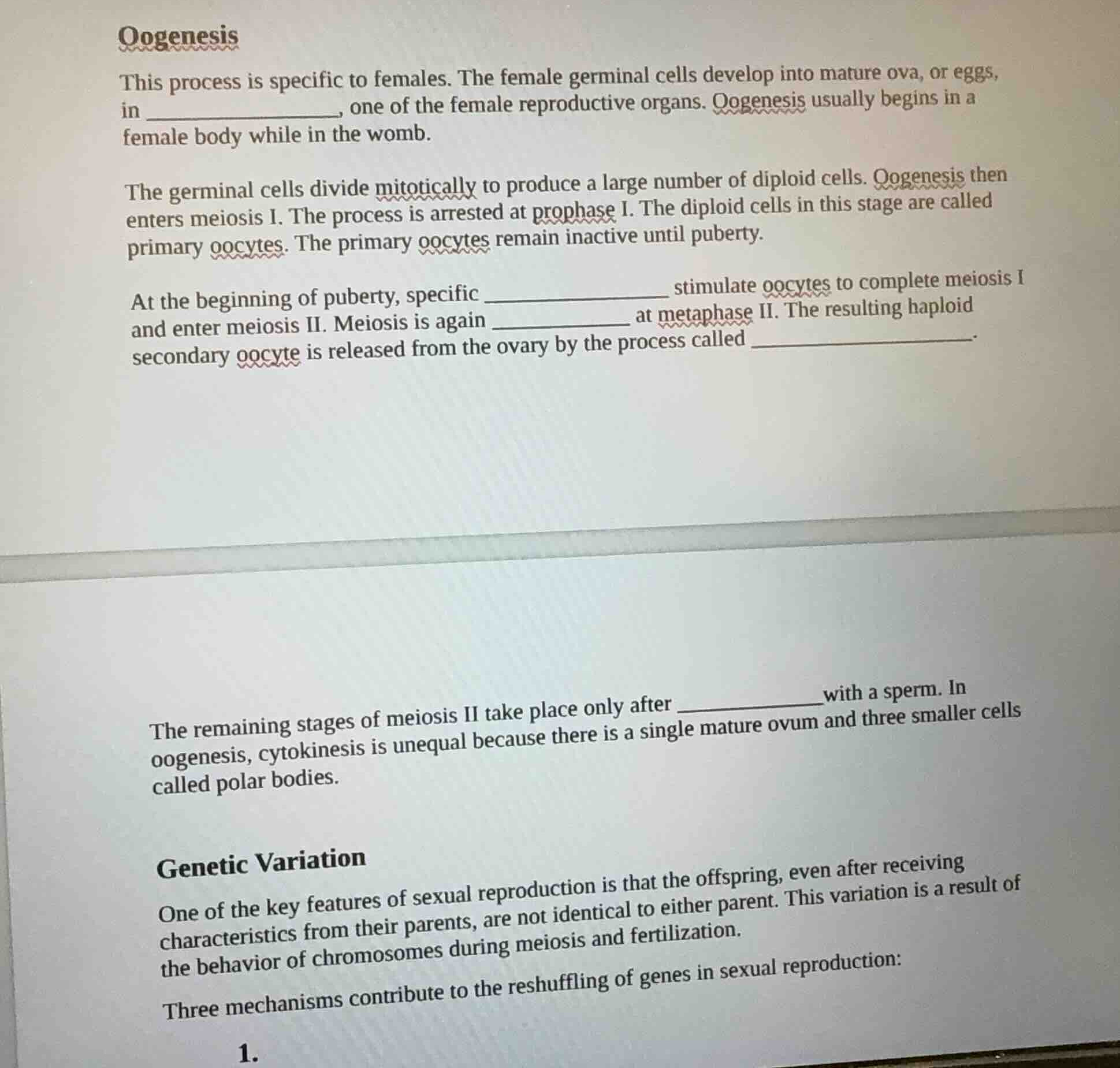
this process is specific to females. the female germinal cells develop into mature ova, or eggs, in __________, one of the female reproductive organs. oogenesis usually begins in a female body while in the womb.
the germinal cells divide mitotically to produce a large number of diploid cells. oogenesis then enters meiosis i. the process is arrested at prophase i. the diploid cells in this stage are called primary oocytes. the primary oocytes remain inactive until puberty.
at the beginning of puberty, specific ________ stimulate oocytes to complete meiosis i and enter meiosis ii. meiosis is again ______ at metaphase ii. the resulting haploid secondary oocyte is released from the ovary by the process called ________.
the remaining stages of meiosis ii take place only after __________ with a sperm. in oogenesis, cytokinesis is unequal because there is a single mature ovum and three smaller cells called polar bodies.
genetic variation
one of the key features of sexual reproduction is that the offspring, even after receiving characteristics from their parents, are not identical to either parent. this variation is a result of the behavior of chromosomes during meiosis and fertilization.
three mechanisms contribute to the reshuffling of genes in sexual reproduction:
1.
Identificar el órgano reproductor femenino
Using the Oogenesis knowledge point
La ovogénesis comienza en los ovarios, que son los órganos reproductores femeninos donde se desarrollan las células germinales para formar óvulos maduros.
Identificar el estímulo hormonal en la pubertad
Using the Oogenesis knowledge point
Al llegar a la pubertad, las hormonas específicas (principalmente las hormonas gonadotrópicas, específicamente la hormona folículo estimulante o FSH) estimulan a los ovocitos primarios para reanudar y completar la meiosis I.
Identificar el estado de detención en la meiosis II
Using the Oogenesis knowledge point
La meiosis II se detiene nuevamente en la etapa de metafase II. El ovocito secundario haploide resultante se libera del ovario mediante el proceso de ovulación.
Identificar el desencadenante de la finalización de la meiosis II
Using the Oogenesis knowledge point
Las etapas restantes de la meiosis II ocurren únicamente después de la fertilización (o fecundación) con un espermatozoide.

Snap & solve any problem in the app
Get step-by-step solutions on Sovi AI
Photo-based solutions with guided steps
Explore more problems and detailed explanations
Oogenesis
This process is specific to females. The female germinal cells develop into mature ova, or eggs, in <blank>the ovaries</blank>, one of the female reproductive organs. Oogenesis usually begins in a female body while in the womb.
The germinal cells divide mitotically to produce a large number of diploid cells. Oogenesis then enters meiosis I. The process is arrested at prophase I. The diploid cells in this stage are called primary oocytes. The primary oocytes remain inactive until puberty.
At the beginning of puberty, specific <blank>hormones (FSH)</blank> stimulate oocytes to complete meiosis I and enter meiosis II. Meiosis is again <blank>arrested</blank> at metaphase II. The resulting haploid secondary oocyte is released from the ovary by the process called <blank>ovulation</blank>.
The remaining stages of meiosis II take place only after <blank>fertilization</blank> with a sperm. In oogenesis, cytokinesis is unequal because there is a single mature ovum and three smaller cells called polar bodies.