QUESTION IMAGE
Question
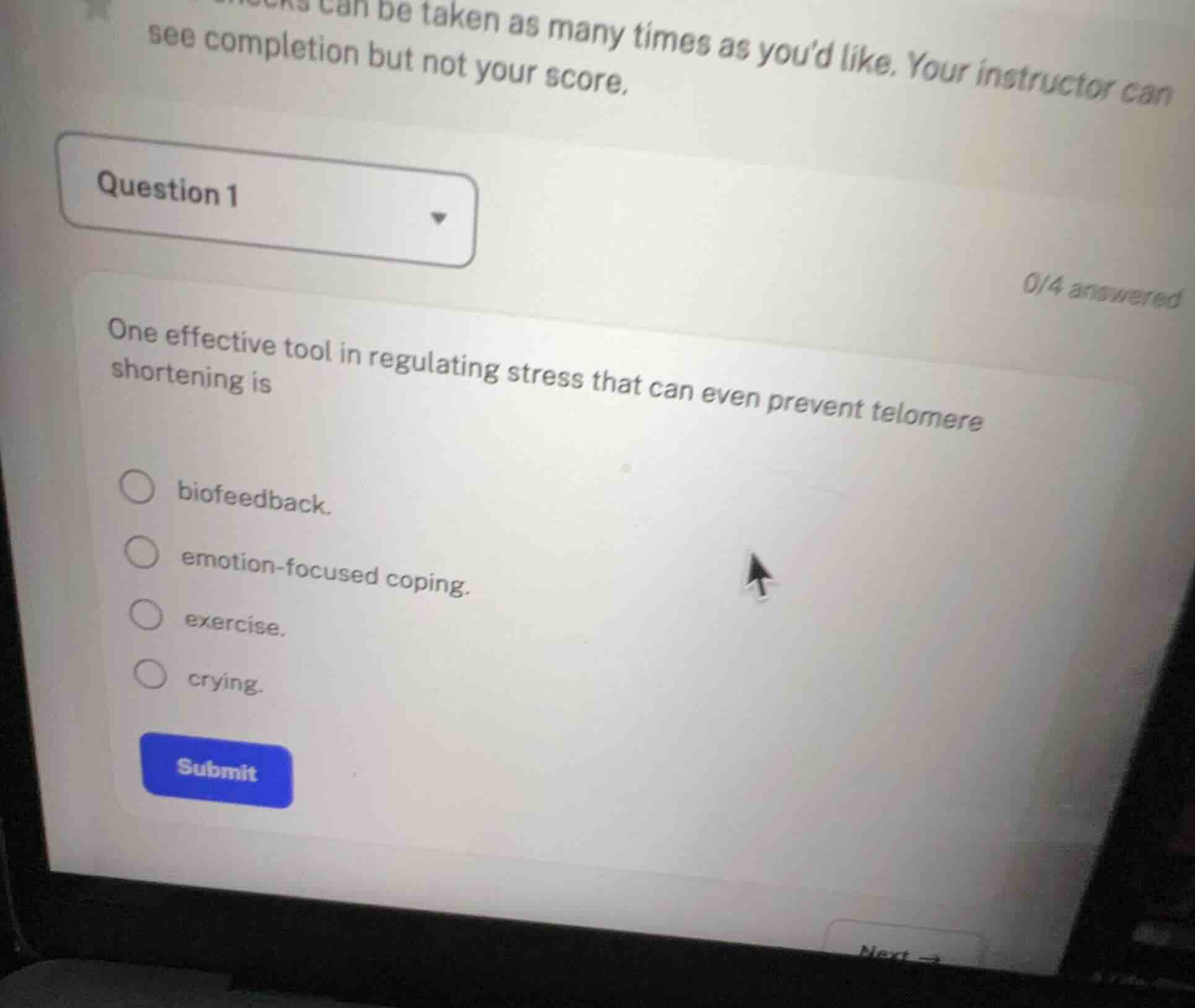
one effective tool in regulating stress that can even prevent telomere shortening is
biofeedback.
emotion-focused coping.
exercise.
crying.
<pre_analysis>
{
"quality": "clear",
"question_count": 1,
"skills_matched": [
"direct_cot",
"multiple_choice_formatter",
"explain_then_answer",
"tutor"
],
"needs_drawing": false,
"concepts_used": [],
"new_concepts": [
"Telomere Shortening",
"Stress Regulation Tools",
"Exercise and Stress"
],
"current_concepts": [
"Telomere Shortening",
"Stress Regulation Tools",
"Exercise and Stress"
]
}
</pre_analysis>
<reasoning>
Identify the core question
The question asks for an effective tool in regulating stress that has been shown to prevent telomere shortening. Telomeres are protective caps at the ends of chromosomes that naturally shorten with age and cellular aging, a process accelerated by chronic stress.
Analyze the physiological impact of stress on telomeres
Chronic psychological stress is associated with accelerated telomere shortening, which is a marker of cellular aging. Research in health psychology and psychoneuroimmunology has investigated various stress-reduction interventions to see if they can protect telomeres or even increase telomerase activity (the enzyme that rebuilds telomeres).
Evaluate the given options
- biofeedback: While helpful for learning to control physiological responses to stress (like heart rate), there is less robust evidence directly linking it to the prevention of telomere shortening compared to physical activity.
- emotion-focused coping: This coping style involves managing the emotional response to a stressor. While useful, it does not consistently show direct, biological prevention of telomere shortening in the same direct physical manner as aerobic exercise.
- exercise: Regular physical exercise, particularly aerobic exercise, has been strongly linked in clinical studies to longer telomeres and increased telomerase activity. Exercise mitigates the oxidative stress and inflammatory processes that accelerate telomere damage.
- crying: Crying is an emotional release but has no scientific evidence supporting a protective effect on telomere length.
Determine the correct answer
Based on scientific literature regarding stress, aging, and physical health, regular physical exercise is a highly documented lifestyle factor that helps regulate stress and directly protects against cellular aging by preventing telomere shortening.
</reasoning>
<answer>
<mcq-option>biofeedback.</mcq-option>
<mcq-option>emotion-focused coping.</mcq-option>
<mcq-correct>exercise.</mcq-correct>
<mcq-option>crying.</mcq-option>
</answer>
<post_analysis>
{
"subject": "Natural Science",
"question_type": "Multiple Choice",
"knowledge_point": [
"Natural Science",
"Psychology",
"Stress and Health"
]
}
</post_analysis>
Snap & solve any problem in the app
Get step-by-step solutions on Sovi AI
Photo-based solutions with guided steps
Explore more problems and detailed explanations
<pre_analysis>
{
"quality": "clear",
"question_count": 1,
"skills_matched": [
"direct_cot",
"multiple_choice_formatter",
"explain_then_answer",
"tutor"
],
"needs_drawing": false,
"concepts_used": [],
"new_concepts": [
"Telomere Shortening",
"Stress Regulation Tools",
"Exercise and Stress"
],
"current_concepts": [
"Telomere Shortening",
"Stress Regulation Tools",
"Exercise and Stress"
]
}
</pre_analysis>
<reasoning>
Identify the core question
The question asks for an effective tool in regulating stress that has been shown to prevent telomere shortening. Telomeres are protective caps at the ends of chromosomes that naturally shorten with age and cellular aging, a process accelerated by chronic stress.
Analyze the physiological impact of stress on telomeres
Chronic psychological stress is associated with accelerated telomere shortening, which is a marker of cellular aging. Research in health psychology and psychoneuroimmunology has investigated various stress-reduction interventions to see if they can protect telomeres or even increase telomerase activity (the enzyme that rebuilds telomeres).
Evaluate the given options
- biofeedback: While helpful for learning to control physiological responses to stress (like heart rate), there is less robust evidence directly linking it to the prevention of telomere shortening compared to physical activity.
- emotion-focused coping: This coping style involves managing the emotional response to a stressor. While useful, it does not consistently show direct, biological prevention of telomere shortening in the same direct physical manner as aerobic exercise.
- exercise: Regular physical exercise, particularly aerobic exercise, has been strongly linked in clinical studies to longer telomeres and increased telomerase activity. Exercise mitigates the oxidative stress and inflammatory processes that accelerate telomere damage.
- crying: Crying is an emotional release but has no scientific evidence supporting a protective effect on telomere length.
Determine the correct answer
Based on scientific literature regarding stress, aging, and physical health, regular physical exercise is a highly documented lifestyle factor that helps regulate stress and directly protects against cellular aging by preventing telomere shortening.
</reasoning>
<answer>
<mcq-option>biofeedback.</mcq-option>
<mcq-option>emotion-focused coping.</mcq-option>
<mcq-correct>exercise.</mcq-correct>
<mcq-option>crying.</mcq-option>
</answer>
<post_analysis>
{
"subject": "Natural Science",
"question_type": "Multiple Choice",
"knowledge_point": [
"Natural Science",
"Psychology",
"Stress and Health"
]
}
</post_analysis>