QUESTION IMAGE
Question
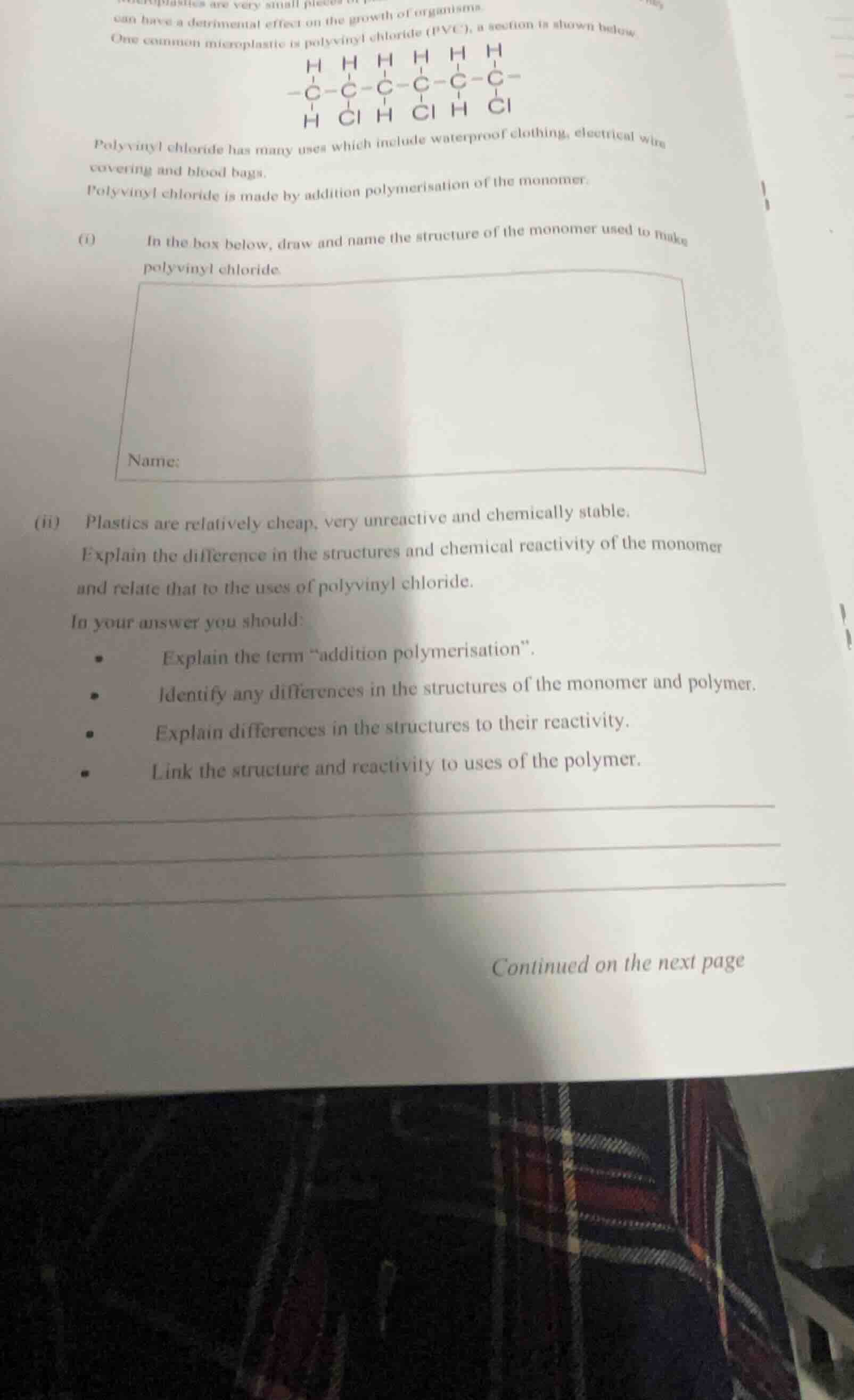
one common microplastic is polyvinyl chloride (pvc), a section is shown below.
polyvinyl chloride has many uses which include waterproof clothing, electrical wire covering and blood bags.
polyvinyl chloride is made by addition polymerisation of the monomer.
(i) in the box below, draw and name the structure of the monomer used to make polyvinyl chloride.
name:
(ii) plastics are relatively cheap, very unreactive and chemically stable.
explain the difference in the structures and chemical reactivity of the monomer and relate that to the uses of polyvinyl chloride.
in your answer you should:
- explain the term \addition polymerisation\.
- identify any differences in the structures of the monomer and polymer.
- explain differences in the structures to their reactivity.
- link the structure and reactivity to uses of the polymer.
Identify the monomer structure and name
$$
\text{Monomer: chloroethene (vinyl chloride)}
$$
$$
\text{Structure: } \text{CH}_2=\text{CHCl}
$$
Explain addition polymerisation and structural differences
$$
\text{Addition polymerisation: Monomers join without losing atoms to form a long chain.}
$$
$$
\text{Monomer has a reactive } \text{C}=\text{C} \text{ double bond (unsaturated).}
$$
$$
\text{Polymer has only } \text{C}-\text{C} \text{ single bonds (saturated).}
$$
Relate structure and reactivity to uses
$$
\text{Monomer is highly reactive due to the weak } \pi \text{-bond in } \text{C}=\text{C}.
$$
$$
\text{Polymer is unreactive (chemically stable) because } \text{C}-\text{C} \text{ and } \text{C}-\text{H} \text{ single bonds are strong and stable.}
$$
$$
\text{This stability makes PVC durable and waterproof, suitable for clothing, wire insulation, and blood bags.}
$$

Snap & solve any problem in the app
Get step-by-step solutions on Sovi AI
Photo-based solutions with guided steps
Explore more problems and detailed explanations
Question (i)
- Structure of the monomer:
$$
LATEXBLOCK0
$$
- Name: Chloroethene (or vinyl chloride)
---
Question (ii)
- Addition polymerisation: A process where many small, unsaturated monomer molecules join together to form a long-chain polymer molecule, with no other products formed.
- Structural differences: The monomer (chloroethene) contains a carbon-to-carbon double bond (\(\text{C}=\text{C}\)) and is unsaturated. The polymer (polyvinyl chloride) contains only carbon-to-carbon single bonds (\(\text{C}-\text{C}\)) in a long, saturated carbon chain.
- Structure and reactivity: The monomer is highly reactive because the double bond (\(\text{C}=\text{C}\)) can easily open up to undergo addition reactions. The polymer is highly unreactive and chemically stable because it contains only strong, stable single covalent bonds (\(\text{C}-\text{C}\), \(\text{C}-\text{H}\), and \(\text{C}-\text{Cl}\)) which require a large amount of energy to break.
- Link to uses: Because the polymer is chemically unreactive, stable, and waterproof, it does not react with water, chemicals, or body fluids. This makes it ideal for durable, long-lasting applications such as waterproof clothing, electrical wire insulation (preventing conduction and degradation), and medical blood bags.