QUESTION IMAGE
Question
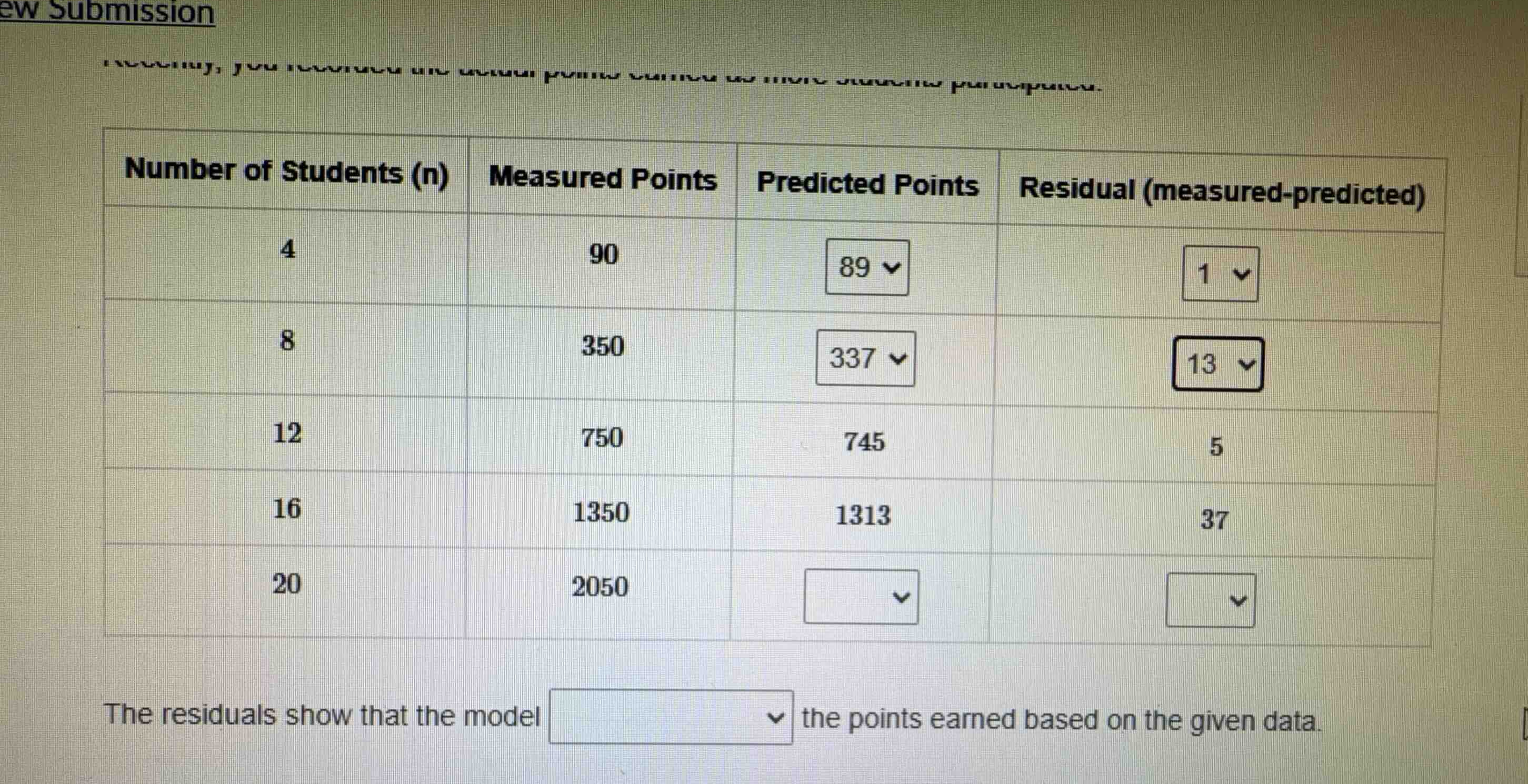
number of students (n) | measured points | predicted points | residual (measured-predicted)
4 | 90 | 89 | 1
8 | 350 | 337 | 13
12 | 750 | 745 | 5
16 | 1350 | 1313 | 37
20 | 2050 | |
the residuals show that the model the points earned based on the given data.
Identify the quadratic model
Using the Quadratic Modeling knowledge point
We need to find the quadratic model \(P(n) = an^2 + bn + c\) that relates the number of students \(n\) to the predicted points \(P(n)\).
Using the given predicted points:
For \(n = 12\), \(P(12) = 745\)
For \(n = 16\), \(P(16) = 1313\)
For \(n = 4\), \(P(4) = 89\)
Let's set up the system of equations:
- \(16a + 4b + c = 89\)
- \(144a + 12b + c = 745\)
- \(256a + 16b + c = 1313\)
Subtracting (1) from (2):
\(128a + 8b = 656 \implies 16a + b = 82\)
Subtracting (2) from (3):
\(112a + 4b = 568 \implies 28a + b = 142\)
Subtracting these two simplified equations:
\(12a = 60 \implies a = 5\)
Substitute \(a = 5\) back:
\(16(5) + b = 82 \implies 80 + b = 82 \implies b = 2\)
Substitute \(a = 5\) and \(b = 2\) into (1):
\(16(5) + 4(2) + c = 89 \implies 80 + 8 + c = 89 \implies c = 1\)
Thus, the quadratic model is:
Let's verify for \(n = 8\):
This matches the table value of 337.
Calculate predicted points for n = 20
Using the Quadratic Modeling knowledge point
We calculate the predicted points for \(n = 20\) using our model:
Calculate residual for n = 20
Using the Residual Calculation knowledge point
The residual is defined as:
For \(n = 20\):
Analyze the model performance
Using the Residual Calculation knowledge point
We examine the sign of all the residuals in the table:
- For \(n = 4\): \(\text{Residual} = 1 > 0\)
- For \(n = 8\): \(\text{Residual} = 13 > 0\)
- For \(n = 12\): \(\text{Residual} = 5 > 0\)
- For \(n = 16\): \(\text{Residual} = 37 > 0\)
- For \(n = 20\): \(\text{Residual} = 9 > 0\)
Since all residuals are positive, the measured values are consistently greater than the predicted values. This means the model consistently underpredicts (underestimates) the points earned.

Snap & solve any problem in the app
Get step-by-step solutions on Sovi AI
Photo-based solutions with guided steps
Explore more problems and detailed explanations
- Predicted Points for \(n = 20\): 2041
- Residual for \(n = 20\): 9
- Model evaluation statement: The residuals show that the model underestimates the points earned based on the given data.