QUESTION IMAGE
Question
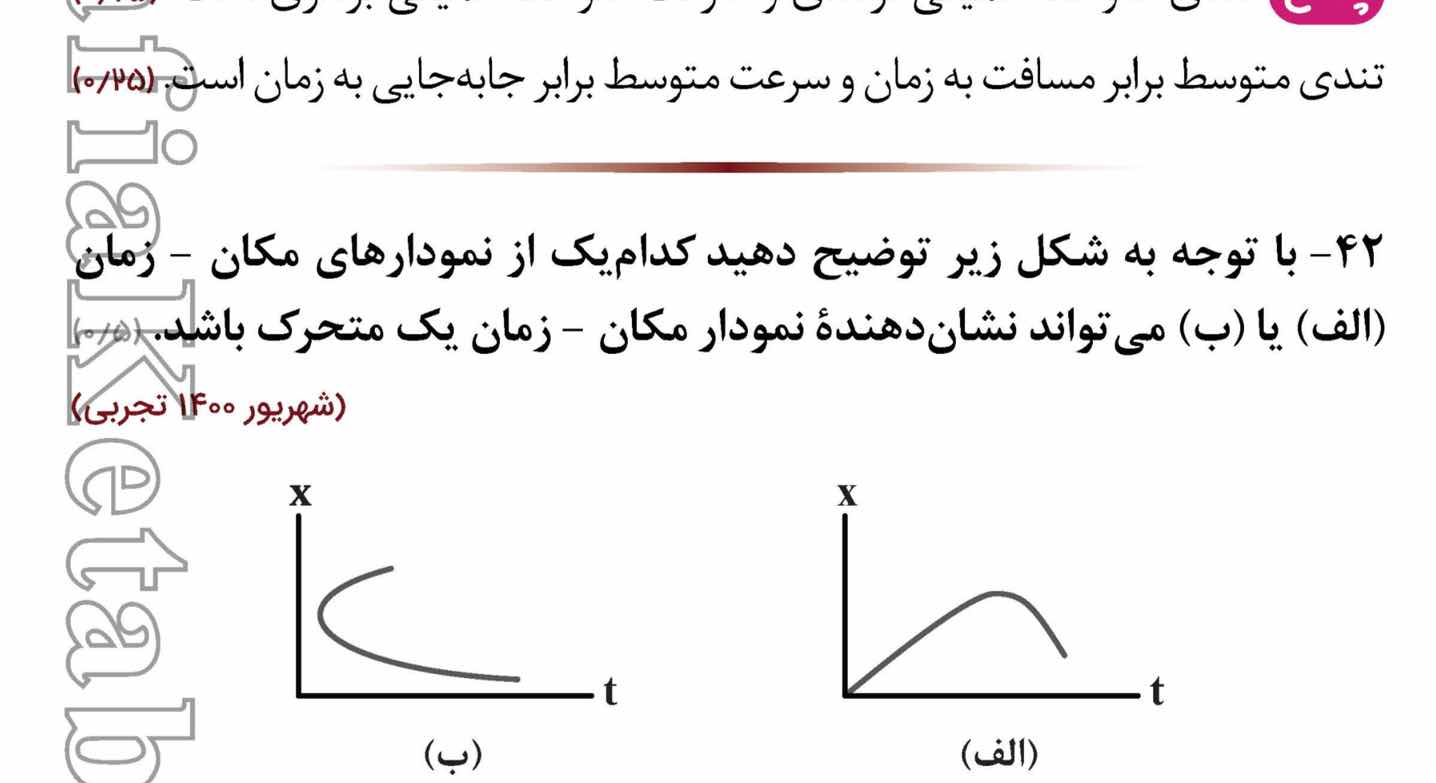
۴۲- با توجه به شکل زیر توضیح دهید کدام یک از نمودارهای مکان - زمان (الف) یا (ب) می تواند نشان دهنده نمودار مکان - زمان یک متحرک باشد.
Translate the question
The Persian text translates to:
"42- With respect to the figure below, explain which of the position-time graphs (a) or (b) can represent the position-time graph of a moving object."
Here, graph (الف) corresponds to (a) on the right, and graph (ب) corresponds to (b) on the left.
Analyze graph (a)
In graph (a), for every value of time \(t\) on the horizontal axis, there is exactly one corresponding position \(x\) on the vertical axis. Time flows forward, and the object occupies a single position at any given instant. This represents a physically possible motion.
Analyze graph (b)
In graph (b), the curve bends backward. If we draw a vertical line at a given time \(t\), it intersects the curve at more than one point. This means that at a single instant in time, the object would have to be in two different positions simultaneously, which is physically impossible.
Formulate the conclusion
Graph (a) is a valid position-time graph because position is a single-valued function of time. Graph (b) is invalid because an object cannot occupy multiple positions at the same instant.
In a position-time graph, position must be a single-valued function of time, meaning that at any given instant \(t\), a moving object can only occupy exactly one position \(x\).
- Graph (a) / (الف): For every value of time \(t\), there is only one corresponding position \(x\). This is physically possible.
- Graph (b) / (ب): A vertical line drawn through the graph intersects the curve at more than one point, meaning the object would occupy multiple positions at the same instant in time, which is physically impossible.
</answer>

Snap & solve any problem in the app
Get step-by-step solutions on Sovi AI
Photo-based solutions with guided steps
Explore more problems and detailed explanations
Graph (a) (labeled الف) can represent the position-time graph of a moving object.
Explanation:
In a position-time graph, position must be a single-valued function of time, meaning that at any given instant \(t\), a moving object can only occupy exactly one position \(x\).
- Graph (a) / (الف): For every value of time \(t\), there is only one corresponding position \(x\). This is physically possible.
- Graph (b) / (ب): A vertical line drawn through the graph intersects the curve at more than one point, meaning the object would occupy multiple positions at the same instant in time, which is physically impossible.