QUESTION IMAGE
Question
naming ionic & covalent compounds
name
Identify the compound types
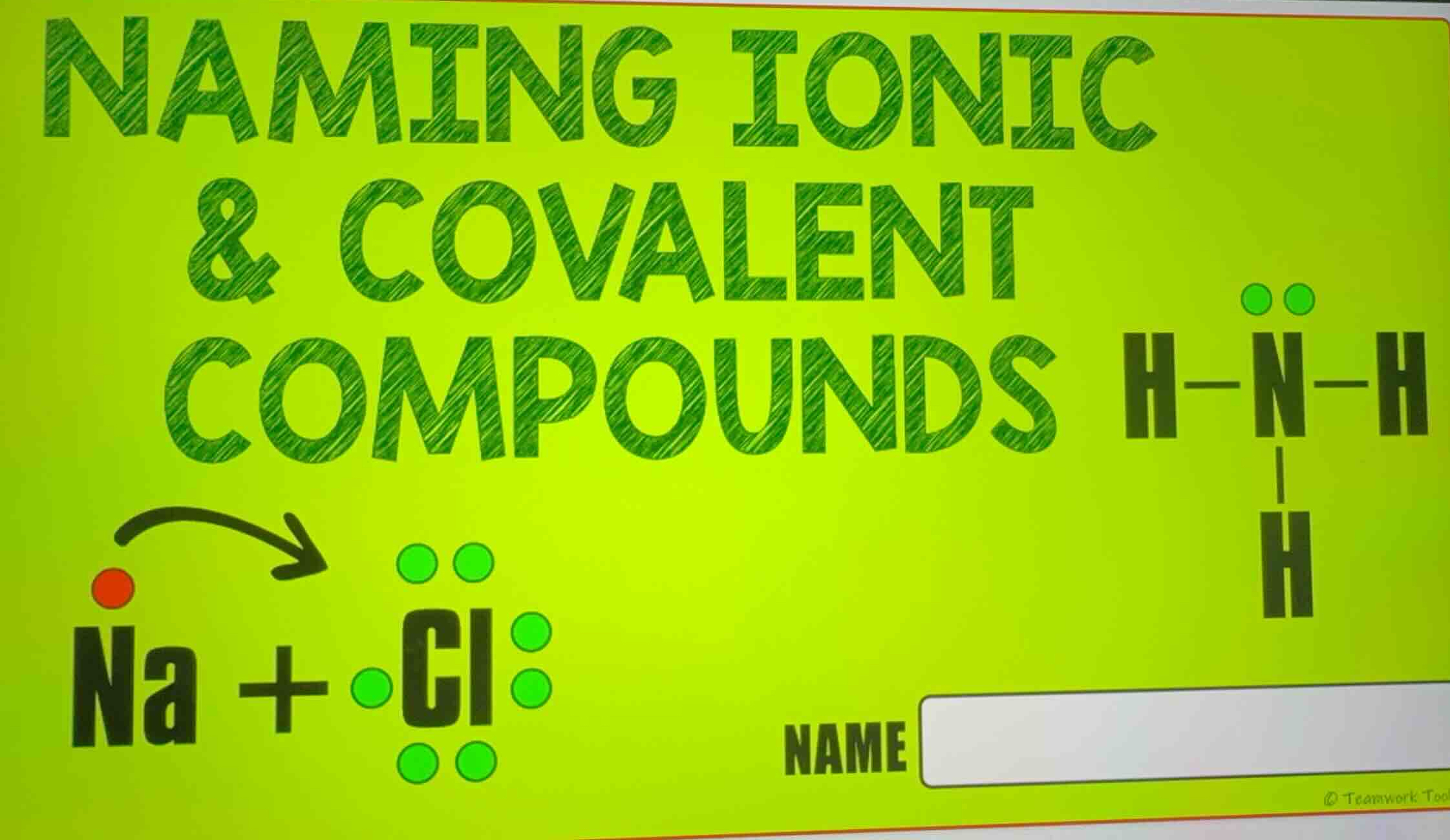
The title slide introduces naming ionic and covalent compounds.
The left diagram shows electron transfer from sodium (\(\text{Na}\)) to chlorine (\(\text{Cl}\)), representing ionic bonding.
The right diagram shows shared electron pairs between nitrogen (\(\text{N}\)) and hydrogen (\(\text{H}\)), representing covalent bonding.
Explain ionic nomenclature
Ionic compounds consist of metals and nonmetals.
The metal cation is named first, keeping its elemental name.
The nonmetal anion is named second, changing its ending to "-ide".
For example, \(\text{NaCl}\) is named sodium chloride.
Explain covalent nomenclature
Covalent compounds consist of nonmetals sharing electrons.
Greek prefixes (mono-, di-, tri-, tetra-, etc.) indicate the number of atoms.
The first element keeps its name (with a prefix if more than one).
The second element gets a prefix and its ending changes to "-ide".
For example, \(\text{NH}_3\) is named nitrogen trihydride (commonly known as ammonia).

Snap & solve any problem in the app
Get step-by-step solutions on Sovi AI
Photo-based solutions with guided steps
Explore more problems and detailed explanations
This title slide introduces the fundamental rules for Naming Ionic and Covalent Compounds:
- Ionic Compounds (represented by the transfer of an electron from \(\text{Na}\) to \(\text{Cl}\) on the left):
- Name the metal cation first using its elemental name.
- Name the nonmetal anion second, changing its ending to -ide.
- Example: \(\text{NaCl}\) is named sodium chloride.
- Covalent Compounds (represented by the shared bonds in ammonia, \(\text{NH}_3\), on the right):
- Use Greek prefixes (mono-, di-, tri-, etc.) to specify the number of atoms of each element.
- Name the first element using its full name (omit "mono-" if there is only one).
- Name the second element using a prefix and change its ending to -ide.
- Example: \(\text{NH}_3\) is systematically named nitrogen trihydride (ammonia).