QUESTION IMAGE
Question
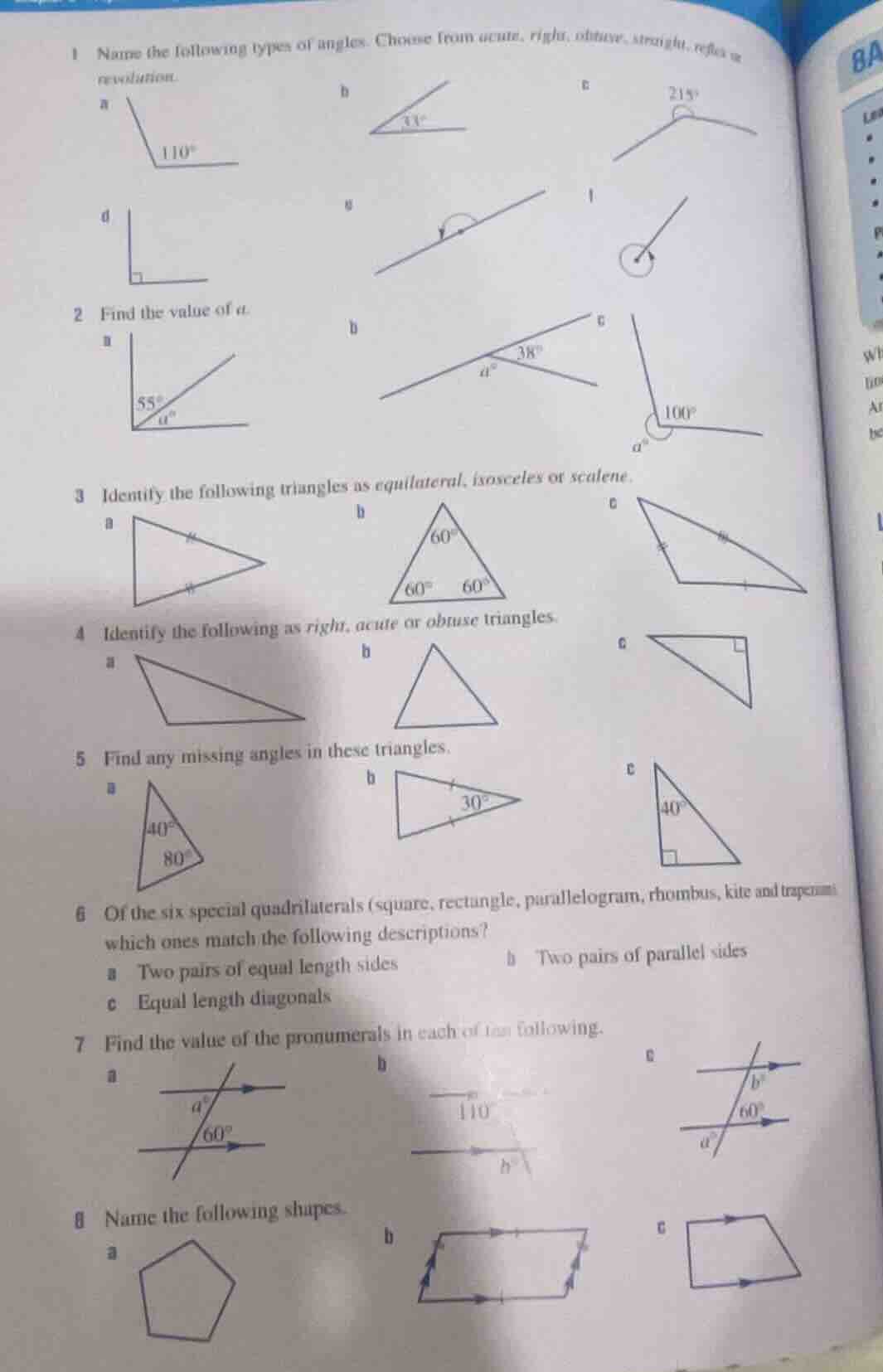
1 name the following types of angles. choose from acute, right, obtuse, straight, reflex or revolution.
2 find the value of (a).
3 identify the following triangles as equilateral, isosceles or scalene.
4 identify the following as right, acute or obtuse triangles.
5 find any missing angles in these triangles.
6 of the six special quadrilaterals (square, rectangle, parallelogram, rhombus, kite and trapezium), which ones match the following descriptions?
a two pairs of equal length sides
b two pairs of parallel sides
c equal length diagonals
7 find the value of the pronumerals in each of the following.
8 name the following shapes.
Classify angles in Question 1
We classify each angle based on its measure:
- a: \(110^\circ\) is between \(90^\circ\) and \(180^\circ\), which is obtuse.
- b: \(33^\circ\) is between \(0^\circ\) and \(90^\circ\), which is acute.
- c: \(215^\circ\) is between \(180^\circ\) and \(360^\circ\), which is reflex.
- d: The square symbol indicates a right angle (\(90^\circ\)).
- e: A straight line represents a straight angle (\(180^\circ\)).
- f: A full circle represents a revolution (\(360^\circ\)).
Solve for unknowns in Question 2
We apply geometric angle relationships:
- a: The two angles form a right angle (\(90^\circ\)):
- b: Vertically opposite angles are equal:
- c: Angles on a straight line add up to \(180^\circ\), or angles at a point add up to \(360^\circ\). Here, the straight line is split by the \(100^\circ\) angle and \(a^\circ\):
Classify triangles in Question 3 and 4
We classify triangles by side lengths and angles:
- 3a: Two sides are marked equal, so it is isosceles.
- 3b: All three angles are \(60^\circ\), so it is equilateral.
- 3c: All three sides have different lengths, so it is scalene.
- 4a: One angle is clearly greater than \(90^\circ\), so it is obtuse.
- 4b: All angles are less than \(90^\circ\), so it is acute.
- 4c: One angle is marked with a right-angle square, so it is right.
Find missing angles in Question 5
The sum of interior angles in any triangle is \(180^\circ\):
- a: Let the missing angle be \(x\):
- b: The triangle is a right-angled triangle (indicated by the square symbol):
- c: The triangle is a right-angled triangle:
Identify quadrilaterals and parallel lines in Questions 6, 7, and 8
For Question 6, we match descriptions to special quadrilaterals:
- a (Two pairs of equal length sides): Parallelogram, rectangle, square, rhombus, kite.
- b (Two pairs of parallel sides): Parallelogram, rectangle, square, rhombus.
- c (Equal length diagonals): Rectangle, square.
For Question 7, we use parallel line angle properties:
- a: Vertically opposite angles are equal, so \(a = 60\).
- b: Co-interior angles add up to \(180^\circ\):
- c: Vertically opposite angles give \(a = 60\). Alternate angles give \(b = 60\).
For Question 8, we name the polygons:
- a: A five-sided polygon is a pentagon.
- b: A quadrilateral with two pairs of parallel sides is a parallelogram.
- c: A quadrilateral with one pair of parallel sides is a trapezium.

Snap & solve any problem in the app
Get step-by-step solutions on Sovi AI
Photo-based solutions with guided steps
Explore more problems and detailed explanations
Question 1
- a: Obtuse
- b: Acute
- c: Reflex
- d: Right
- e: Straight
- f: Revolution
Question 2
- a: \(a = 35\)
- b: \(a = 38\)
- c: \(a = 80\)
Question 3
- a: Isosceles
- b: Equilateral
- c: Scalene
Question 4
- a: Obtuse
- b: Acute
- c: Right
Question 5
- a: \(60^\circ\)
- b: \(60^\circ\)
- c: \(50^\circ\)
Question 6
- a: Parallelogram, rectangle, square, rhombus, kite
- b: Parallelogram, rectangle, square, rhombus
- c: Rectangle, square
Question 7
- a: \(a = 60\)
- b: \(b = 70\)
- c: \(a = 60\), \(b = 60\)
Question 8
- a: Pentagon
- b: Parallelogram
- c: Trapezium