QUESTION IMAGE
Question
name ____ class ____
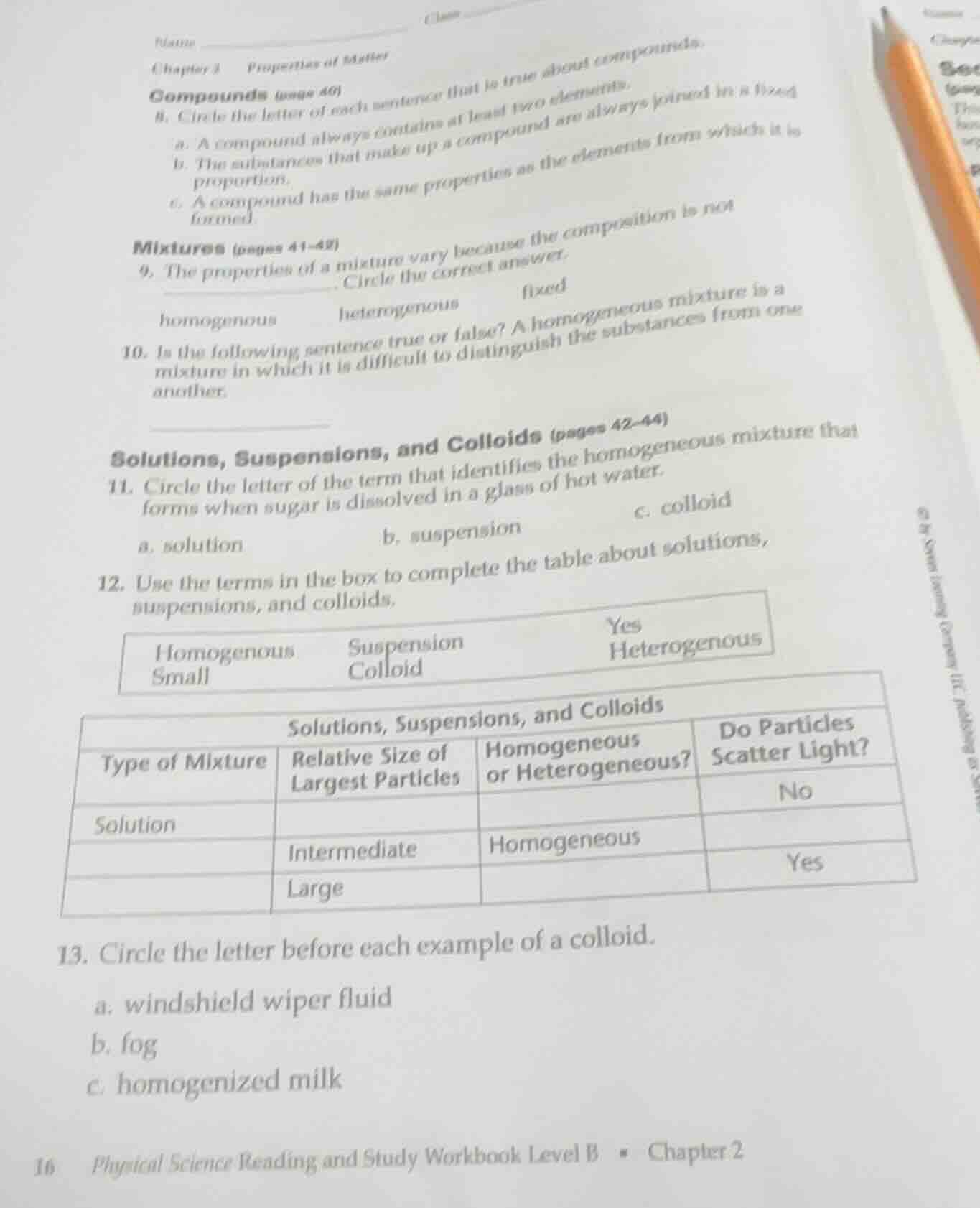
chapter 2 properties of matter
compounds (page 40)
- circle the letter of each sentence that is true about compounds.
a. a compound always contains at least two elements.
b. the substances that make up a compound are always joined in a fixed proportion.
c. a compound has the same properties as the elements from which it is formed.
mixtures (pages 41-42)
- the properties of a mixture vary because the composition is not ______. circle the correct answer.
homogenous | heterogenous | fixed
- is the following sentence true or false? a homogeneous mixture is a mixture in which it is difficult to distinguish the substances from one another.
solutions, suspensions, and colloids (pages 42-44)
- circle the letter of the term that identifies the homogeneous mixture that forms when sugar is dissolved in a glass of hot water.
a. solution
b. suspension
c. colloid
- use the terms in the box to complete the table about solutions, suspensions, and colloids.
homogenous | suspension | yes
small | colloid | heterogenous
solutions, suspensions, and colloids
type of mixture | relative size of largest particles | homogeneous or heterogeneous? | do particles scatter light?
solution | | | no
| intermediate | homogeneous | |
| large | yes |
- circle the letter before each example of a colloid.
a. windshield wiper fluid
b. fog
c. homogenized milk
Analyze questions 8 to 10
Analyze questions 11 to 13

Snap & solve any problem in the app
Get step-by-step solutions on Sovi AI
Photo-based solutions with guided steps
Explore more problems and detailed explanations
Question 8
Circle the letter of each sentence that is true about compounds.
- a. A compound always contains at least two elements.
- b. The substances that make up a compound are always joined in a fixed proportion.
Question 9
The properties of a mixture vary because the composition is not fixed.
Question 10
Is the following sentence true or false? A homogeneous mixture is a mixture in which it is difficult to distinguish the substances from one another.
true
Question 11
Circle the letter of the term that identifies the homogeneous mixture that forms when sugar is dissolved in a glass of hot water.
- a. solution
Question 12
| Type of Mixture | Relative Size of Largest Particles | Homogeneous or Heterogeneous? | Do Particles Scatter Light? |
|---|---|---|---|
| Colloid | Intermediate | Homogeneous | Yes |
| Suspension | Large | Heterogeneous | Yes |
Question 13
Circle the letter before each example of a colloid.
- b. fog
- c. homogenized milk