QUESTION IMAGE
Question
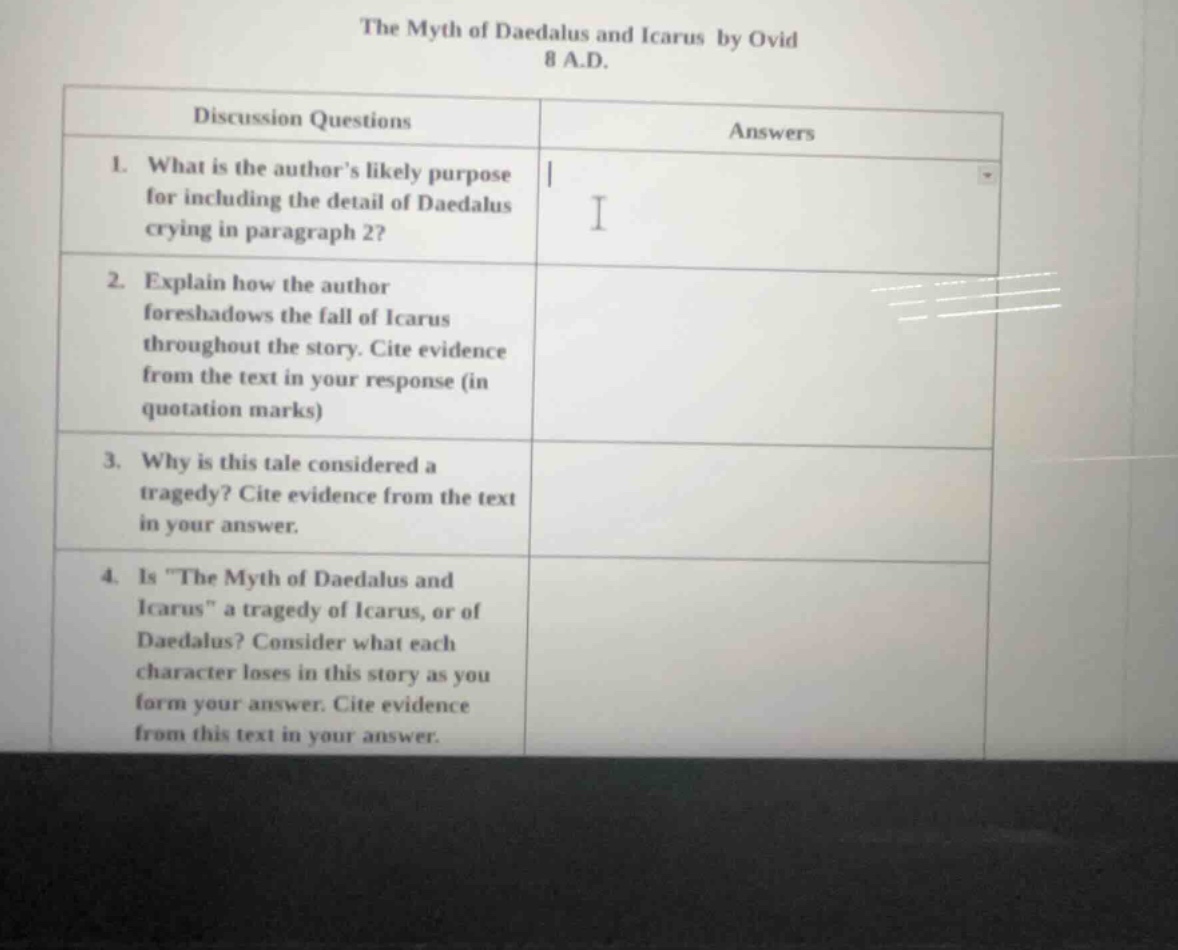
the myth of daedalus and icarus by ovid
8 a.d.
discussion questions
- what is the authors likely purpose for including the detail of daedalus crying in paragraph 2?
- explain how the author foreshadows the fall of icarus throughout the story. cite evidence from the text in your response (in quotation marks)
- why is this tale considered a tragedy? cite evidence from the text in your answer.
- is \the myth of daedalus and icarus\ a tragedy of icarus, or of daedalus? consider what each character loses in this story as you form your answer. cite evidence from this text in your answer.
Authorial purpose of Daedalus crying
Using the Authorial Purpose knowledge point
- The detail of Daedalus crying ("the cheeks of the father were wet with tears") humanizes the brilliant inventor.
- It emphasizes his paternal love and highlights his deep, instinctual dread for his son's safety before they fly.
Foreshadowing the fall of Icarus
Using the Foreshadowing knowledge point
- The author foreshadows the fall through the preparation of the wings and the father's warnings.
- Key evidence: Daedalus warns Icarus to "fly in the middle path" because if he goes too high, "the sun will scorch" the feathers.
- Additional evidence: While fitting the wings on Icarus, Daedalus's hands tremble, signaling impending doom.
Classification as a tragedy
Using the Classical Tragedy knowledge point
- The tale is a tragedy because it depicts a high-status character's downfall due to hubris (pride/overconfidence).
- Key evidence: Icarus is "carried away by a desire for heaven" and flies too high, leading directly to his death in the sea.
Tragedy of Icarus or Daedalus
Using the Literary Analysis knowledge point
- It is a tragedy for both, but fundamentally it is the tragedy of Daedalus.
- Daedalus loses his only son due to his own creation: "the unhappy father, no longer a father, called out 'Icarus, where are you?'"
- Icarus loses his life, but Daedalus must live with the eternal grief and guilt of his technological hubris.

Snap & solve any problem in the app
Get step-by-step solutions on Sovi AI
Photo-based solutions with guided steps
Explore more problems and detailed explanations
Question 1
The author includes the detail of Daedalus crying to emphasize his paternal love and his deep, instinctual dread for his son's safety, humanizing the brilliant inventor before their flight.
Question 2
The author foreshadows the fall of Icarus through Daedalus's explicit warnings and physical anxiety. For example, Daedalus warns Icarus to "fly in the middle path" so that "the sun will scorch" the feathers, and as he fits the wings, "the hands of the father trembled."
Question 3
The tale is considered a tragedy because it depicts a catastrophic downfall resulting from hubris and a disregard for natural limits. This is shown when Icarus, "carried away by a desire for heaven," flies too close to the sun, causing the wax to melt and leading to his fatal plunge into the sea.
Question 4
While it is a physical tragedy for Icarus who loses his life, it is ultimately the tragedy of Daedalus, who must live with the grief of losing his son to his own invention. This is highlighted when the "unhappy father, no longer a father," searches for his son and curses his own artistic skills ("cursed his own arts").