QUESTION IMAGE
Question
the myth of daedalus and icarus by ovid
8 a.d.
discussion questions
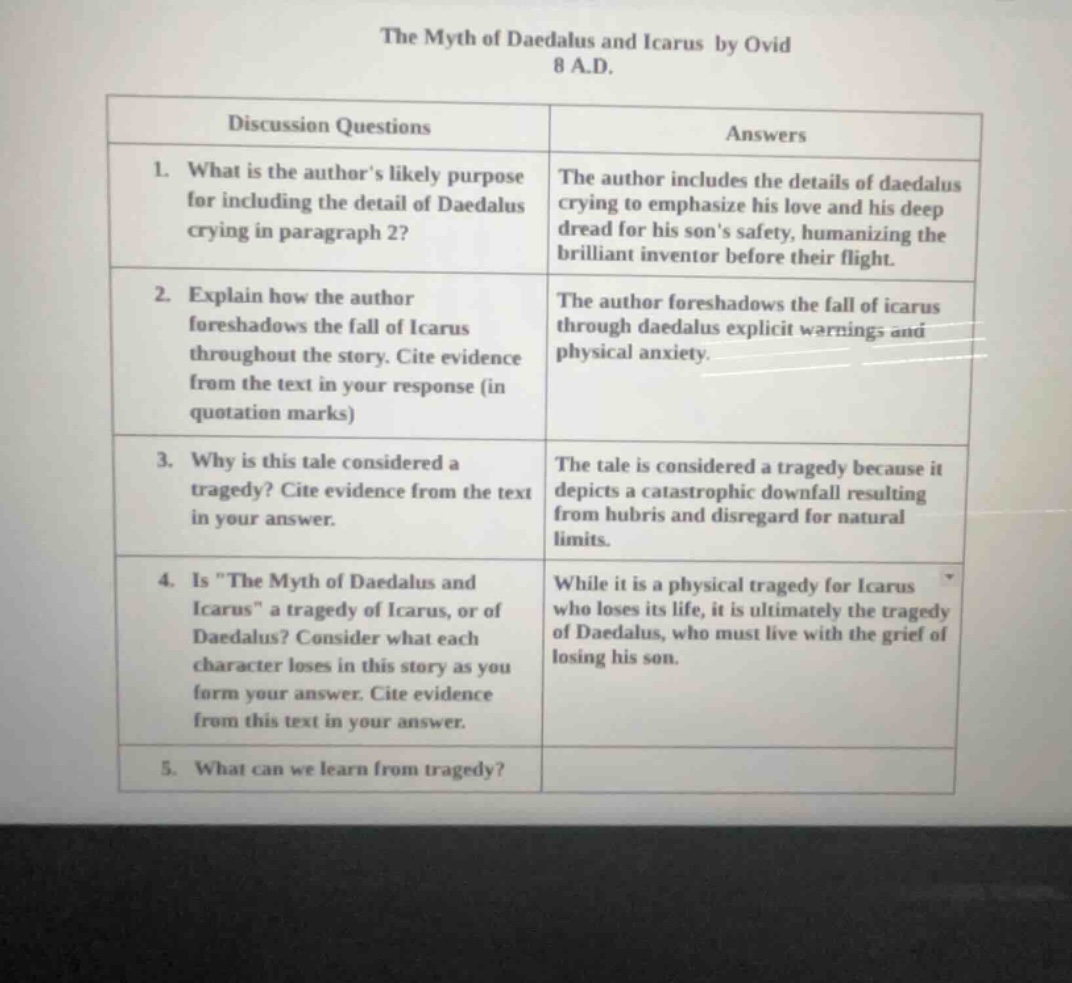
- what is the authors likely purpose for including the detail of daedalus crying in paragraph 2?
- explain how the author foreshadows the fall of icarus throughout the story. cite evidence from the text in your response (in quotation marks)
- why is this tale considered a tragedy? cite evidence from the text in your answer.
- is \the myth of daedalus and icarus\ a tragedy of icarus, or of daedalus? consider what each character loses in this story as you form your answer. cite evidence from this text in your answer.
- what can we learn from tragedy?
Analyze the unanswered prompt
The table lists five discussion questions based on "The Myth of Daedalus and Icarus" by Ovid. The first four questions have completed answers in the right-hand column, while Question 5, "What can we learn from tragedy?", is left blank. The goal is to provide a thoughtful, high-school-level response to this final question.
Connect to classical tragedy
Using the Classical Tragedy knowledge point, we understand that tragedy serves a deeper purpose than merely depicting suffering. In classical literature, tragedy often acts as a cautionary tale about the consequences of overreaching human limitations, known as hubris.
Identify the moral lessons
Using the Authorial Purpose knowledge point, Ovid uses the tragic downfall of Icarus to convey universal truths. Tragedy teaches us the value of moderation, the necessity of listening to wise counsel, and the reality of natural boundaries that humans must respect.
Formulate the final response
We synthesize these ideas into a concise, meaningful answer for Question 5. Tragedy teaches us about human vulnerability, the importance of balance (the golden mean), and how suffering can lead to deeper wisdom and self-awareness.

Snap & solve any problem in the app
Get step-by-step solutions on Sovi AI
Photo-based solutions with guided steps
Explore more problems and detailed explanations
Tragedy teaches us the vital importance of moderation, humility, and respecting natural boundaries. By witnessing the catastrophic downfall of characters driven by hubris, we learn to recognize our own human limitations and the consequences of ignoring wise counsel. Ultimately, tragedy fosters empathy and provides deep moral lessons on how to navigate the delicate balance between ambition and caution in our own lives.