QUESTION IMAGE
Question
multiple choice question
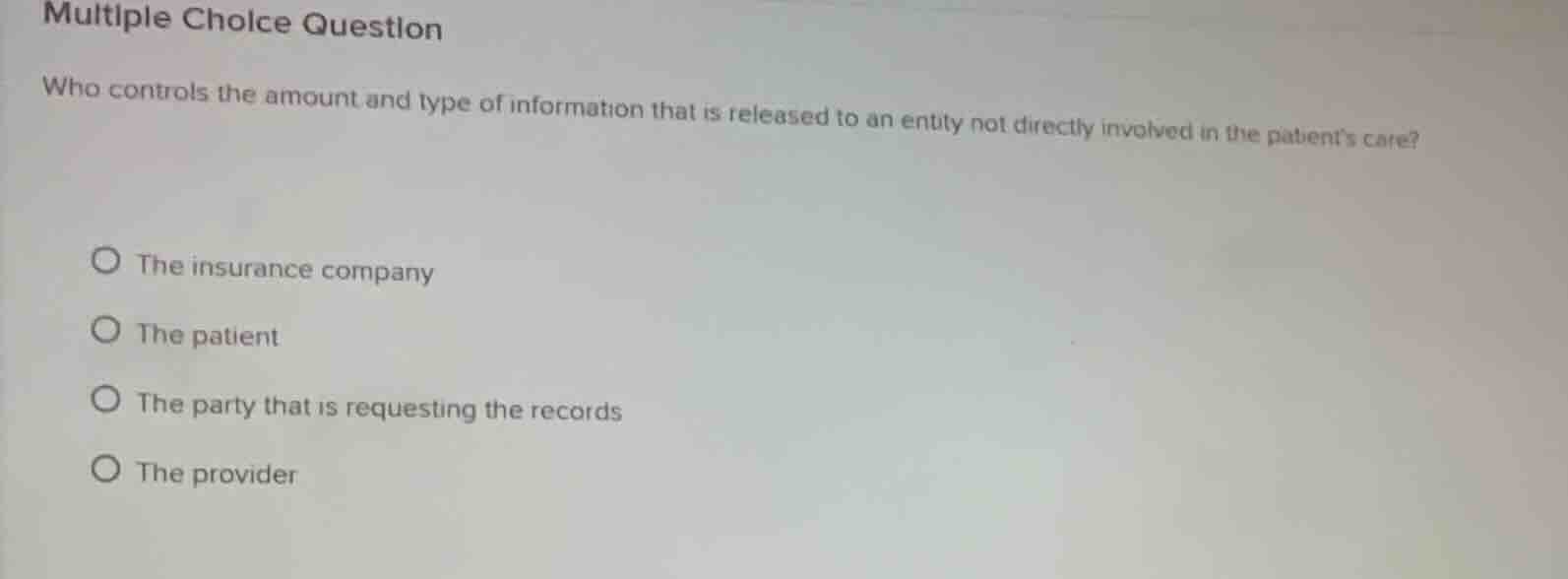
who controls the amount and type of information that is released to an entity not directly involved in the patients care?
- the insurance company
- the patient
- the party that is requesting the records
- the provider
<pre_analysis>
{
"quality": "clear",
"question_count": 1,
"skills_matched": [
"direct_cot",
"multiple_choice_formatter",
"explain_then_answer",
"tutor",
"mastery_adaptive_brevity"
],
"needs_drawing": false,
"concepts_used": [
"Patient Privacy Regulations"
],
"new_concepts": [],
"current_concepts": [
"Patient Privacy Regulations",
"Medical Record Ownership"
]
}
</pre_analysis>
<reasoning>
Analyze the core question
The question asks who controls the amount and type of medical information released to an external entity not directly involved in the patient's care.
Apply patient privacy principles
Using the Patient Privacy Regulations knowledge point:
Under HIPAA and standard medical privacy regulations, the patient holds the ultimate authority over their protected health information (PHI). While the healthcare provider physically owns the medical record, the patient controls who can access it and what specific information may be disclosed to third parties (such as employers, lawyers, or other non-treating entities) through written authorization.
Evaluate the given options
- The insurance company: They only receive information necessary for billing and payment, and do not control general disclosures.
- The patient: Holds the legal right to authorize and restrict the release of their personal health information to outside entities.
- The party that is requesting the records: The requester cannot dictate what is released without the patient's explicit consent.
- The provider: The provider maintains the physical records but must comply with the patient's authorization directives regarding third-party disclosures.
</reasoning>
<answer>
<mcq-option>The insurance company</mcq-option>
<mcq-correct>The patient</mcq-correct>
<mcq-option>The party that is requesting the records</mcq-option>
<mcq-option>The provider</mcq-option>
</answer>
<post_analysis>
{
"subject": "Others",
"question_type": "Multiple Choice",
"knowledge_point": [
"Others",
"Healthcare Administration",
"Patient Privacy Regulations"
]
}
</post_analysis>
Snap & solve any problem in the app
Get step-by-step solutions on Sovi AI
Photo-based solutions with guided steps
Explore more problems and detailed explanations
<pre_analysis>
{
"quality": "clear",
"question_count": 1,
"skills_matched": [
"direct_cot",
"multiple_choice_formatter",
"explain_then_answer",
"tutor",
"mastery_adaptive_brevity"
],
"needs_drawing": false,
"concepts_used": [
"Patient Privacy Regulations"
],
"new_concepts": [],
"current_concepts": [
"Patient Privacy Regulations",
"Medical Record Ownership"
]
}
</pre_analysis>
<reasoning>
Analyze the core question
The question asks who controls the amount and type of medical information released to an external entity not directly involved in the patient's care.
Apply patient privacy principles
Using the Patient Privacy Regulations knowledge point:
Under HIPAA and standard medical privacy regulations, the patient holds the ultimate authority over their protected health information (PHI). While the healthcare provider physically owns the medical record, the patient controls who can access it and what specific information may be disclosed to third parties (such as employers, lawyers, or other non-treating entities) through written authorization.
Evaluate the given options
- The insurance company: They only receive information necessary for billing and payment, and do not control general disclosures.
- The patient: Holds the legal right to authorize and restrict the release of their personal health information to outside entities.
- The party that is requesting the records: The requester cannot dictate what is released without the patient's explicit consent.
- The provider: The provider maintains the physical records but must comply with the patient's authorization directives regarding third-party disclosures.
</reasoning>
<answer>
<mcq-option>The insurance company</mcq-option>
<mcq-correct>The patient</mcq-correct>
<mcq-option>The party that is requesting the records</mcq-option>
<mcq-option>The provider</mcq-option>
</answer>
<post_analysis>
{
"subject": "Others",
"question_type": "Multiple Choice",
"knowledge_point": [
"Others",
"Healthcare Administration",
"Patient Privacy Regulations"
]
}
</post_analysis>