QUESTION IMAGE
Question
multiple choice question
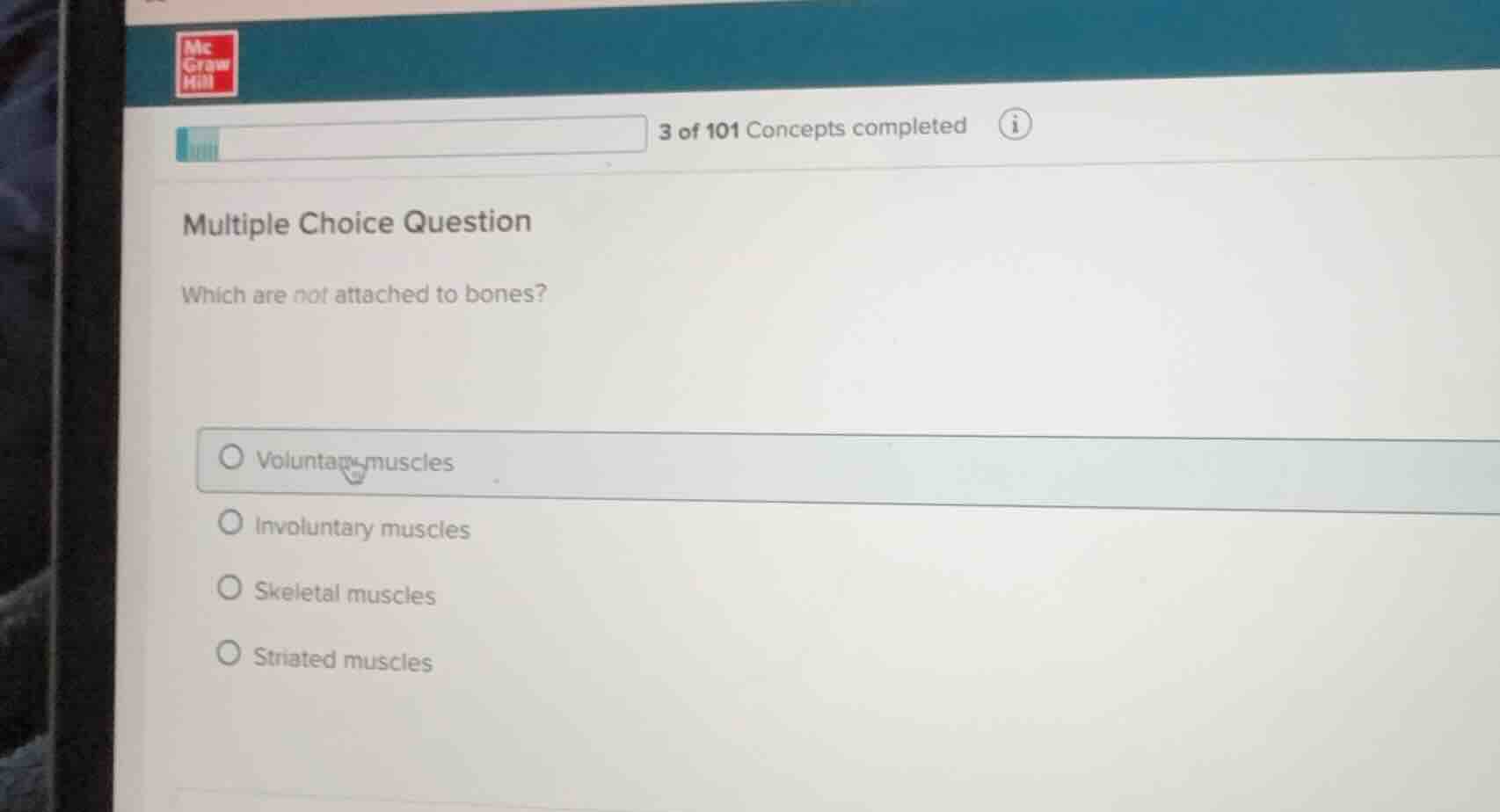
which are not attached to bones?
- voluntary muscles
- involuntary muscles
- skeletal muscles
- striated muscles
Analyze the question and options
The question asks: "Which are not attached to bones?"
We need to evaluate the four types of muscles listed in the options to determine which category is generally not attached to the skeletal system.
Evaluate skeletal and voluntary muscles
Using the Skeletal Muscle Properties and Voluntary Muscle Control knowledge points
Skeletal muscles are named for their primary location, which is attached to bones of the skeleton. Because skeletal muscles are under conscious control, they are also classified as voluntary muscles. Therefore, both skeletal muscles and voluntary muscles are typically attached to bones.
Evaluate striated muscles
Striated muscles include both skeletal muscle and cardiac muscle. While cardiac muscle is located in the heart wall and not attached to bones, the vast majority of striated muscle tissue in the body is skeletal muscle, which is attached to bones. Thus, "striated muscles" as a general category does not represent the group that is characteristically "not attached to bones."
Evaluate involuntary muscles
Using the Involuntary Muscle Control knowledge point
Involuntary muscles include smooth muscle and cardiac muscle. Smooth muscle is found in the walls of internal hollow organs (such as the stomach, intestines, and blood vessels), and cardiac muscle forms the contractile wall of the heart. Neither smooth muscle nor cardiac muscle is attached to bones. Therefore, involuntary muscles are the group that is not attached to bones.

Snap & solve any problem in the app
Get step-by-step solutions on Sovi AI
Photo-based solutions with guided steps
Explore more problems and detailed explanations
- Voluntary muscles
- Involuntary muscles (Correct answer)
- Skeletal muscles
- Striated muscles