QUESTION IMAGE
Question
multiple choice question
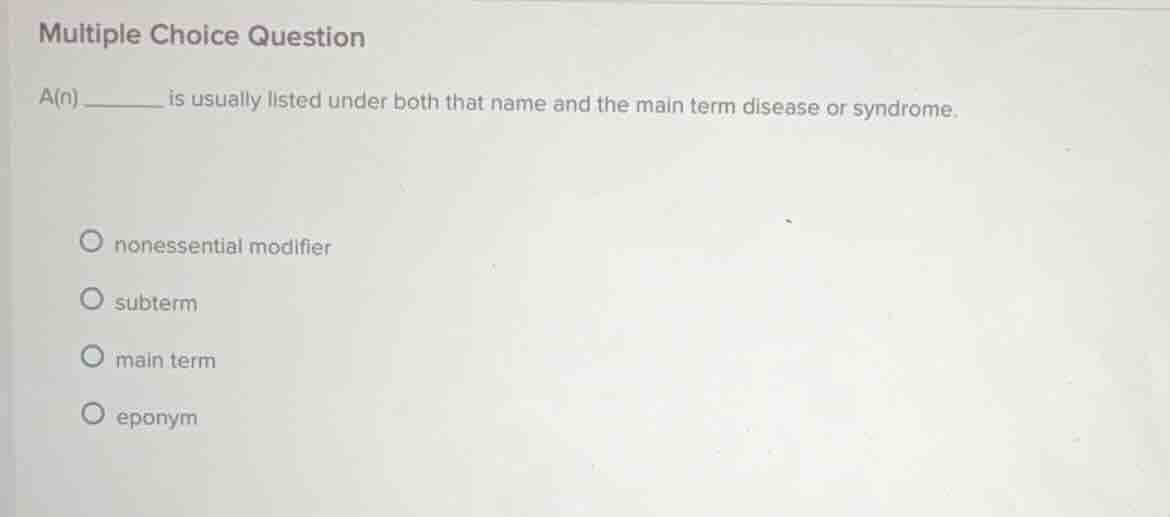
a(n) ______ is usually listed under both that name and the main term disease or syndrome.
- nonessential modifier
- subterm
- main term
- eponym
Analyze the question stem
The question asks to identify the term that is usually listed in the ICD-10-CM Alphabetic Index under both its own name and under the main term "disease" or "syndrome".
Evaluate the options
- nonessential modifier: These are supplementary words in parentheses that do not affect the code assignment. They are not listed as main terms in this manner.
- subterm: These are indented under main terms to describe essential differences (site, etiology, clinical type). They are not independent main terms listed under multiple locations in this way.
- main term: These are the primary entries in the Alphabetic Index (usually diseases, conditions, or injuries), but the definition in the stem specifically describes a sub-type of main term.
- eponym: An eponym is a disease, structure, or procedure named after a person (e.g., Crohn's disease, Down syndrome). In the ICD-10-CM Alphabetic Index, an Eponym Coding convention dictates that eponyms are indexed under both the eponym name itself (e.g., Crohn's) and under the main term "disease" or "syndrome" (e.g., Disease, Crohn's).
Confirm the correct concept
Using the Eponym Coding knowledge point, we know that medical conditions named after people (eponyms) are cross-referenced in the Alphabetic Index under both the name of the person and the general main term "disease" or "syndrome" to ensure coders can locate them easily.

Snap & solve any problem in the app
Get step-by-step solutions on Sovi AI
Photo-based solutions with guided steps
Explore more problems and detailed explanations
- nonessential modifier
- subterm
- main term
- eponym (Correct answer)