QUESTION IMAGE
Question
multiple choice question
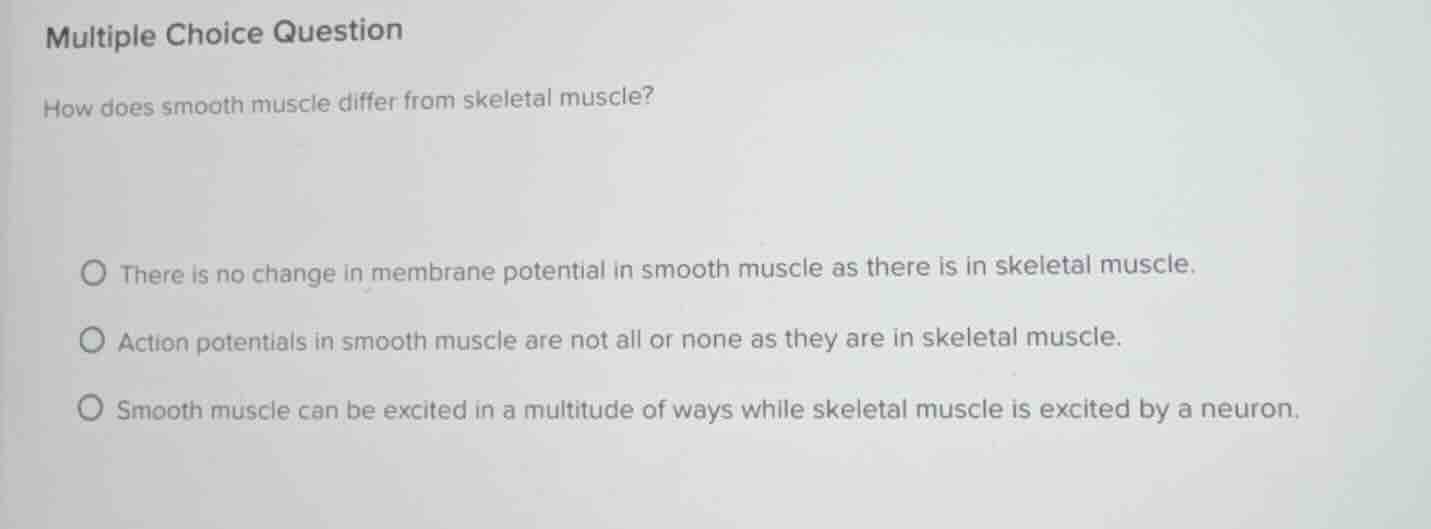
how does smooth muscle differ from skeletal muscle?
there is no change in membrane potential in smooth muscle as there is in skeletal muscle.
action potentials in smooth muscle are not all or none as they are in skeletal muscle.
smooth muscle can be excited in a multitude of ways while skeletal muscle is excited by a neuron.
Compare excitation mechanisms
Using the Smooth Muscle Characteristics and Muscle Excitation knowledge points:
- Skeletal muscle contraction is strictly neurogenic, requiring stimulation by a somatic motor neuron at the neuromuscular junction.
- Smooth muscle is myogenic and multi-stimulatory; it can be excited by autonomic nerves, hormones, local chemical factors (like pH, \(CO_2\), or \(O_2\) levels), temperature changes, or mechanical stretch.
- Both muscle types experience changes in membrane potential and exhibit action potentials.
Evaluate the given options
- Option 1: Incorrect. Smooth muscle cells undergo changes in membrane potential during excitation and contraction.
- Option 2: Incorrect. Action potentials in smooth muscle cells, when they occur, still follow an all-or-none physiological principle.
- Option 3: Correct. Smooth muscle can be stimulated by various chemical, mechanical, and hormonal signals, whereas skeletal muscle relies on neural excitation.

Snap & solve any problem in the app
Get step-by-step solutions on Sovi AI
Photo-based solutions with guided steps
Explore more problems and detailed explanations
- There is no change in membrane potential in smooth muscle as there is in skeletal muscle.
- Action potentials in smooth muscle are not all or none as they are in skeletal muscle.
- Smooth muscle can be excited in a multitude of ways while skeletal muscle is excited by a neuron. (Correct answer)