QUESTION IMAGE
Question
multiple choice question
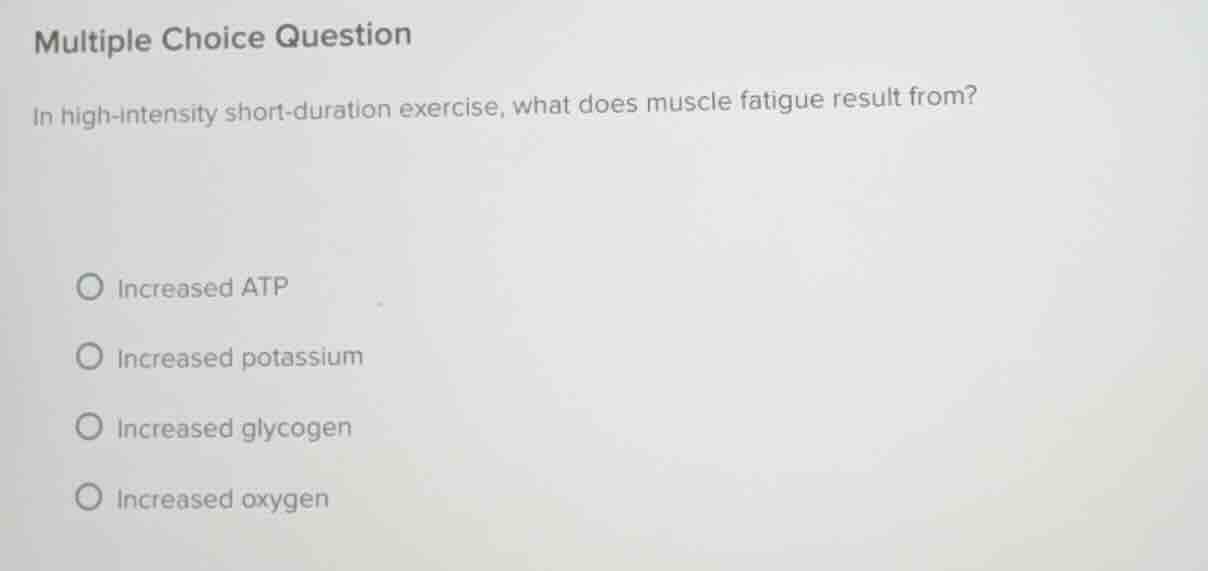
in high-intensity short-duration exercise, what does muscle fatigue result from?
increased atp
increased potassium
increased glycogen
increased oxygen
Analyze the physiological changes during short-duration high-intensity exercise
Using the Muscle Metabolism knowledge point
During short-duration, high-intensity exercise, rapid action potential propagation along the sarcolemma and down the T-tubules causes a massive efflux of potassium ions (\(\text{K}^+\)) from the sarcoplasm into the extracellular fluid (interstitial space of the T-tubules). This accumulation of extracellular potassium alters the membrane potential, reducing the excitability of the muscle fiber and contributing directly to muscle fatigue.
Evaluate the incorrect options
- Increased ATP: High-intensity exercise depletes ATP and phosphocreatine stores; ATP levels do not increase.
- Increased glycogen: Glycogen is rapidly broken down (glycogenolysis) to fuel glycolysis, so glycogen levels decrease rather than increase.
- Increased oxygen: High-intensity short-duration exercise relies primarily on anaerobic pathways, and oxygen delivery does not increase sufficiently to meet the immediate demand, nor does tissue oxygen concentration rise.

Snap & solve any problem in the app
Get step-by-step solutions on Sovi AI
Photo-based solutions with guided steps
Explore more problems and detailed explanations
- Increased ATP
- Increased potassium (Correct answer)
- Increased glycogen
- Increased oxygen