QUESTION IMAGE
Question
multiple choice question
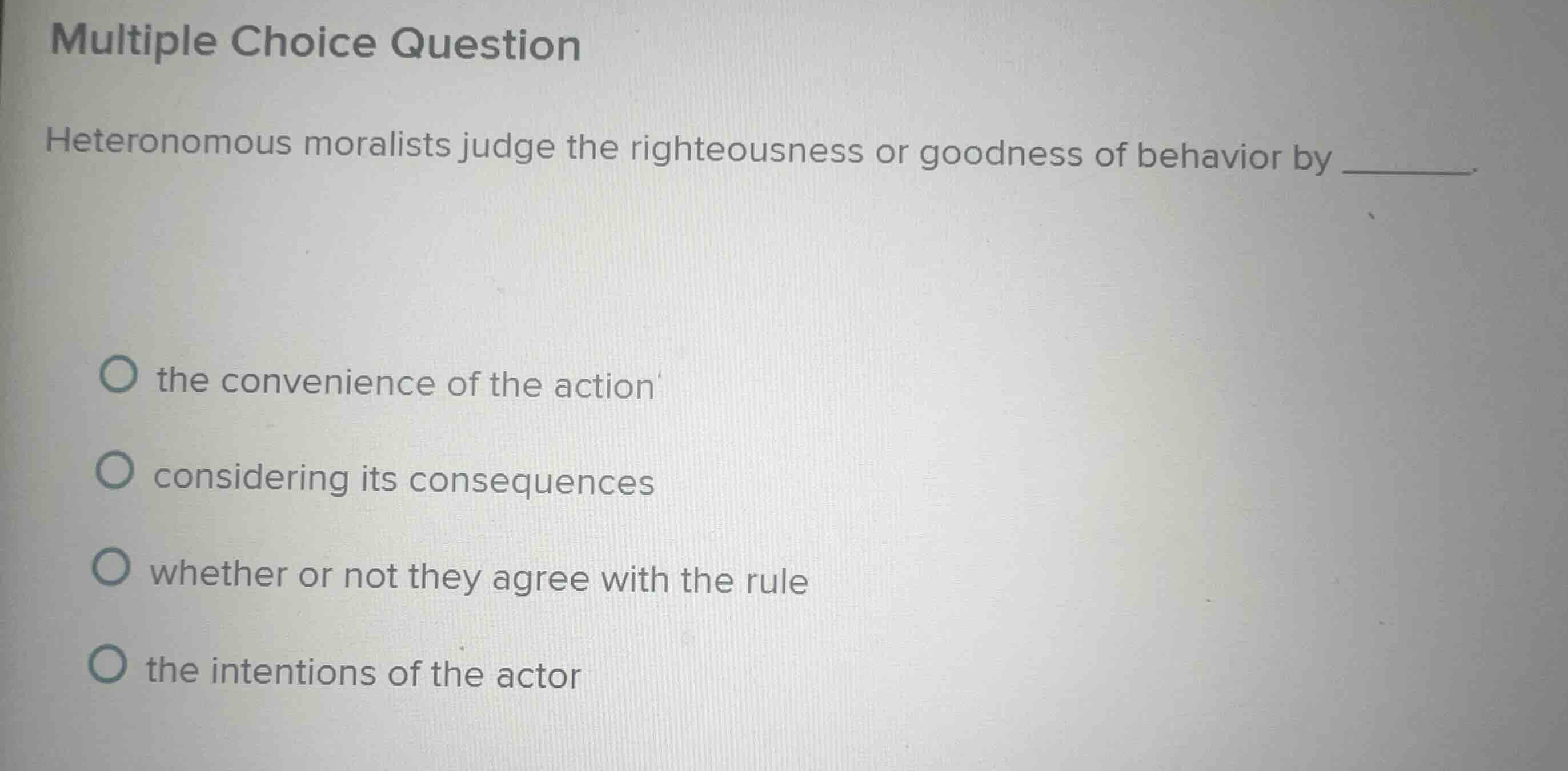
heteronomous moralists judge the righteousness or goodness of behavior by _______
the convenience of the action
considering its consequences
whether or not they agree with the rule
the intentions of the actor
Define heteronomous morality
Heteronomous morality is the first stage of moral development in Jean Piaget's theory, occurring from approximately 4 to 7 years of age. At this stage, children view justice and rules as unchangeable properties of the world, removed from the control of people.
Analyze judgment criteria
Because heteronomous moralists believe rules are absolute and handed down by authority, they judge the goodness or righteousness of a behavior strictly by its physical consequences, rather than by the intentions of the actor. For example, breaking twelve cups accidentally is seen as worse than breaking one cup deliberately.
Evaluate the given options
- the convenience of the action: Incorrect. Moral judgments are not based on personal convenience.
- considering its consequences: Correct. Heteronomous moralists focus on the objective consequences (e.g., the amount of damage) of an action.
- whether or not they agree with the rule: Incorrect. Children at this stage do not question or negotiate rules; they accept them as absolute.
- the intentions of the actor: Incorrect. Judging by intentions is characteristic of autonomous morality (the second stage of Piaget's moral development), which develops later.
Connect to moral development frameworks
This concept of judging by objective consequences rather than subjective intentions is a foundational milestone in developmental psychology, closely preceding the stages of Kohlberg Moral Development where reasoning shifts from external consequences to internal principles.

Snap & solve any problem in the app
Get step-by-step solutions on Sovi AI
Photo-based solutions with guided steps
Explore more problems and detailed explanations
- the convenience of the action
- considering its consequences (Correct answer)
- whether or not they agree with the rule
- the intentions of the actor