Sovi.AI - AI Math Tutor

Scan to solve math questions

QUESTION IMAGE

multiple choice question covered entities are those that _______ transm…

Question

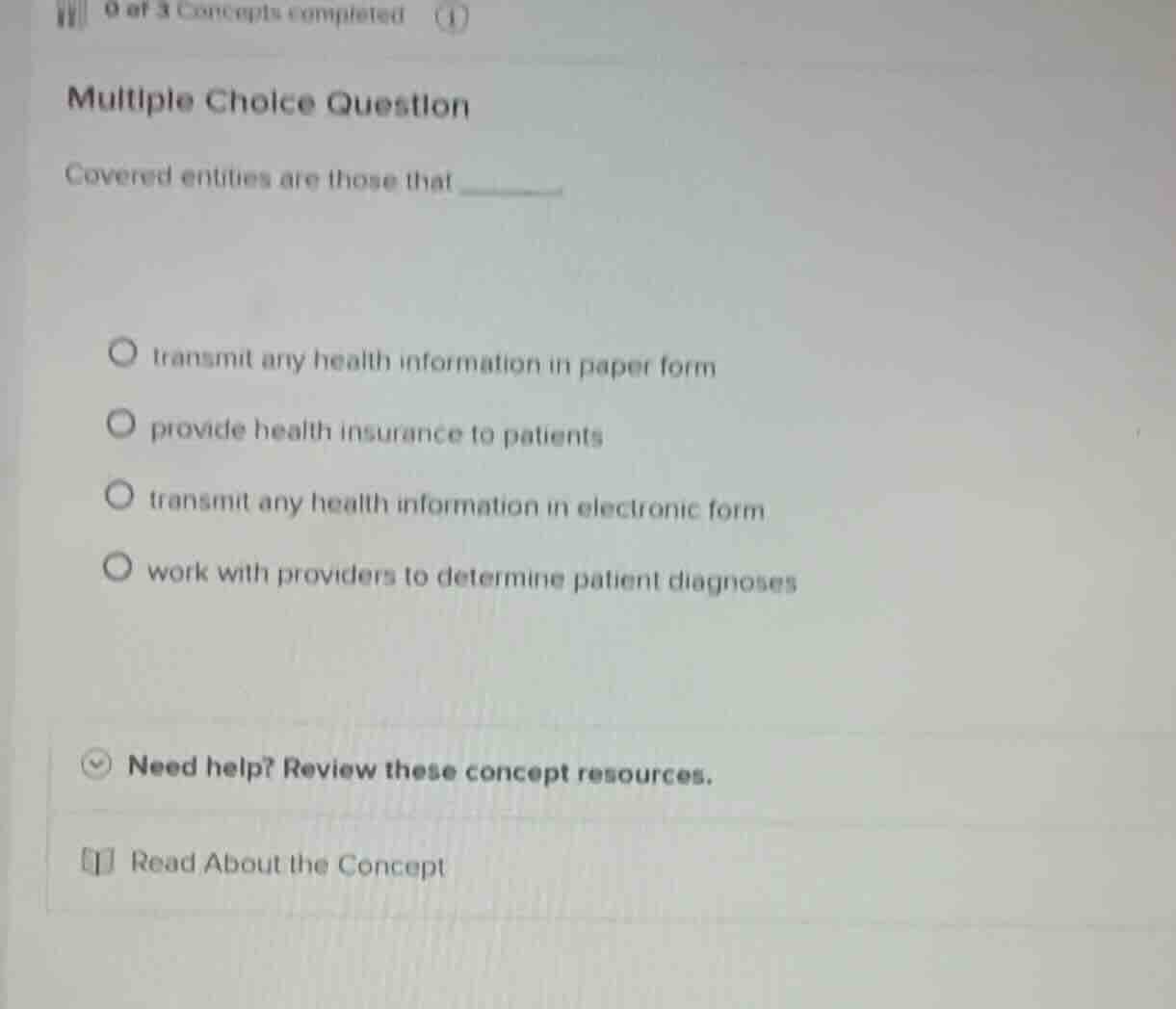
multiple choice question

covered entities are those that _______

transmit any health information in paper form
provide health insurance to patients
transmit any health information in electronic form
work with providers to determine patient diagnoses

Explanation:

Response

<pre_analysis>
{
"quality": "clear",
"question_count": 1,
"skills_matched": [
"direct_cot",
"multiple_choice_formatter",
"explain_then_answer",
"tutor",
"mastery_adaptive_brevity"
],
"needs_drawing": false,
"concepts_used": [
"HIPAA Structure",
"Patient Privacy Regulations"
],
"new_concepts": [
"Covered Entities Definition"
],
"current_concepts": [
"HIPAA Structure",
"Patient Privacy Regulations",
"Covered Entities Definition"
]
}
</pre_analysis>

<reasoning>

Define HIPAA covered entities

Using the HIPAA Structure and Patient Privacy Regulations knowledge points

Under the Health Insurance Portability and Accountability Act (HIPAA), a "covered entity" is defined as a health plan, a healthcare clearinghouse, or a healthcare provider who transmits any health information in electronic form in connection with a transaction for which HHS has adopted a standard.

Evaluate the options

  • Option 1: "transmit any health information in paper form" is incorrect because HIPAA regulations specifically focus on transactions transmitted electronically.
  • Option 2: "provide health insurance to patients" is incorrect because while health plans are covered entities, providing insurance is not the defining characteristic for all covered entities (such as individual healthcare providers).
  • Option 3: "transmit any health information in electronic form" is correct because electronic transmission of protected health information (PHI) is the key trigger that subjects a provider or entity to HIPAA compliance.
  • Option 4: "work with providers to determine patient diagnoses" is incorrect as this describes clinical collaboration rather than the regulatory definition of a covered entity.

</reasoning>

<answer>
<mcq-option>(A) transmit any health information in paper form</mcq-option>
<mcq-option>(B) provide health insurance to patients</mcq-option>
<mcq-correct>(C) transmit any health information in electronic form</mcq-correct>
<mcq-option>(D) work with providers to determine patient diagnoses</mcq-option>
</answer>

<post_analysis>
{
"subject": "Others",
"question_type": "Multiple Choice",
"knowledge_point": [
"Others",
"Healthcare Administration",
"Covered Entities Definition"
]
}
</post_analysis>

Answer:

<pre_analysis>
{
"quality": "clear",
"question_count": 1,
"skills_matched": [
"direct_cot",
"multiple_choice_formatter",
"explain_then_answer",
"tutor",
"mastery_adaptive_brevity"
],
"needs_drawing": false,
"concepts_used": [
"HIPAA Structure",
"Patient Privacy Regulations"
],
"new_concepts": [
"Covered Entities Definition"
],
"current_concepts": [
"HIPAA Structure",
"Patient Privacy Regulations",
"Covered Entities Definition"
]
}
</pre_analysis>

<reasoning>

Define HIPAA covered entities

Using the HIPAA Structure and Patient Privacy Regulations knowledge points

Under the Health Insurance Portability and Accountability Act (HIPAA), a "covered entity" is defined as a health plan, a healthcare clearinghouse, or a healthcare provider who transmits any health information in electronic form in connection with a transaction for which HHS has adopted a standard.

Evaluate the options

  • Option 1: "transmit any health information in paper form" is incorrect because HIPAA regulations specifically focus on transactions transmitted electronically.
  • Option 2: "provide health insurance to patients" is incorrect because while health plans are covered entities, providing insurance is not the defining characteristic for all covered entities (such as individual healthcare providers).
  • Option 3: "transmit any health information in electronic form" is correct because electronic transmission of protected health information (PHI) is the key trigger that subjects a provider or entity to HIPAA compliance.
  • Option 4: "work with providers to determine patient diagnoses" is incorrect as this describes clinical collaboration rather than the regulatory definition of a covered entity.

</reasoning>

<answer>
<mcq-option>(A) transmit any health information in paper form</mcq-option>
<mcq-option>(B) provide health insurance to patients</mcq-option>
<mcq-correct>(C) transmit any health information in electronic form</mcq-correct>
<mcq-option>(D) work with providers to determine patient diagnoses</mcq-option>
</answer>

<post_analysis>
{
"subject": "Others",
"question_type": "Multiple Choice",
"knowledge_point": [
"Others",
"Healthcare Administration",
"Covered Entities Definition"
]
}
</post_analysis>