QUESTION IMAGE
Question
multiple choice question
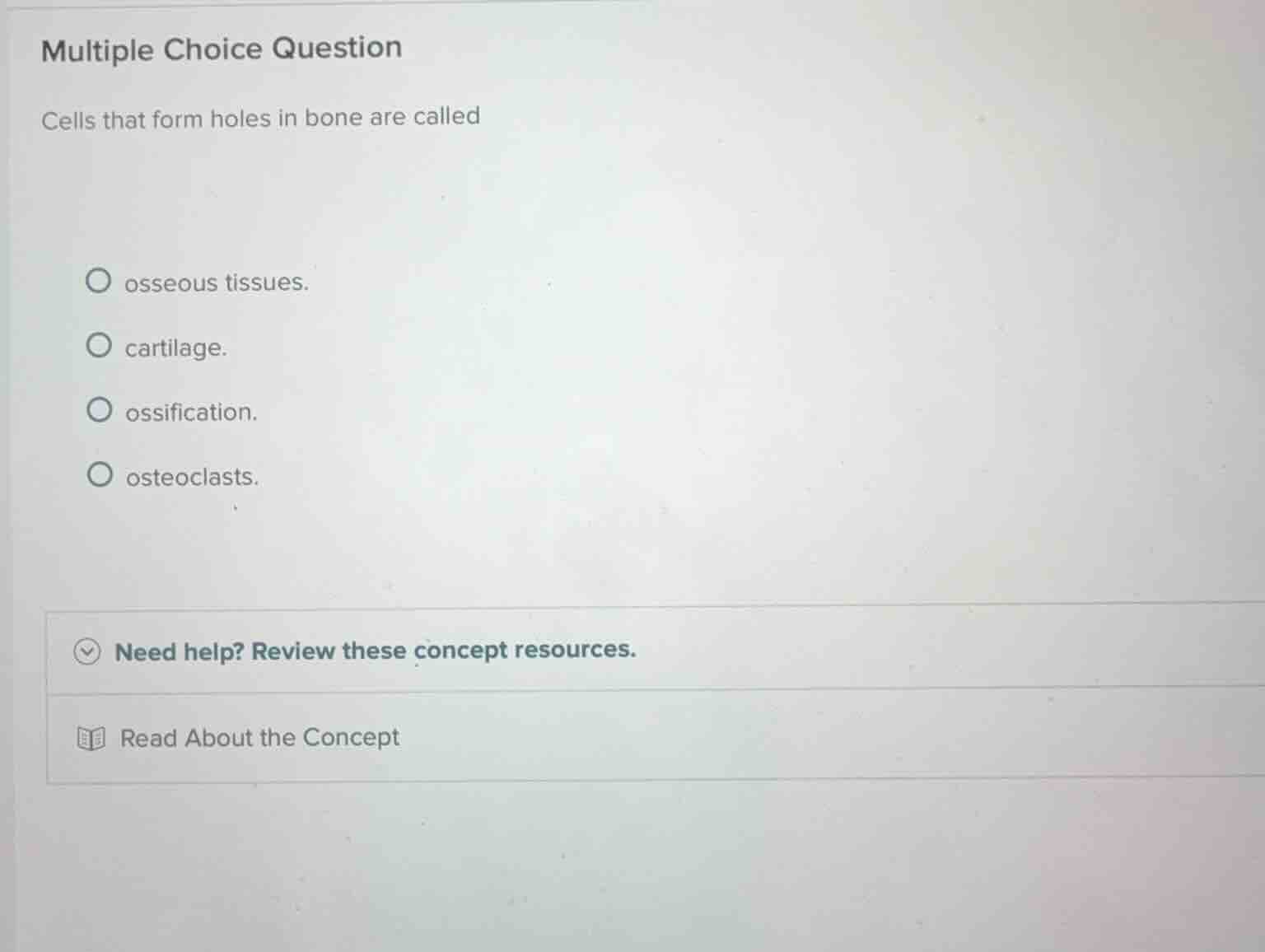
cells that form holes in bone are called
osseous tissues.
cartilage.
ossification.
osteoclasts.
<pre_analysis>
{
"quality": "clear",
"question_count": 1,
"skills_matched": [
"direct_cot",
"multiple_choice_formatter",
"explain_then_answer",
"tutor",
"mastery_adaptive_brevity"
],
"needs_drawing": false,
"concepts_used": [
"Osseous Tissue Types",
"Ossification Types"
],
"new_concepts": [
"Bone Cells",
"Osteoclasts Function"
],
"current_concepts": [
"Osseous Tissue Types",
"Ossification Types",
"Bone Cells",
"Osteoclasts Function"
]
}
</pre_analysis>
<reasoning>
Analyze the question prompt
The question asks for the name of the cells that form holes in bone (resorb or break down bone tissue).
Evaluate the options
Using the Osseous Tissue Types and Ossification Types knowledge points:
- osseous tissues: This refers to bone tissue as a whole, not a specific cell type.
- cartilage: This is a flexible connective tissue found in joints, not a bone-resorbing cell.
- ossification: This is the process of bone formation, not a cell.
- osteoclasts: These are large, multinucleated cells responsible for bone resorption, which breaks down bone matrix and can be described as forming holes or cavities in bone.
Select the correct option
The term "osteoclasts" correctly identifies the cells that break down bone matrix, effectively forming holes or cavities during bone remodeling.
</reasoning>
<answer>
<mcq-option>osseous tissues.</mcq-option>
<mcq-option>cartilage.</mcq-option>
<mcq-option>ossification.</mcq-option>
<mcq-correct>osteoclasts.</mcq-correct>
</answer>
<post_analysis>
{
"subject": "Natural Science",
"question_type": "Multiple Choice",
"knowledge_point": [
"Natural Science",
"Biology",
"Skeletal System Anatomy"
]
}
</post_analysis>
Snap & solve any problem in the app
Get step-by-step solutions on Sovi AI
Photo-based solutions with guided steps
Explore more problems and detailed explanations
<pre_analysis>
{
"quality": "clear",
"question_count": 1,
"skills_matched": [
"direct_cot",
"multiple_choice_formatter",
"explain_then_answer",
"tutor",
"mastery_adaptive_brevity"
],
"needs_drawing": false,
"concepts_used": [
"Osseous Tissue Types",
"Ossification Types"
],
"new_concepts": [
"Bone Cells",
"Osteoclasts Function"
],
"current_concepts": [
"Osseous Tissue Types",
"Ossification Types",
"Bone Cells",
"Osteoclasts Function"
]
}
</pre_analysis>
<reasoning>
Analyze the question prompt
The question asks for the name of the cells that form holes in bone (resorb or break down bone tissue).
Evaluate the options
Using the Osseous Tissue Types and Ossification Types knowledge points:
- osseous tissues: This refers to bone tissue as a whole, not a specific cell type.
- cartilage: This is a flexible connective tissue found in joints, not a bone-resorbing cell.
- ossification: This is the process of bone formation, not a cell.
- osteoclasts: These are large, multinucleated cells responsible for bone resorption, which breaks down bone matrix and can be described as forming holes or cavities in bone.
Select the correct option
The term "osteoclasts" correctly identifies the cells that break down bone matrix, effectively forming holes or cavities during bone remodeling.
</reasoning>
<answer>
<mcq-option>osseous tissues.</mcq-option>
<mcq-option>cartilage.</mcq-option>
<mcq-option>ossification.</mcq-option>
<mcq-correct>osteoclasts.</mcq-correct>
</answer>
<post_analysis>
{
"subject": "Natural Science",
"question_type": "Multiple Choice",
"knowledge_point": [
"Natural Science",
"Biology",
"Skeletal System Anatomy"
]
}
</post_analysis>