QUESTION IMAGE
Question
multiple choice 2 points
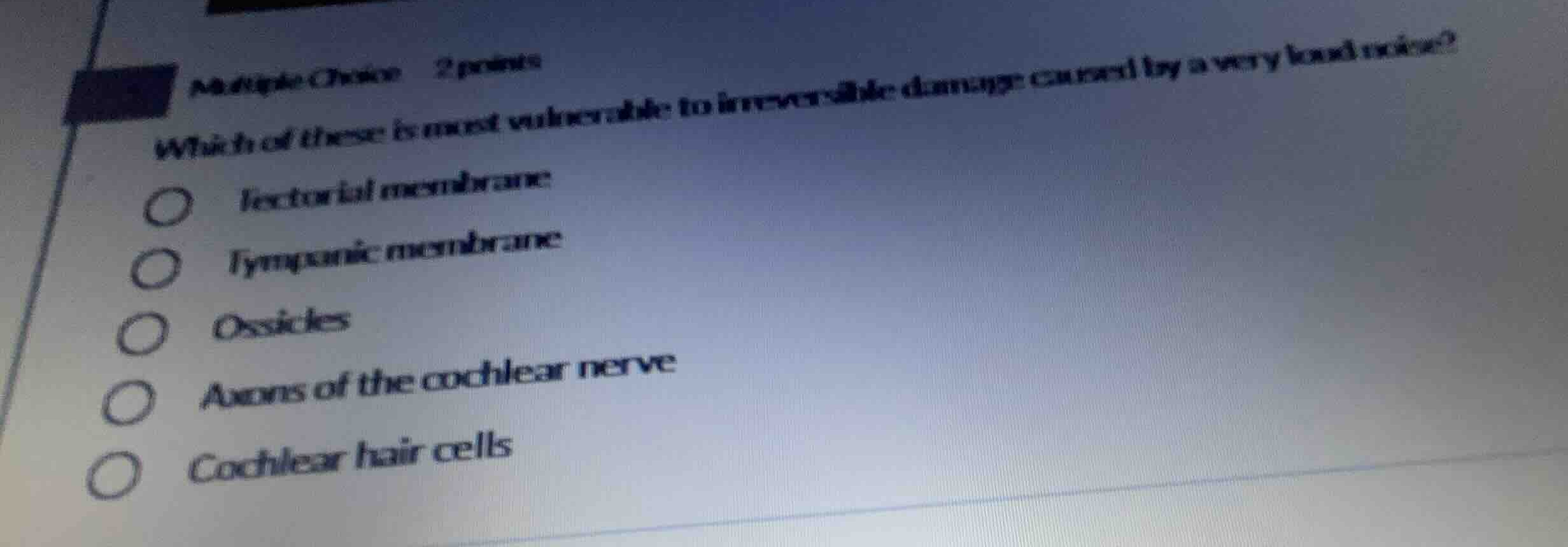
which of these is most vulnerable to irreversible damage caused by a very loud noise?
tectorial membrane
tympanic membrane
ossicles
axons of the cochlear nerve
cochlear hair cells
Identify the structures of the auditory system
The question asks which structure is most vulnerable to irreversible damage caused by a very loud noise. The options listed are:
- Tectorial membrane
- Tympanic membrane
- Ossicles
- Axons of the cochlear nerve
- Cochlear hair cells
Evaluate the regenerative capacity and vulnerability of each structure
- Tympanic membrane (eardrum) and Ossicles (middle ear bones): While they can be damaged or ruptured by extremely loud sounds (acoustic trauma), they generally have a high capacity to heal or can be surgically repaired.
- Tectorial membrane: This is an extracellular gelatinous structure that covers the hair cells. It is resilient and not the primary site of permanent cellular death from noise.
- Axons of the cochlear nerve: While secondary neural degeneration can occur, the primary and most immediate site of irreversible cellular damage is at the sensory receptor level.
- Cochlear hair cells: These are the specialized sensory receptors of the auditory system located within the organ of Corti. In mammals, including humans, auditory hair cells do not regenerate once they are destroyed. Exposure to intense noise causes mechanical overstimulation, metabolic stress, and excitotoxicity, leading to the permanent death of these cells, which is the primary cause of permanent noise-induced hearing loss.
Formulate the final conclusion
Because mammalian cochlear hair cells cannot replicate or regenerate, their destruction by loud noises leads to permanent, irreversible hearing loss. Therefore, they are the most vulnerable to irreversible damage.

Snap & solve any problem in the app
Get step-by-step solutions on Sovi AI
Photo-based solutions with guided steps
Explore more problems and detailed explanations
- Tectorial membrane
- Tympanic membrane
- Ossicles
- Axons of the cochlear nerve
- Cochlear hair cells (Correct answer)