QUESTION IMAGE
Question
multiple choice 2 points
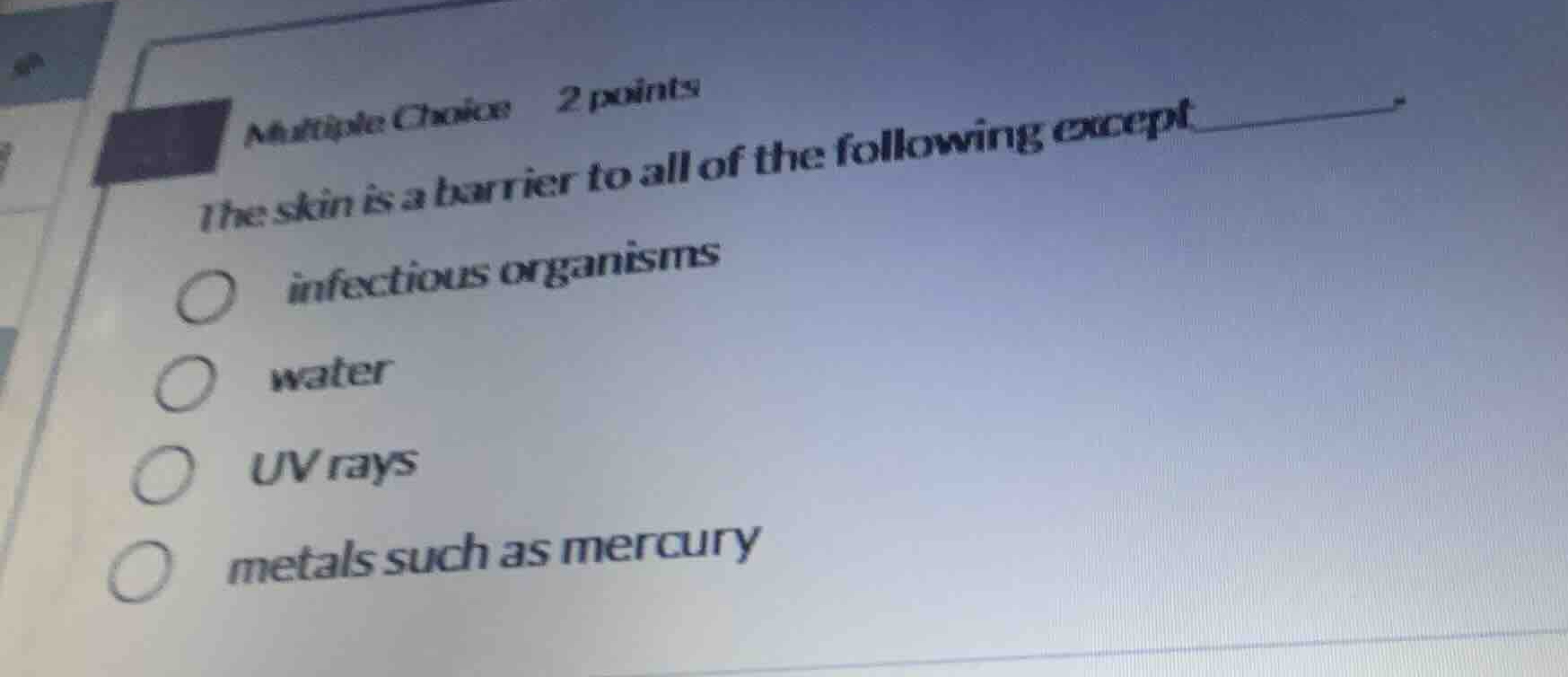
the skin is a barrier to all of the following except
infectious organisms
water
uv rays
metals such as mercury
Analyze skin barrier functions
The skin serves as a protective barrier with physical, chemical, and biological defense mechanisms. We must evaluate how it interacts with each option to identify what it does not block effectively.
Evaluate protection against infectious organisms
The outer keratinized layer of the epidermis (stratum corneum) and the acid mantle provide a highly effective physical and chemical barrier against pathogens. Therefore, the skin is a barrier to infectious organisms.
Evaluate protection against water
Keratin and glycolipids in the epidermis prevent excessive water loss from the body and prevent water from entering freely. Thus, the skin acts as a barrier to water.
Evaluate protection against UV rays
Melanin produced by melanocytes in the epidermis absorbs harmful ultraviolet radiation, protecting deeper tissues. Therefore, the skin acts as a barrier to UV rays.
Evaluate protection against heavy metals
Using our understanding of Skin Histology, we know that while the epidermis is highly protective, certain lipid-soluble substances, organic solvents, and heavy metals (such as mercury, lead, and arsenic) can penetrate the skin barrier via transdermal absorption. Therefore, the skin is not an effective barrier to metals such as mercury.

Snap & solve any problem in the app
Get step-by-step solutions on Sovi AI
Photo-based solutions with guided steps
Explore more problems and detailed explanations
- (A) infectious organisms
- (B) water
- (C) UV rays
- (D) metals such as mercury (Correct answer)