QUESTION IMAGE
Question
multiple choice 2 points
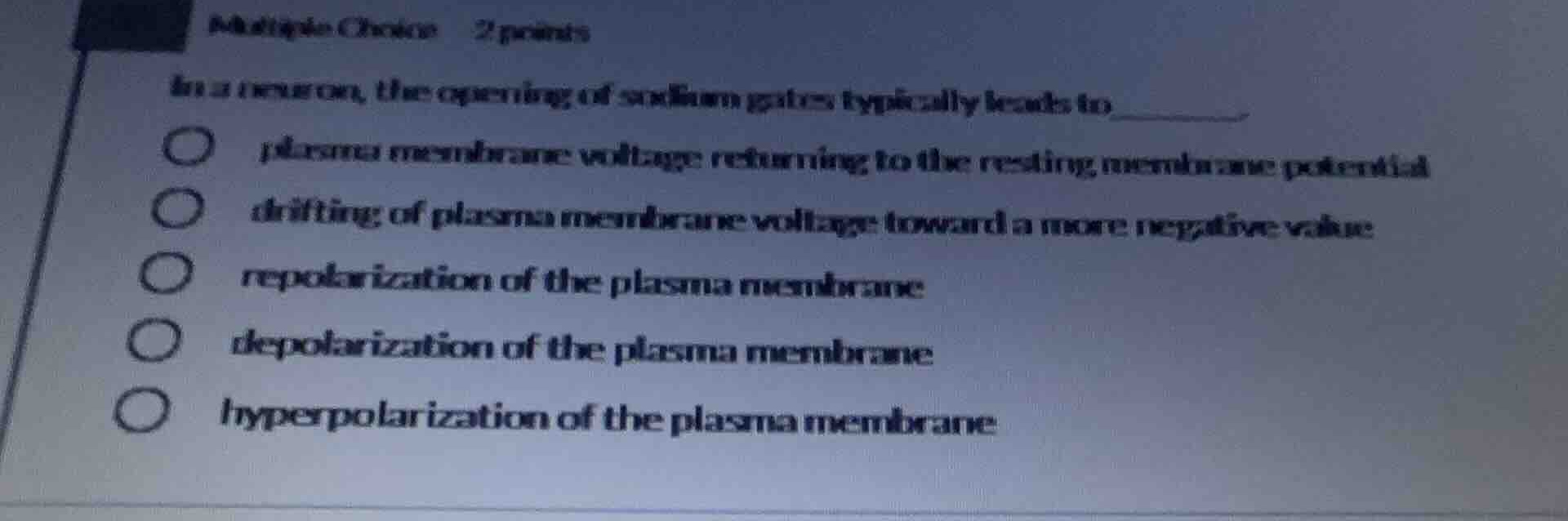
in a neuron, the opening of sodium gates typically leads to
plasma membrane voltage returning to the resting membrane potential
drifting of plasma membrane voltage toward a more negative value
repolarization of the plasma membrane
depolarization of the plasma membrane
hyperpolarization of the plasma membrane
Analyze the electrochemical gradient of sodium ions
In a resting neuron, sodium ions \(\text{Na}^+\) are in much higher concentration outside the cell than inside. Additionally, the interior of the resting cell is negatively charged relative to the exterior. This creates both a chemical gradient and an electrical gradient favoring the entry of \(\text{Na}^+\) into the cell.
Determine the effect of opening sodium gates
When sodium gates (voltage-gated \(\text{Na}^+\) channels) open, \(\text{Na}^+\) ions rapidly rush into the neuron down their electrochemical gradient. This influx of positive charge makes the inside of the cell less negative (more positive).
Identify the physiological term for this change
The shift of the membrane potential toward a more positive (less negative) value is called depolarization. This is the initial phase of an action potential.
Evaluate the given multiple-choice options
- plasma membrane voltage returning to the resting membrane potential: This describes repolarization or stabilization, not the initial opening of sodium gates.
- drifting of plasma membrane voltage toward a more negative value: This describes hyperpolarization or repolarization.
- repolarization of the plasma membrane: This is caused by the exit of potassium ions \(\text{K}^+\), making the cell negative again.
- depolarization of the plasma membrane: This matches the influx of positive sodium ions.
- hyperpolarization of the plasma membrane: This is an increase in negativity beyond the resting potential, typically caused by prolonged potassium exit or chloride entry.

Snap & solve any problem in the app
Get step-by-step solutions on Sovi AI
Photo-based solutions with guided steps
Explore more problems and detailed explanations
- plasma membrane voltage returning to the resting membrane potential
- drifting of plasma membrane voltage toward a more negative value
- repolarization of the plasma membrane
- depolarization of the plasma membrane (Correct answer)
- hyperpolarization of the plasma membrane