QUESTION IMAGE
Question
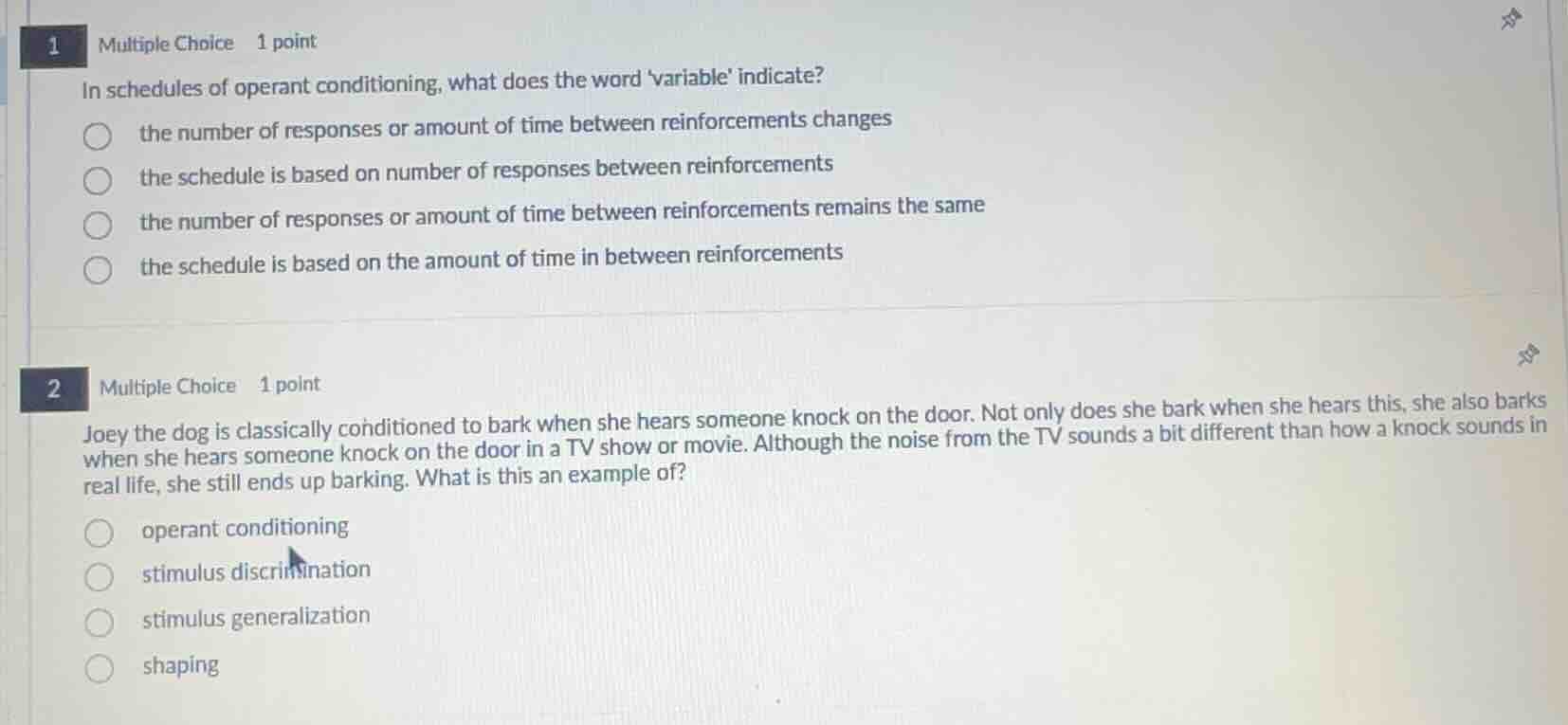
1 multiple choice 1 point
in schedules of operant conditioning, what does the word variable indicate?
the number of responses or amount of time between reinforcements changes
the schedule is based on number of responses between reinforcements
the number of responses or amount of time between reinforcements remains the same
the schedule is based on the amount of time in between reinforcements
2 multiple choice 1 point
joey the dog is classically conditioned to bark when she hears someone knock on the door. not only does she bark when she hears this, she also barks when she hears someone knock on the door in a tv show or movie. although the noise from the tv sounds a bit different than how a knock sounds in real life, she still ends up barking. what is this an example of?
operant conditioning
stimulus discrimination
stimulus generalization
shaping
Analyze the meaning of 'variable' in operant conditioning schedules
In operant conditioning, reinforcement schedules are categorized as either fixed (unchanging) or variable (changing/unpredictable). Therefore, "variable" indicates that the number of responses or the amount of time between reinforcements changes.
Analyze Joey the dog's behavior in classical conditioning
Joey is conditioned to bark at a real knock on the door. She also barks at a similar but different sound (a knock on TV). Responding to a stimulus that is similar to the conditioned stimulus is known as stimulus generalization.

Snap & solve any problem in the app
Get step-by-step solutions on Sovi AI
Photo-based solutions with guided steps
Explore more problems and detailed explanations
Question 1
- (A) the number of responses or amount of time between reinforcements changes (Correct answer)
- (B) the schedule is based on number of responses between reinforcements
- (C) the number of responses or amount of time between reinforcements remains the same
- (D) the schedule is based on the amount of time in between reinforcements
Question 2
- (A) operant conditioning
- (B) stimulus discrimination
- (C) stimulus generalization (Correct answer)
- (D) shaping