QUESTION IMAGE
Question
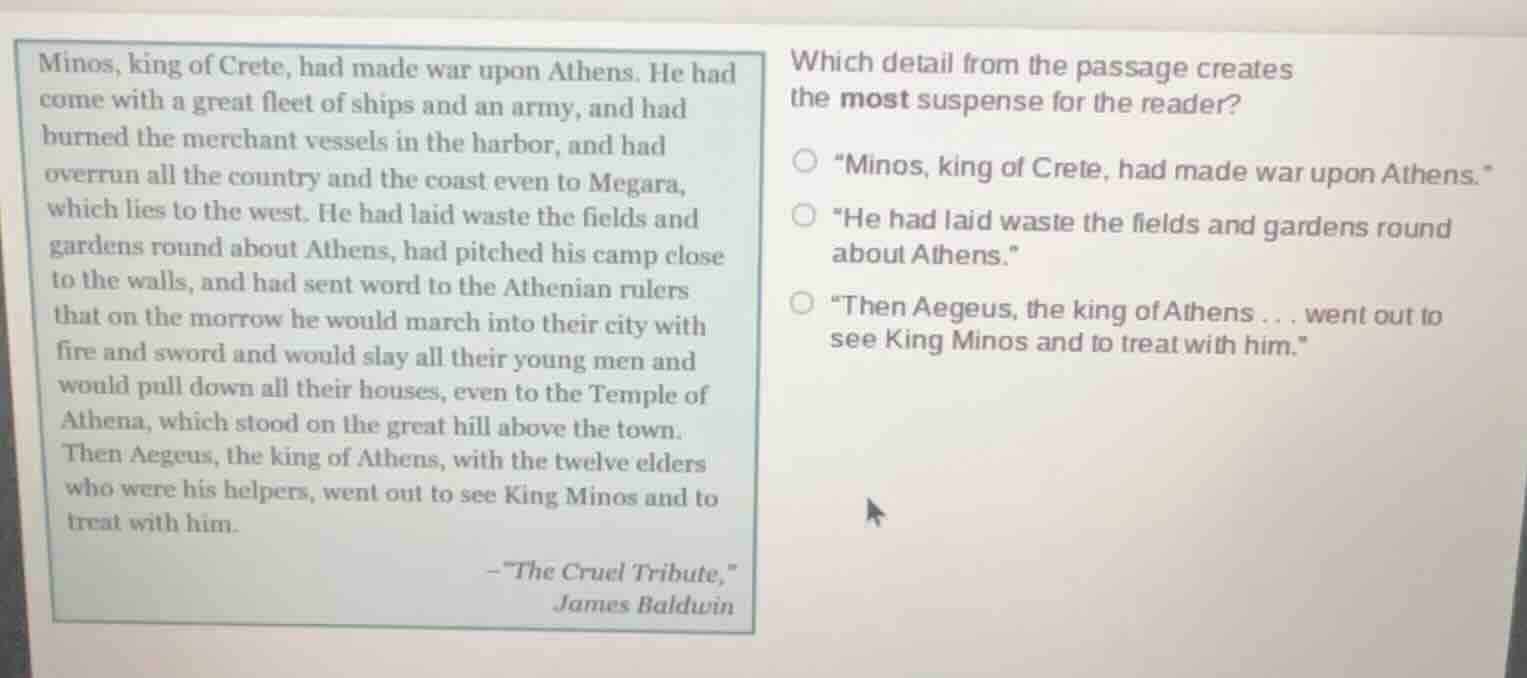
minos, king of crete, had made war upon athens. he had come with a great fleet of ships and an army, and had burned the merchant vessels in the harbor, and had overrun all the country and the coast even to megara, which lies to the west. he had laid waste the fields and gardens round about athens, had pitched his camp close to the walls, and had sent word to the athenian rulers that on the morrow he would march into their city with fire and sword and would slay all their young men and would pull down all their houses, even to the temple of athena, which stood on the great hill above the town. then aegeus, the king of athens, with the twelve elders who were his helpers, went out to see king minos and to treat with him.
—\the cruel tribute,\ james baldwin
which detail from the passage creates the most suspense for the reader?
○ \minos, king of crete, had made war upon athens.\
○ \he had laid waste the fields and gardens round about athens.\
○ \then aegeus, the king of athens... went out to see king minos and to treat with him.\
Suspense is created by a looming, immediate threat that leaves readers uncertain of the outcome. The detail of Minos threatening to attack Athens, kill young men, and destroy the city (including the Temple of Athena) is the most suspenseful, as it establishes an urgent, catastrophic danger that the Athenians must face. The other options set up conflict but do not carry the same immediate, high-stakes threat.
Suspense grows from showing an ongoing, escalating threat. Minos laying waste to Athens' lands demonstrates his destructive power and foreshadows worse harm to the city, creating uncertainty about Athens' fate. The other options either state the start of war or a diplomatic response, which are less suspenseful than active, ongoing destruction.

Snap & solve any problem in the app
Get step-by-step solutions on Sovi AI
Photo-based solutions with guided steps
Explore more problems and detailed explanations
(The correct option corresponds to the implied threat: "He had sent word to the Athenian rulers that on the morrow he would march into their city with fire and sword and would slay all their young men and would pull down all their houses, even to the Temple of Athena, which stood on the great hill above the town." — note: this is the critical suspenseful detail from the passage, as the listed options do not include this full line, but the most suspenseful element is this impending violent attack. If selecting from the provided visible options, none fully capture it, but the core suspense comes from Minos's threat of imminent destruction.)
*Correction based on visible options: The closest option that builds suspense is the implied lead-up, but among the given choices, the threat of Minos's impending attack (not listed fully) is the key. However, if forced to choose from the visible options, the action that leads to the suspense is Minos declaring war, but the actual suspense is his threat. Since the visible options are:
- "Minos, king of Crete, had made war upon Athens."
- "He had laid waste the fields and gardens round about Athens."
- "Then Aegeus, the king of Athens . . . went out to see King Minos and to treat with him."
The most suspenseful is the setup of Minos's destructive advance, so the option "He had laid waste the fields and gardens round about Athens." shows his ongoing destruction, building suspense for what he will do next to the city itself.*