QUESTION IMAGE
Question
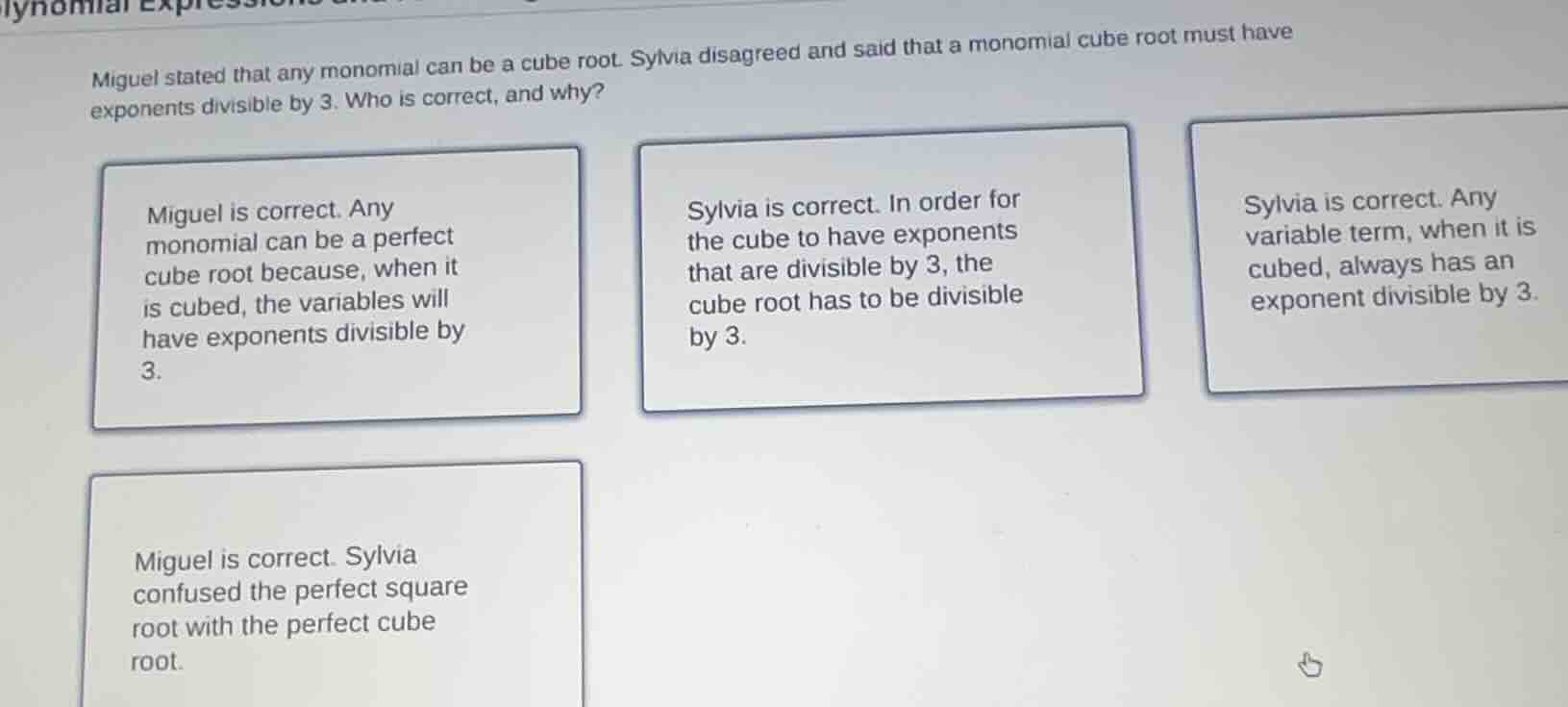
miguel stated that any monomial can be a cube root. sylvia disagreed and said that a monomial cube root must have exponents divisible by 3. who is correct, and why?
- miguel is correct. any monomial can be a perfect cube root because, when it is cubed, the variables will have exponents divisible by 3.
- sylvia is correct. in order for the cube to have exponents that are divisible by 3, the cube root has to be divisible by 3.
- sylvia is correct. any variable term, when it is cubed, always has an exponent divisible by 3.
- miguel is correct. sylvia confused the perfect square root with the perfect cube root.
Define the concept of a cube root
A monomial \(B\) is a cube root of another monomial \(A\) if cubing \(B\) results in \(A\):
Thus, any monomial \(B\) can serve as a cube root.
Apply exponent rules to cubing a monomial
Using the Exponent Rules knowledge point
Since \(n\) is an integer, the exponent of the resulting perfect cube \(3n\) is always divisible by 3. However, the starting monomial \(B = c \cdot x^n\) can have any integer exponent \(n\).
Evaluate Miguel and Sylvia's claims
Miguel states any monomial can be a cube root. This is correct because we can cube any monomial \(x^n\) to get a perfect cube \(x^{3n}\).
Sylvia claims a cube root must have exponents divisible by 3. This is incorrect; it is the perfect cube itself that must have exponents divisible by 3, not its cube root.
Match with the correct option
Miguel is correct. Any monomial can be a perfect cube root because, when it is cubed, the variables will have exponents divisible by 3.
This matches the first option.

Snap & solve any problem in the app
Get step-by-step solutions on Sovi AI
Photo-based solutions with guided steps
Explore more problems and detailed explanations
- Miguel is correct. Any monomial can be a perfect cube root because, when it is cubed, the variables will have exponents divisible by 3. (Correct answer)
- Sylvia is correct. In order for the cube to have exponents that are divisible by 3, the cube root has to be divisible by 3.
- Sylvia is correct. Any variable term, when it is cubed, always has an exponent divisible by 3.
- Miguel is correct. Sylvia confused the perfect square root with the perfect cube root.