QUESTION IMAGE
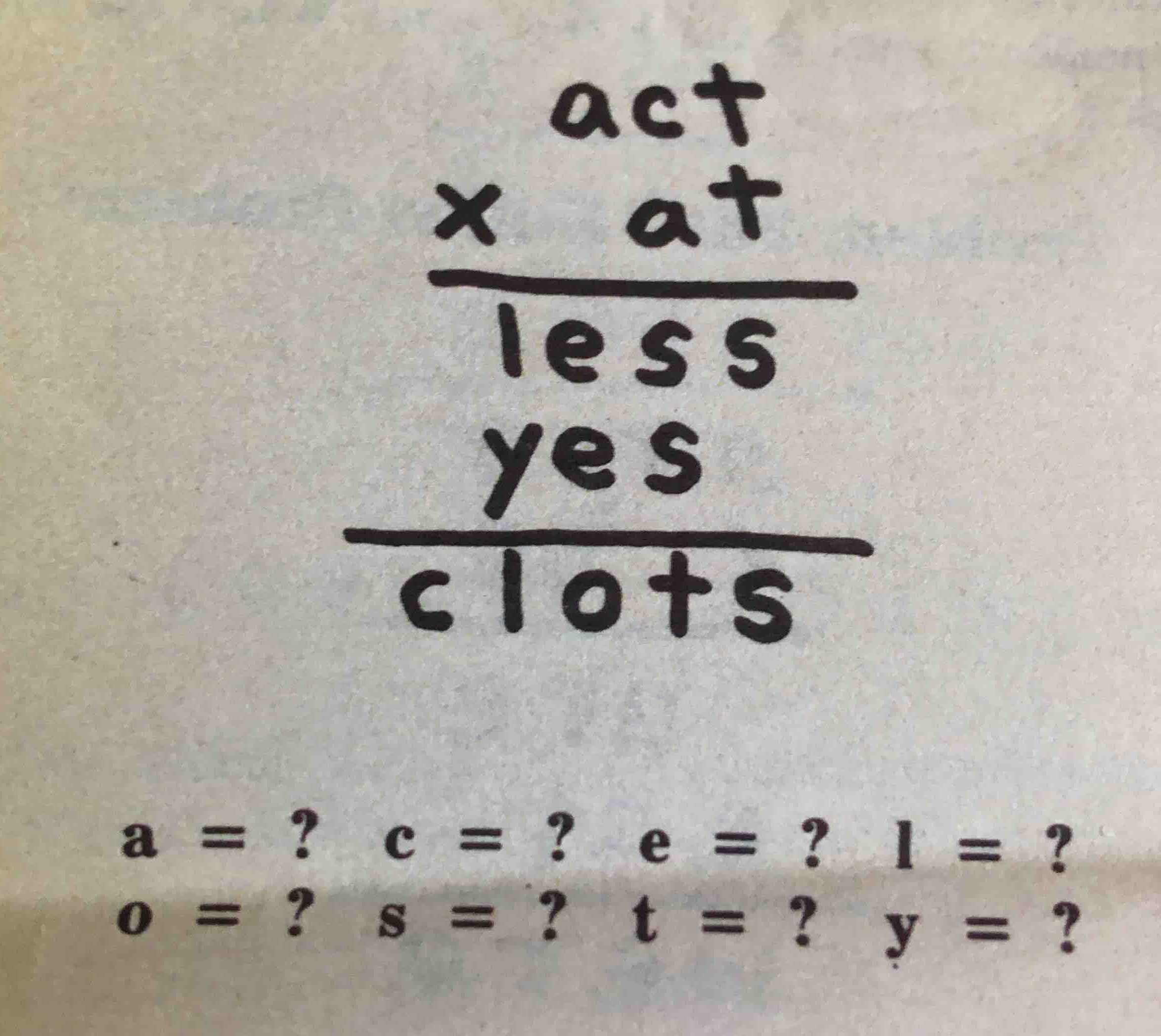
Question
\\
\
\\
\\(a = ?\\) \\(c = ?\\) \\(e = ?\\) \\(l = ?\\)
\\(o = ?\\) \\(s = ?\\) \\(t = ?\\) \\(y = ?\\)
Analyze the multiplication structure and bounds
Since \(\text{act} \times a = \text{yes}\) (a 3-digit number) and \(\text{act}\) is a 3-digit number starting with \(a\):
If \(a \ge 3\), then \(\text{act} \times a \ge 300 \times 3 = 900\). If \(a \ge 4\), \(\text{act} \times a\) would exceed 1000 (a 4-digit number).
Thus, \(a\) must be \(1\) or \(2\).
If \(a = 2\), then \(\text{act} \times 2 = \text{yes}\). Since \(\text{act} \ge 200\), \(\text{yes} \ge 400\), so \(y \ge 4\).
Also, \(\text{act} \times t = \text{less}\) (a 4-digit number). Since \(\text{act}\) starts with \(2\), \(t\) must be at least \(5\) because \(200 \times 4 = 800\) (3-digit).
Let's test \(a = 1\):
If \(a = 1\), then \(\text{act} \times 1 = \text{yes} \implies \text{1ct} = \text{yes}\).
This implies \(y = 1\), which violates the rule that different letters represent different digits (since \(a = 1\) and \(y = 1\)).
Therefore, \(a\) must be \(2\).
Solve the remaining digits with \(a = 2\)
Since \(a = 2\), the units digit of \(\text{cl2ts}\) is \(s\).
From \(\text{act} \times t = \text{less}\), the units digit of \(t \times t\) is \(s\).
From \(\text{less} + 10 \times \text{yes} = \text{cl2ts}\):
The units digit of \(\text{less}\) is \(s\), which matches the units digit of \(\text{cl2ts}\).
The tens digit: \(s + s = t \pmod{10}\) or \(s + s + \text{carry} = t \pmod{10}\).
Since \(\text{yes} = 2 \times \text{2ct}\), \(s\) (the units digit of \(\text{yes}\)) must be even.
If \(t = 8\):
\(\text{2c8} \times 8 = \text{le88} \implies 8 \times 8 = 64 \implies s = 4\).
If \(s = 4\), then \(\text{yes} = 2 \times \text{2c8} = \text{ye4} \implies 2 \times 8 = 16 \implies\) units digit of \(\text{yes}\) is \(6\), which contradicts \(s = 4\).
If \(t = 6\):
\(\text{2c6} \times 6 = \text{le66} \implies 6 \times 6 = 36 \implies s = 6\), which contradicts \(t
eq s\).
If \(t = 9\):
\(\text{2c9} \times 9 = \text{le99} \implies 9 \times 9 = 81 \implies s = 1\).
Then \(\text{yes} = 2 \times \text{2c9} = \text{ye8} \implies s = 8\), contradiction.
If \(t = 7\):
\(\text{2c7} \times 7 = \text{le77} \implies 7 \times 7 = 49 \implies s = 9\).
Then \(\text{yes} = 2 \times \text{2c7} = \text{ye4} \implies s = 4\), contradiction.
If \(t = 3\):
\(\text{2c3} \times 3 = \text{le33} \implies 3 \times 3 = 9 \implies s = 9\).
Then \(\text{yes} = 2 \times \text{2c3} = \text{ye6} \implies s = 6\), contradiction.
If \(t = 4\):
\(\text{2c4} \times 4 = \text{le44} \implies 4 \times 4 = 16 \implies s = 6\).
Then \(\text{yes} = 2 \times \text{2c4} = \text{ye8} \implies s = 8\), contradiction.
If \(t = 5\):
\(\text{2c5} \times 5 = \text{le55} \implies 5 \times 5 = 25 \implies s = 5\), contradiction.
If \(t = 8\) and \(s = 6\):
Let's check \(278 \times 28 = 7784\):
\(278 \times 8 = 2…

Snap & solve any problem in the app
Get step-by-step solutions on Sovi AI
Photo-based solutions with guided steps
Explore more problems and detailed explanations